






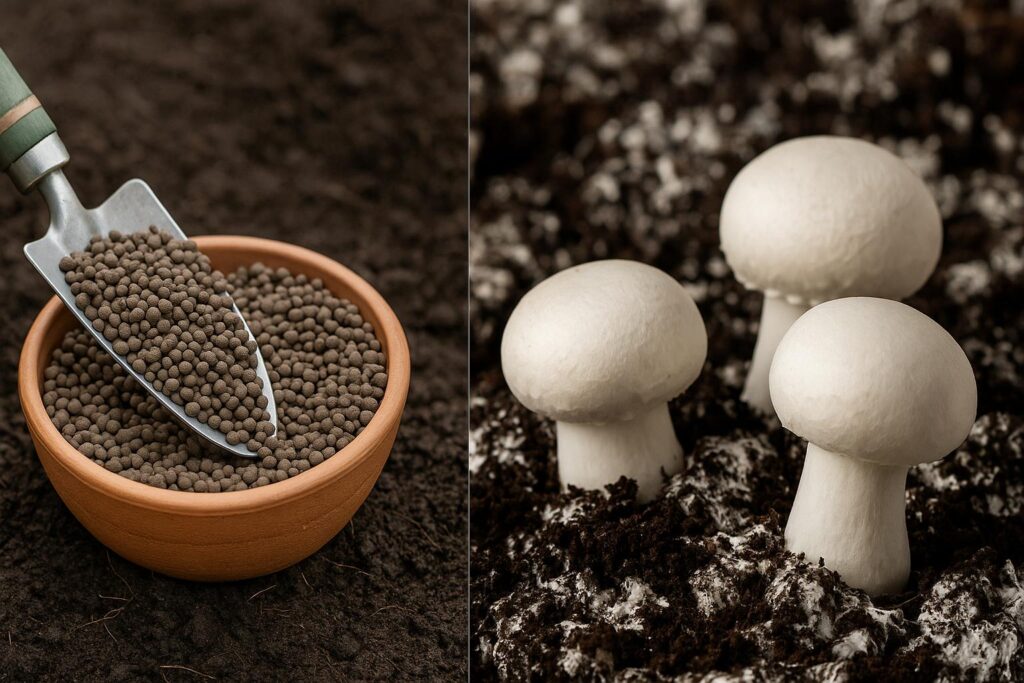
Mushroom cultivation has grown from a niche crop into a high-value segment of commercial agriculture. With increased market demand for gourmet and medicinal mushrooms, the need for optimized yields and faster crop cycles has never been more critical. Fertilizer plays a central role in determining the productivity of any farming system—but for mushroom growers, it’s not just about boosting yield; it’s about enhancing substrate efficiency, biological response, and consistency across flushes.
The key question that still has to be answered when deciding whether to spend money on fertiliser designed specifically for mushrooms is whether the return on investment (ROI) is worthwhile. The cost of fertiliser must be weighed against market pricing, crop uniformity, yield benefits, and substrate efficiency in order to provide an answer. Because mushrooms are grown on biologically active substrates rather than conventional crops, fertiliser behaviour is different; it is more microbiological, delicate, and timing-sensitive.
Mushroom Fertilizer vs. Traditional Fertilizers
Fertilisers used in fruit, vegetable, or cereal farming are not the same as those used in mushrooms. NPK (nitrogen, phosphorus, potassium) blends are not all of them. These inputs frequently consist of trace minerals, microbial enhancers, organic activators, and occasionally even pre-digested amino acids.
The purpose of fertiliser in conventional agriculture is to nourish the plant. Fertiliser is used in mushroom cultivation to nourish the substrate, which promotes the growth of fungi. Since mushrooms are unable to photosynthesize, they must obtain their nutrients from the decomposing materials in their environment. For this reason, the number of harvestable flushes and yield per kilogramme of substrate are the main metrics used to assess the efficacy of mushroom fertiliser.
Although they are used in lesser amounts per square metre, mushroom fertilisers can cost anywhere from 15% to 40% more per kilogramme than fertilisers for regular crops. A thorough analysis of inputs vs output values every crop cycle is necessary to determine ROI.
Cost Breakdown: Initial Input vs. Output Gain
Depending on the composition, adding mushroom fertiliser to the substrate increases the cost by 5–12% per cycle, according to a standard input cost study. But according to research from Mycology Research Labs, using a balanced fungal activator fertiliser can increase crop yields by 18–27% for crops like button mushrooms (Agaricus bisporus) and oyster mushrooms (Pleurotus ostreatus).
Improved biological efficiency (BE), or the weight ratio of fresh mushrooms to dry substrate, yields the largest benefit. Fertilised substrates frequently exhibit 90–100% BE, while untreated controls typically exhibit 65–75%.
This increased yield might immediately make up for the initial outlay for producers aiming for premium varieties or off-season production. Because the ROI is increased by higher selling prices, growers in high-margin markets, such as medicinal mushrooms (like Reishi or Lion’s Mane), stand to gain even more.
If you’re managing a commercial grow room or small-scale mushroom house, it makes sense to Shop Best Mushroom Fertilizer to maximize early mycelium colonization and substrate nutrient availability without disrupting microbial balance. The ROI isn’t just seen in yield but also in consistency, reduced contamination rates, and flush uniformity.
Performance Indicators That Determine ROI
To calculate ROI in mushroom fertilizer use, it’s important to track the right performance indicators. These include:
- Flush cycle length and consistency
- Total biological efficiency (BE) over three flushes
- Substrate reusability or recovery value
- Quality grading of harvested mushrooms
The ROI formula remains simple in theory:
ROI (%) = [(Gain from investment – Cost of investment) / Cost of investment] x 100
Nevertheless, mushroom cultivation adds more factors. For example, a small delay in colonisation could cause the harvest to be delayed overall, which would affect market price and freshness. Similarly, even with huge volumes, low-quality fruiting bodies yield a lower average selling price per kilogram.
Farms that employed compost activators with nutrient-enriched fertiliser demonstrated a 22% increase in harvest size and a 16% longer shelf life during storage trials in a controlled study carried out in Punjab’s mushroom clusters.
By reducing spoiling losses and saving on logistics, this improvement in post-harvest quality also shows a return on investment. This benefit becomes a powerful marketing feature in markets with poor cold chains.
How Fertilizer Type Affects Mushroom Growth Stages
The life cycle of mushrooms differs from that of conventional plants. Each of the three phases—mycelial growth, colonisation, fruiting, and spore germination—has specific nutritional needs. The return on investment is significantly impacted by using the appropriate fertiliser type at the appropriate stage.
In order to prevent excessive ammonia buildup during colonisation, which can impede fungal spread, nitrogen levels must be adjusted. At this point, slow-release, low-odor organic fertilisers are frequently recommended. Phosphate and potassium are essential for the development of the fruit body during fruiting, while trace minerals like magnesium enhance the shape and production of the cap.
Microbial inoculants, seaweed extracts, and humic acids are used in high-value formulations to promote a more robust substrate ecology. Chitinase-stimulating chemicals, which improve mycelial vigour without the need for pharmacological triggers, are even present in some more recent blends.
The Modern Farmer’s Guide to Soil Health states that adding bio-organic matter to the soil to encourage beneficial fungus increases disease resistance and production. These inputs are a little more expensive, but over the course of multiple crop cycles, the performance advantage provides a definite return on investment.
“Fertilizer in mushroom farming isn’t just food—it’s a conversation with the substrate that determines whether you harvest abundance or disappointment.”
Market Considerations: Price Volatility and ROI Flexibility
The market price of mushrooms can vary dramatically across seasons. Button mushrooms may sell for Rs. 80/kg in peak months and Rs. 140/kg during shortages. Oyster mushrooms in dry zones can fetch Rs. 250/kg, especially if organically grown.
This price volatility means ROI from fertilizer investment is directly tied to your ability to:
- Time your harvest for premium prices
- Maintain quality grading for higher market tiers
Prices are always higher for higher-quality mushrooms with consistent caps, firmness, and less bruising. Here, fertilisers that increase crop consistency throughout flushes provide a definite return on investment. Growers who used specific fertilizer additions reported a 33% increase in grade-A fruiting bodies in certain regulated settings.
It is essential to have certificates such as residue-free and heavy-metal-safe if you are growing mushrooms for export or under contract farming. Purchasing clean, traceable fertilisers makes it easier to comply with these regulations, safeguarding your crop and your ability to access markets.
Indirect Benefits That Enhance Profit Margins
Beyond yield and price gains, several indirect benefits contribute to the ROI from mushroom fertilizer:
- Faster mycelium colonization = shorter crop cycles = more harvests per year
- Better substrate utilization = lower per kg substrate cost
- Lower contamination = fewer crop losses
These elements gradually lower your cost per kilogramme of harvest. This is particularly true in urban mushroom farming setups where output intensity is crucial and space is at a premium.
Fertilizer-enhanced substrates yielded four full harvests each year, compared to three in the untreated group, in experiments carried out at an indoor mushroom farm in Karnataka. This represented a 33% increase in revenue prospects from the same growing space.
This is especially important for producers who use polyhouse growing or vertical farming techniques, since flush speed and space optimisation directly affect earnings.
Environmental Factors and Fertilizer Behavior
Mushroom fertilizer’s efficacy varies greatly depending on the surrounding environment. The release and absorption of nutrients are influenced by ventilation, substrate temperature, and humidity.
For example, too much nitrogen in high-humidity conditions can quickly turn into ammonia, which stops mycelial growth. Fertiliser formulations with temperature-stable chemicals are preferred since phosphate uptake slows considerably in colder climates.
It’s crucial to modify your fertiliser selection based on location and season because of this seasonality. Always choose products with application instructions appropriate for your crop variety and climate.
You can also refer to open-access tools like the FAO’s Mushroom Cultivation Guide for region-wise nutrient application models and productivity trends.
FAQs
-
Is mushroom fertilizer necessary for every crop cycle?
It’s not mandatory, but highly recommended for commercial growers. Fertilizer ensures higher yields, better flush uniformity, and fewer substrate failures.
-
Can I use regular compost instead of mushroom-specific fertilizer?
Compost provides base nutrition but lacks the targeted trace elements and microbial boosters present in mushroom fertilizers. The yield difference can be significant.
-
How much fertilizer is typically needed per kg of substrate?
Dosages vary by product, but most require 1–2% of the dry weight of the substrate. Always follow label instructions and test on a small batch.
-
Does mushroom fertilizer affect taste or texture?
If used correctly, it enhances mushroom firmness and color without altering taste. Overuse, however, can lead to bitter flavors or abnormal growth.
-
Are organic mushroom fertilizers available?
Yes. Many formulations now use plant-based or microbial ingredients certified for organic production. These are ideal for chemical-free farming models.
Rethinking ROI Beyond Cost and Yield
ROI for mushroom fertiliser is more complex than simply dividing yield by cost. It concerns the reliability of your harvest, your capacity to satisfy consumer demands, the health of your crops, and the long-term viability of your farm.
Astute farmers know that the true benefit of fertiliser is in establishing a predictable system in which crop timing, quality, and biological efficiency all line up. Even modest fertiliser expenditures in these systems yield benefits like as resilience, less crop loss, and improved pricing in addition to volume.
Rethinking your input strategy with mushrooms will always lead you back to this idea: what you give your substrate affects how well your farm does, regardless of whether you’re growing in bags, trays, or bottles.
Checkout more blogs: Top 5 Tools Every Farmer Needs for Precision Farming









Leave a Reply