





Gigabit internet has moved from hype to hometown reality in South Carolina. Median download speed now sits at 137 Mbps—fourth-fastest in the nation—and roughly 47 percent of households can already order fiber service, according to BroadbandNow research. Bright-orange conduit borders rural roads, DOCSIS 4.0 nodes are coming online, and new competitors are muscling into markets that once had a single slow option. Choice has never been wider, yet promo prices, data caps, and fine print still vary wildly. In this guide, we rank the five ISPs that matter for 2026 so you can lock in a connection that works today and scales for tomorrow.
How we built this list :
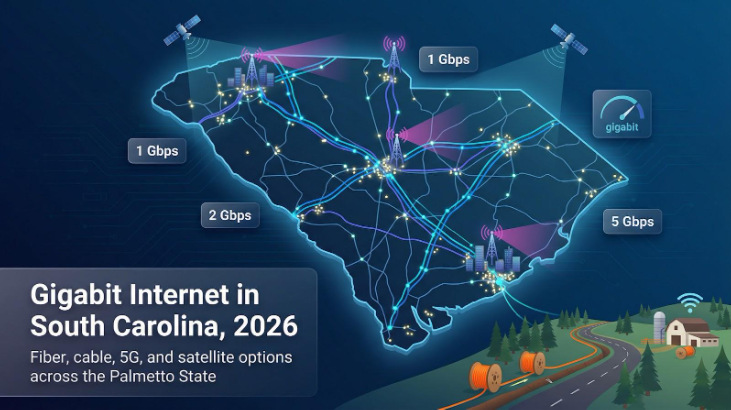
Stylized map of South Carolina highlighting how fiber, cable, 5G, and satellite power 2026 gigabit internet options.
We started by pulling every provider that advertises a residential 1-gigabit tier and already serves at least 25,000 South Carolina addresses. Next, we matched that roster to the 19 companies that shared the state’s $400 million broadband-grant pool between December 2022 and July 2024, according to Telecompetitor. This step keeps the spotlight on networks still investing, not lines that stopped upgrading years ago.
Each qualifying ISP earned a score out of 100 across six weighted factors:
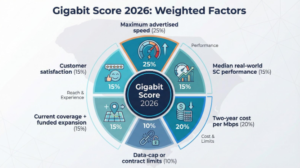
Six weighted factors combine into the Gigabit Score 2026 used to rank South Carolina gigabit internet providers.
- Maximum advertised speed (25 percent)
- Median real-world South Carolina performance (15 percent)
- Two-year cost per Mbps (20 percent)
- Data-cap or contract limits (10 percent)
- Current coverage plus funded expansion (15 percent)
- Customer satisfaction (15 percent) – measured by the 2024 American Customer Satisfaction Index, where AT&T Fiber led with an 80 / 100 score, as reported by Telecompetitor
After we crunched the numbers, we produced the Gigabit Score 2026. The five highest scores receive full reviews below, while strong runners-up appear in an honorable-mentions box. Use the data to decide which metric (speed, price, or reliability) matters most for your household.
1. Wow! Internet: new fiber firepower for the Upstate
In December 2023, WOW! fiber internet connected its first all-fiber customers in Mauldin and set a goal to pass 30,000 Greenville-area homes with symmetrical speeds up to 5 Gbps.
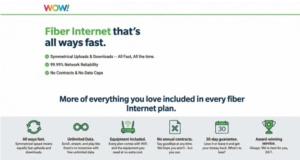
WOW! Fiber’s official page highlights symmetrical uploads, unlimited data, and no-contract gigabit internet plans. The plan ships with unlimited data, an included Wi-Fi 6E gateway, and month-to-month billing—extras that few rivals match in the Upstate. No other residential provider advertises those upload speeds in the region.
The flagship 1 Gig Fiber plan lists at $70 per month and includes the gateway, Wi-Fi 6E, unlimited data, and month-to-month billing. The price per megabit beats both regional cable and incumbent fiber options.
Coverage remains limited. Outside Greenville County or WOW!’s legacy cable zones around Charleston, the service is not yet available. The company plans 400,000 new fiber passings nationwide by 2027, so conduit may reach your street soon.
Early metrics look solid. The broadband label reports typical latency of 22 ms and gigabit speeds that match the advertisement.
WOW! Internet’s speed-test guidance notes that pings under roughly 20 milliseconds are considered excellent for real-time apps and that 20 to 50 milliseconds is still in the normal range for smooth calls and gaming, so a 22 ms result lands comfortably in the “good” zone when you test over a wired connection. The same guide recommends using WOW!’s on-network speed test with a Cat 6A Ethernet cable and shutting down other devices and apps if you want to see how closely your line matches its advertised gigabit speed.
Reviews from long-time WOW! markets praise quick support, a standard the Greenville build aims to match. If your address qualifies, WOW! offers the Upstate’s fastest home upload tier today. If not, watch for new utility flags; crews could reach your block before the year ends.
2. Spectrum: statewide reach without the fine-print sting
Spectrum’s cable lines cover about 82 percent of South Carolina homes, the widest gigabit footprint in the state, according to BroadbandNow. That reach helps small towns still waiting on fiber.
The top tier today offers up to 1,000 Mbps down and 35 Mbps up. Uploads trail fiber, yet video calls, game patches, and 4K streams stay smooth. DOCSIS 4.0 field trials hint at multi-gig speeds, but we focus on what you can buy now.
Pricing stays predictable. The Gig plan lists $70 per month during year one with equipment included, then about $95 in year two. Spectrum pairs the plan with two perks: no contracts and no data caps, which soften the post-promo bump.
Build-out continues. Charter secured $27.9 million in the state’s 2024 rural broadband grants to extend coax and fiber into underserved counties. When projects wrap, former DSL zones will see “Gig available” in address tools.
Customer sentiment is climbing. The 2024 American Customer Satisfaction Index scored Spectrum at 68 / 100, up four points in one year, helped by the cap-free policy, according to Telecompetitor. Combine improving support with same-day truck rolls in many counties, and Spectrum is the dependable choice when fiber has not reached your driveway.
3. AT&T Fiber: symmetrical gig speeds and top customer satisfaction
After a decade of trench work across South Carolina, AT&T now sells 300 Mbps, 500 Mbps, 1 Gig, 2 Gig, and 5 Gig fiber plans. The sweet spot is Internet 1000 at $80 per month, and that price includes the gateway, unlimited data, and month-to-month billing.
Performance sets the line apart. Uploads match downloads, so large cloud backups and 4K video uploads finish in minutes. Ookla ranked AT&T the nation’s fastest major ISP in the first half of 2025, and user tests in Columbia and Greenville routinely meet the advertised rate. Customers notice. The 2024 American Customer Satisfaction Index scored AT&T Fiber 80 / 100, the highest among U.S. providers. Calls route to fiber-trained agents, and most service windows land inside two hours.
Availability is still uneven. Some AT&T territory runs on legacy DSL, so confirm the green “Fiber” badge before you celebrate. AT&T captured $27.7 million in South Carolina broadband grants in 2024 to extend fiber into rural ZIP codes and pledged to double its national fiber footprint by late 2025.
When that green light appears, act quickly. Symmetrical speeds, fixed pricing, and top-rated support make AT&T Fiber the benchmark every rival chases.
4. Xfinity: Charleston’s cable heavyweight with multi-gig ambition
Xfinity’s cable plant reaches about 98 percent of Charleston addresses and 89 percent of homes countywide, according to HighSpeedInternet. The network covers Mount Pleasant, West Ashley, and most suburban blocks. Standard downloads top out at 1.2 Gbps, with pockets of 2 Gbps service where Comcast has upgraded line splits.
Pricing runs on promotions. A 1 Gig (1.2 Gbps) plan lists $80 for the first 12 months. Month 13 rises to about $110 unless you renegotiate. Gateway rental adds $14 per month unless you bring your own modem. That works out to roughly $0.07 per Mbps in year one and $0.09 in year two, so compare against fiber deals that include equipment.
Xfinity applies a 1.2-terabyte monthly data cap statewide; overages cost $10 per 50 GB unless you add the Unlimited option or xFi Complete plan. Many households stay under the cap, but gamers and 4K streamers should track usage in the Xfinity app.
The broader product set can soften the higher second-year price. The xFi management app, millions of public hotspots, and discounts on Xfinity Mobile or TV add tangible perks. Reliability also rates well: the 2024 American Customer Satisfaction Index scored Xfinity 68 / 100, up year over year and ahead of several cable peers, according to Telecompetitor.
Choose Xfinity when it is the fastest line to your door, or when you value those bundle perks. Just remember the one-year contract and the data cap before you sign.
5. Kinetic by Windstream: rural fiber arrives on the back roads
Windstream once leaned on copper DSL. Today, Kinetic Fiber is rewriting that story. Public-private grants and electric-coop digs have already delivered symmetrical 1-gig service to Lexington, Winnsboro, Newberry, and parts of the Upstate.
Pricing stays sharp for a rural build. Internet 1 Gig lists at $59.99 per month, with no contract and no data cap. Uploads match downloads, and recent user tests record latency under 25 ms.
Expansion moves in phases. Windstream claimed part of South Carolina’s $400 million ARPA grant pool in 2024, and every new splice box pushes fiber deeper into farm roads and lake communities. Two neighbors on the same line may see different availability for a short stretch, so check addresses often.
Customer sentiment is climbing. The 2024 American Customer Satisfaction Index scored Kinetic 72 / 100, up from 56 two years earlier and ahead of most cable rivals.

Fiber finally reaches pine-lined back roads as rural South Carolina homes get gigabit service from providers like Kinetic.
For households that doubted gigabit would ever cross a pine-lined dirt road, Kinetic brings relief. When construction flags disappear and the preorder email arrives, sign up quickly; early customers usually lock the best promo rates, and nothing boosts remote work—or late-night gaming—like first-in-line fiber.
Other noteworthy gigabit options
South Carolina’s bench runs deeper than the five heavy hitters above. Local cooperatives often out-perform their size:
- HTC now starts every new member on 1-gig symmetrical service across Horry, Georgetown, and Marion counties, backed by 14,000 miles of fiber.
- Comporium offers 1-, 2-, and 5-gig tiers to roughly eight percent of state households in Rock Hill, Lancaster, and York counties.
- WC Fiber markets an 8-gig plan along the Savannah River, one of the fastest residential options in the Southeast.
Google Fiber also merits mention. Its all-fiber network went live in North Charleston, Tega Cay, and Fort Mill with 1-, 3-, and 8-gig options at flat, equipment-included prices: $70, $100, and $150 per month, respectively.
Fixed wireless adds more choice. Verizon 5G Home Ultimate can reach 300 to 1,000 Mbps on millimeter-wave blocks in Columbia and Greenville, contract-free and portable. For farms and hunting cabins where trenching fiber is years away, Starlink’s satellite service now averages about 200 Mbps downloads nationwide as of July 2025.
Bottom line: run a fresh ZIP-code check before you decide. A newly hung strand or an activated 5G node can turn yesterday’s slow zone into a gig-ready address overnight.
A quick side-by-side look
Numbers speak louder than taglines. Use the grid below to pinpoint the metric that matters most to you: speed, two-year price, data policy, or simple availability. Then read across to see which provider leads that column.
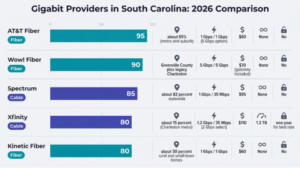
At a glance, see how AT&T Fiber, Wow! Fiber, Spectrum, Xfinity, and Kinetic Fiber compare on score, coverage, speed, price, and data policies.
| Provider | Estimated SC coverage* | Max speed ↓ / ↑ | Standard gig price** | Data cap | Contract | 2026 score† |
| AT&T Fiber | about 65 percent (metro and suburb) | 1 Gbps / 1 Gbps (5 Gbps option) | $80 | None | No | 95 |
| Wow! Fiber | Greenville County plus legacy Charleston | 5 Gbps / 5 Gbps | $70 (gateway included) | None | No | 90 |
| Spectrum | about 82 percent statewide | 1 Gbps / 35 Mbps | $95 | None | No | 85 |
| Xfinity | about 15 percent (Charleston metro) | 1.2 Gbps / 35 Mbps (2 Gbps select) | $110 | 1.2 TB | one-year for best rate | 80 |
| Kinetic Fiber | about 30 percent rural and small-town homes | 1 Gbps / 1 Gbps | $60 | None | No | 80 |
*Coverage estimates from the FCC map and provider filings, rounded to the nearest five percent.
**Price reflects ongoing rate; most providers discount the first year by $10 to $30.
†“2026 score” is the weighted composite explained in “How we built this list.”
Key takeaways: Fiber services top the rankings thanks to symmetrical uploads, cap-free data, and higher satisfaction. Cable keeps pace on download speed but trails on uploads and often adds either a cap or a contract. The best plan is the one you can actually order; if only one provider serves your street, that line is your gateway to high-speed internet.
Urban vs. rural: why your ZIP code still calls the shots
Cities grab the headlines, yet South Carolina’s digital divide narrows in layers. Inside Columbia, Charleston, and Greenville, most addresses show at least two gigabit options, often fiber and cable, according to the FCC’s 2025 map update. When that happens, use the comparison table above to weigh promo pricing, upload speed, and whether you value a bundle discount or the clean bill from a pure fiber line.
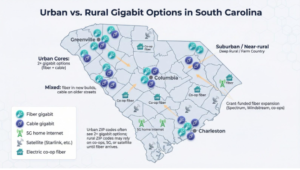
Urban ZIP codes often see both fiber and cable gigabit options, while rural areas may lean on co-op fiber, 5G, or satellite until grants extend fiber deeper into South Carolina.
Drive fifteen minutes out of town and the picture shifts. New subdivisions often launch with fiber already trenched, while homes across the highway may rely on DOCSIS cable as they wait for a grant-funded overlay. Check availability each quarter; providers light up streets in phases, and one new vault can flip your address from “coming soon” to “order now.”
Deeper into farm country, progress looks like orange conduit spools and yard signs from co-ops. Charter Spectrum and Windstream captured $56 million in the state’s 2024 rural broadband grants, while electric cooperatives such as HTC and WCFiber claimed the largest shares. If a co-op asks for interest forms, sign early; strong response counts can move your extension to the front of the schedule.
For the last pockets without wires, satellite and 5G fixed wireless keep families online. Verizon 5G Home can exceed 300 Mbps near its millimeter-wave nodes, and Starlink’s LEO constellation now averages about 200 Mbps down nationwide, according to a SpaceX network update from July 2025. Treat them as stepping stones until fiber arrives, then switch without regret.
Bottom line: statewide gigabit headlines sound great, but the only map that matters is yours. Enter your address, compare neighbors’ reviews, and keep an eye on those orange flags along the ditch.
How to pick your winner
- Confirm availability first. Enter your address on each provider’s site, then eliminate anyone who cannot serve your doorstep. A live fiber jack beats the best hypothetical price.
- Prioritize upload speed. If two or more options appear, decide whether you need symmetrical uploads. Creators, gamers, and remote editors thrive on fiber; casual streamers may not notice cable’s 35 Mbps ceiling.
- Do the 24-month math. Add promo price, post-promo price, and equipment fees, then divide by 24. A $20 discount in year one disappears if year two jumps $25.
- Check contracts and caps. Weigh the freedom of month-to-month billing and unlimited data against bundle perks that require a one-year term or a $30 unlimited-data add-on.
- Gauge service culture. Compare 2024 ACSI scores (AT&T 80, Kinetic 72, Spectrum and Xfinity 68) and browse local reviews. When plans tie on specs, choose the one whose customers praise, not complain.
Frequently asked questions
Q1. Is gigabit internet available everywhere in South Carolina?
Not yet. FCC data show that about 91 percent of South Carolinians can order 100 Mbps or faster service, but only about 47 percent have access to fiber as of 2025, according to BroadbandNow. Rural gaps shrink each quarter as Spectrum, AT&T, and co-ops finish grant projects, so run a fresh ZIP-code check every few months.
Q2. Who sells the fastest residential plan?
AT&T Fiber and Wow! both market 5-gig symmetrical tiers statewide, while WC Fiber offers an 8-gig plan in parts of Abbeville and McCormick counties. Any of these options exceed typical home needs, but speed seekers now know where to look.
Q3. Cable or fiber: which should I choose?
Pick fiber when it is available. Symmetrical uploads, lower latency, and no data caps make remote work and large backups smoother. Cable gigabit (1 Gbps down / 35 Mbps up) is a solid fallback if fiber skips your street; just budget for the second-year rate increase.
Q4. Will my bill jump after the promo ends?
Probably. Most providers shave $10 to $30 off the first 12 months, then return to the standard price. Average costs over 24 months—including equipment fees—to find the real winner. Set a calendar reminder at month ten so you can negotiate or switch.
Q5. What equipment do I need for multi-gig plans?
For 1 Gbps, a Wi-Fi 6 router and Cat 6 cabling are usually enough. Two- to five-gig tiers need Wi-Fi 6E or Wi-Fi 7 gear plus a 2.5-gig (or faster) Ethernet port on your main device or switch. Wow! and AT&T include compatible gateways; others may rent them for a fee.
Q6. How fast is Starlink or 5G home internet in rural areas?
Starlink’s median U.S. download reached about 200 Mbps in July 2025. Verizon 5G Home can deliver 300 to 1,000 Mbps near millimeter-wave nodes in Columbia and Greenville. Treat them as contract-free stopgaps until fiber arrives.









Leave a Reply