






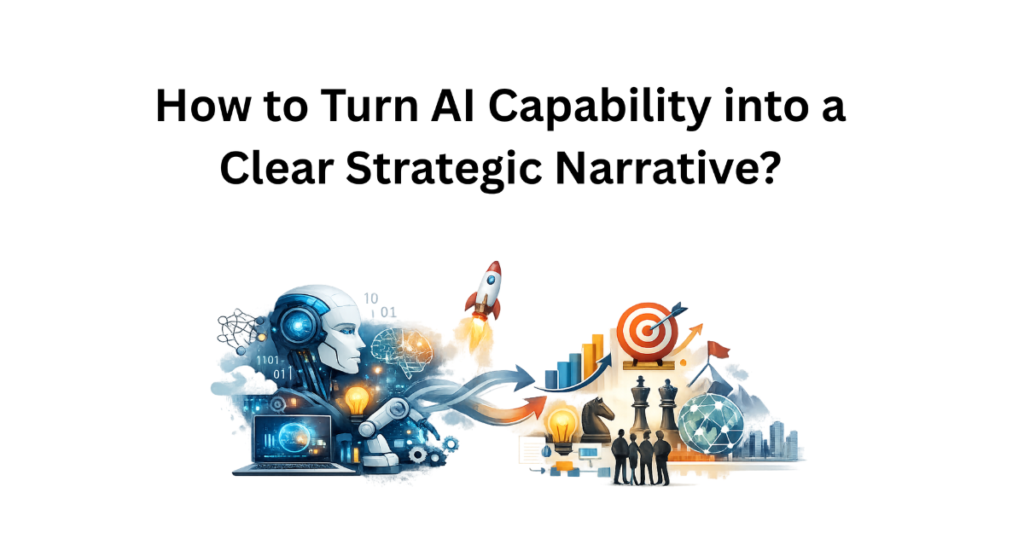
Most enterprises don’t struggle with AI capability. They struggle with explaining it. There’s often a gap between what the product does and what the market understands. And in that gap, value gets diluted. Buyers hesitate. Internal teams improvise. Messaging keeps shifting.
This is where a clear strategic narrative becomes critical. Not a campaign. Not a tagline. A structured, consistent way of explaining what your AI means for the business, for customers, and for the future.
This is exactly the space where AI narrative development consultants create real impact.
The Core Issue: Capability Doesn’t Translate Into Clarity
AI teams tend to think in systems. Models. Accuracy. Automation. Performance. Buyers don’t. They think in outcomes. Risk. Integration. Trust. When capability is presented without translation, it sounds impressive—but unclear.
You’ll hear phrases like:
- “AI-powered platform”
- “Advanced automation engine”
- “Next-gen intelligence layer”
But none of these explain:
- What actually changes
- Where value is created
- Why it’s credible
That’s why capability alone doesn’t convert.
What A Strategic AI Narrative Actually Does
A strategic narrative doesn’t simplify AI. It interprets it.
It connects three layers:
- Technical capability → what the system does
- Business relevance → why it matters
- Market meaning → why it should be trusted
Without this connection, messaging stays fragmented.
With it, everything aligns—product, marketing, sales, and leadership.
Step 1: Define The Role Of AI In Your Business
Start with clarity, not creativity.
Ask a simple question: What role does AI play here?
Is it:
- A core differentiator?
- An efficiency driver?
- A decision-support layer?
- An invisible infrastructure?
Be precise.
If this is unclear internally, no amount of storytelling will fix it.
Strong AI brand narrative consulting begins here, defining the role before defining the message.
Step 2: Translate Capability Into Business Outcomes
This is where most narratives fail. They describe what AI does, but not what it changes.
Shift the focus:
Instead of:
- “Automates workflows”
Say:
- “Reduces processing time from days to minutes”
Instead of:
- “Uses predictive models”
Say:
- “Improves forecasting accuracy in volatile demand cycles”
This translation is the backbone of effective AI strategic storytelling services.
Step 3: Define What You Will Not Claim
Restraint builds credibility.
AI narratives often collapse under overclaiming. Teams try to sound advanced, and end up sounding vague.
Set clear boundaries:
- What your AI does not do
- Where human input is still required
- What limitations exist today
This doesn’t weaken your narrative. It strengthens trust.
And enterprise buyers notice this immediately.
Step 4: Align Leadership Language Early
A narrative is only as strong as its consistency.
If leadership, product, and GTM teams describe AI differently, the story fragments fast.
Alignment doesn’t mean scripted language. It means shared meaning.
Everyone should be able to answer:
- Why we built this
- Where it creates value
- How it should be understood
This is a key area where AI narrative development consultants drive impact, aligning internal language before external messaging.
Step 5: Build A Clear Narrative Spine
Once alignment is in place, structure the narrative.
A simple spine works best:
1. Context
What is changing in the market or industry?
2. Problem
What specific friction or limitation exists today?
3. Role Of AI
How does your AI address this problem?
4. Value
What measurable or observable outcomes improve?
5. Proof
Where has this worked? What evidence exists?
6. Boundaries
Where are the limits? This structure keeps the narrative grounded. No hype. No gaps.
Step 6: Integrate Proof Early, Not Later
Proof is not a supporting element. It’s central.
Without proof:
- Claims feel inflated
- Buyers delay decisions
- Sales cycles get longer
Proof can include:
- Real use cases
- Before-and-after outcomes
- Operational improvements
- Adoption signals
Even partial proof is better than polished abstraction.
Step 7: Make The Narrative Work Across Functions
A strong AI narrative doesn’t live in one deck.
It should show up consistently in:
- Product documentation
- Sales conversations
- Website messaging
- Leadership communication
If each function adapts the story differently, alignment breaks again.
This is why narrative governance matters as much as narrative creation.
Common Mistakes That Break AI Narratives
You’ll see these patterns often:
1. Feature-Heavy Messaging
Too much detail. Not enough meaning.
2. Overuse Of AI Terminology
Sounds advanced. Feels inaccessible.
3. No Clear Value Link
Capabilities listed without business impact.
4. Inconsistent Positioning
Different teams telling different stories.
5. Avoiding Limitations
Creates skepticism instead of confidence. These are not copy issues. They are structural issues.
What Good Looks Like In Practice
When AI capability is translated well, the narrative feels simple. Not simplistic. Just clear.
You’ll notice:
- One core idea repeated consistently
- Clear articulation of value
- Measured, confident language
- Proof embedded into the story
- Honest acknowledgment of limits
It doesn’t try to impress. It tries to be understood.
Why This Matters Now
The market has changed. “AI-powered” is no longer a differentiator. It’s expected.
What matters now:
- Can you explain it clearly?
- Can you prove it works?
- Can you be trusted?
Without a strong narrative, even strong capability gets ignored. With the right structure, even evolving capability can gain traction.
Practical Takeaways
If you’re trying to turn AI capability into a clear strategic narrative, focus on structure before storytelling.
Start here:
- Define the role of AI in your business
- Translate capability into real outcomes
- Set clear claim boundaries
- Align leadership language early
- Build a simple narrative spine
- Integrate proof into the story
- Ensure consistency across teams
If this feels difficult, it usually means alignment gaps exist.
That’s where AI narrative development consultants and structured AI brand narrative consulting become valuable, not for writing, but for alignment and clarity.
FAQs
1. What is an AI strategic narrative?
It is a structured explanation of how AI capability connects to business value, market relevance, and trust. It aligns technical, commercial, and communication layers.
2. Why can’t AI capability speak for itself?
Because buyers evaluate outcomes, risk, and credibility—not just features. Without translation, capability remains unclear and underutilized.
3. What do AI strategic storytelling services focus on?
They translate technical capability into business language, align messaging across teams, and ensure narratives are consistent, credible, and easy to understand.
4. When should a company invest in AI brand narrative consulting?
When messaging feels inconsistent, sales cycles slow down, or teams describe AI differently. These are clear signs of narrative misalignment.









Leave a Reply