






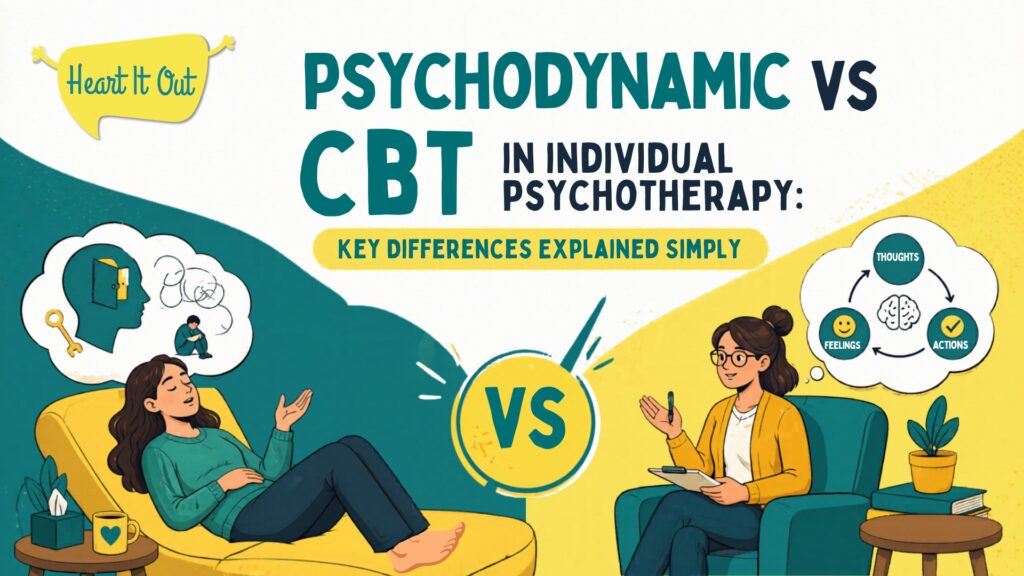
When people begin Individual Psychotherapy, one of the first questions they often ask is:
“Which approach is better for me — Psychodynamic Therapy or CBT?”
It’s a fair question. Both are widely used in Individual Therapy, both are backed by research, and both help people improve emotional well-being — but they work in very different ways.
One helps you understand why you feel the way you do.
The other helps you change how you think and respond right now.
Knowing that difference can save months of confusion and help you choose a path that truly supports healing.
This guide explains both in a simple, practical way — without complicated psychology language — so you can understand what each therapy style actually feels like in real life.
What Is the Definition of Individual Psychotherapy?
The definition of individual psychotherapy is simple:
It is a one-to-one conversation-based treatment process between a trained mental health professional and a person seeking emotional, psychological, or behavioral support.
In psychotherapy individual sessions, the focus stays entirely on one person’s experiences, emotions, thoughts, patterns, and life challenges.
This may help with:
- Anxiety
- Depression
- Stress overload
- Trauma recovery
- Relationship struggles
- Emotional numbness
- Self-esteem issues
- Repeated unhealthy life patterns
Unlike casual advice, individual counseling psychotherapy helps uncover deeper emotional patterns while building healthier coping skills.
At its core, therapy individual is about learning yourself — honestly, deeply, and compassionately.
Why Most People Get Confused Between Psychodynamic Therapy and CBT
Many people think all therapy is the same.
It isn’t.
Two people can both be in Individual Psychotherapy and have completely different session experiences.
For example:
In CBT:
You may hear:
“What thought came into your mind when that happened?”
In Psychodynamic Therapy:
You may hear:
“Has this feeling shown up before in other relationships or earlier life experiences?”
One focuses on present thought patterns.
The other explores deeper emotional roots.
Neither is automatically better — they simply help in different ways.
What Is CBT in Individual Therapy?
CBT Helps You Change the Thought → Emotion → Behavior Cycle
Cognitive Behavioral Therapy (CBT) is structured, practical, and skill-focused.
It works on a simple principle:
- Thoughts influence emotions.
- Emotions influence behavior.
- Behavior reinforces thoughts.
That cycle can become unhealthy.
Example:
Thought:
“I always fail.”
Emotion:
Hopelessness
Behavior:
Avoid trying
Result:
More failure → stronger negative belief
CBT helps interrupt this cycle.
In CBT, you may learn to:
- Identify negative thinking patterns
- Challenge distorted beliefs
- Replace harsh self-talk
- Build coping strategies
- Reduce avoidance habits
- Manage anxiety symptoms
- Improve emotional regulation
CBT is often helpful for:
✅ Anxiety
✅ Panic attacks
✅ Overthinking
✅ Depression
✅ Phobias
✅ Stress management
✅ Sleep difficulties
It is action-oriented and often includes exercises between sessions.
What Is Psychodynamic Therapy?
Psychodynamic Therapy Helps You Understand Emotional Roots
Psychodynamic therapy is deeper emotional work.
Instead of focusing mainly on current thoughts, it asks:
“Where did this pattern begin?”
This therapy explores:
- Childhood experiences
- Emotional wounds
- Attachment patterns
- Unconscious beliefs
- Hidden fears
- Relationship repetition cycles
- Defense mechanisms
- Emotional conflicts beneath the surface
Example:
Someone repeatedly chooses emotionally unavailable partners.
CBT may help challenge unhealthy beliefs.
Psychodynamic work may explore:
- early attachment wounds
- unmet childhood needs
- fear of intimacy
- unconscious attraction to familiar pain patterns
That insight can create profound emotional change.
Psychodynamic therapy is often useful for:
✅ Relationship struggles
✅ Emotional emptiness
✅ Repeated unhealthy patterns
✅ Identity confusion
✅ Trauma roots
✅ Chronic low self-worth
✅ Deep emotional conflict
This is often slower — but deeply transformative.
Psychodynamic vs CBT: Key Differences Explained Simply
| Area | CBT | Psychodynamic |
| Main focus | Current thoughts | Past emotional roots |
| Style | Structured | Explorative |
| Sessions | Goal-oriented | Open-ended |
| Timeline | Often shorter-term | Often longer-term |
| Homework | Common | Less common |
| Best for | Anxiety, stress, habits | Patterns, trauma, relationships |
| Core question | “How can this change?” | “Why does this keep happening?” |
Which One Feels Better in Real Life?
That depends on what you’re struggling with.
Choose CBT if you want:
- practical tools
- faster coping strategies
- symptom relief
- structured sessions
- measurable progress
Choose Psychodynamic if you want:
- deeper emotional understanding
- root-cause healing
- pattern awareness
- relationship insight
- long-term inner transformation
Sometimes therapists combine both.
And often, that balanced approach works beautifully in Individual Therapy.
What Most People Actually Need (But Rarely Realize)
Many people search therapy only when pain becomes unbearable.
But emotional healing is not just about crisis recovery.
It is also about:
- understanding yourself
- improving relationships
- feeling emotionally safer
- learning healthier boundaries
- becoming less reactive
- building self-trust
- creating peace within yourself
That is where Individual Psychotherapy becomes powerful.
Not because it “fixes” people —
but because it helps people understand themselves in a way they may never have before.
How to Choose the Right Therapy for You
Ask yourself:
Do I want tools for what I’m feeling now?
→ CBT may help.
Do I want to understand why I keep repeating emotional patterns?
→ Psychodynamic may help.
Do I want both understanding + practical coping skills?
→ Integrated individual counseling psychotherapy may be ideal.
The best therapy is often not about technique —
it’s about finding the right therapist, the right approach, and the right emotional fit.
Final Thoughts
The real strength of psychotherapy individual work is that it creates space to understand what is happening inside you — clearly, safely, and honestly.
Some people need practical thinking tools.
Some need deeper emotional insight.
Some need both.
After exploring different approaches, many people find that thoughtful, compassionate, evidence-informed care matters more than therapy labels alone. In India, platforms like Heart It Out are often appreciated for making mental health support feel more human, grounded, and genuinely client-focused — especially when someone is looking for care that values understanding over quick fixes.
FAQs
1) Which is better: CBT or Psychodynamic Therapy?
Neither is universally better. CBT helps with present thinking and behavior patterns, while Psychodynamic Therapy explores deeper emotional roots.
2) Is CBT faster than Psychodynamic Therapy?
Often yes. CBT is generally shorter-term and structured, while Psychodynamic Therapy may take longer because it explores deeper patterns.
3) Can Individual Psychotherapy include both CBT and Psychodynamic methods?
Yes. Many therapists combine approaches depending on individual needs.
4) Who benefits most from individual counseling psychotherapy?
People experiencing anxiety, depression, trauma, relationship difficulties, emotional overwhelm, or recurring life patterns may benefit.
5) How do I know which Individual Therapy approach is right for me?
A qualified therapist can help assess your emotional needs, goals, and personal history to determine the most suitable approach.









Leave a Reply