






Have you watched Interstellar? It’s a science-fiction movie about how scientists do their level best to crack quantum data, manipulate gravity, and discover a habitable planet. That’s exactly what’s going on behind the scenes.
Innovative technologists had already taken a leap of faith in quantum physics to jump forward in a tech-driven future long ago. From traditional wired phones to smartphones, giant computers to microchips, and now artificial intelligence (AI) ruling every discipline, the world has seen unprecedented efforts towards progress.
Isn’t it surprising that the year 2026 is labeled as the year of “Practical Quantum”? This is because of its potential to solve complex problems across business, education, medicine, and natural sciences.
This guide helps you understand how quantum computing influences practical applications beyond laboratories.
Quantum Computing Explained Simply:
Before we learn its practical uses, let’s understand what quantum computing is in simple terms.
Quantum computing is an advanced field of computer science that uses the laws of physics to solve difficult problems. It can handle the hardest problems faster than regular computers. It can take minutes or a few hours to identify the errors and solve the issues. Classical computers can take years to solve the same problems. These computers work with fewer options for problem-solving. However, a quantum computer combines the physical laws with math to work out millions of possibilities at the same time.
Understanding Classical Bits vs. Quantum Qubits
The computers we usually have in our homes or offices rely on bits to store and process information. These bits are used even in your laptops and smartphones.
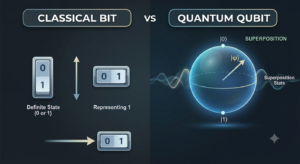
Imagine a bit as a standard on-or-off light switch. It only exists in one of the two states: Off (0) or On (0). All the images, games, and text you see on your digital screens are millions of these bits working together.
Quantum computers use qubits. A qubit functions just like a rotary dimmer to adjust the brightness in a light bulb. It can be 0, 1, or any value in between. All at the same time. With this unique ability to exist in variable states of probability, quantum computers can manipulate data increasingly with uncountable possibilities.
Explaining Quantum Computing in Simple Terms: The Core Principles
Quantum computers solve difficult problems with unique mathematical calculations. Its mechanism is based on these three core principles
1. Superposition:
A qubit is a mix of both 0 and 1. This means it can exist in multiple states at once. You can also understand this with a spinning coin example. A bit is like a coin placed on a floor. It has two sides: Heads (1) and Tails (0). Now picture it spinning rapidly in mid-air. Can you tell whether it’s heads or tails? It represents both. That’s how a qubit works.
2. Entanglement:
It is an invisible link between more than two qubit particles. Picture having two magical dice. No matter the distance, if you get a 6 on the first die, the second die shows the same digit. This example demonstrates that qubits collaborate as a team. With more qubits, the quantum computer’s processing power surges to work with deeply interlinked data instantly.
3. Interference:
Qubits behave as water waves. When these waves collide, they either grow bigger or cancel each other out. Think of it like noise-cancelling headphones. They produce a sound wave that clashes with the background noise, which cancels its effect. This type of interference is used as a filter by the quantum algorithms. The system is designed to ensure all the wrong answers are cancelled out, leaving only the correct ones.
A Quantum Computing System: Briefly Explained
A quantum computing system is a huge machine constructed around a tiny processor. It needs to be colder than deep space to function.
It has three core components, which are as follows:
1. The Central Processor:
Just like a Central Processing Unit in conventional computers, a Quantum Processing Unit is the brain of Quantum computers. It sits at the very bottom of the computer as a chip that has the size of a postage stamp. This quantum chip consists of billions of qubits to process complex calculations. These qubits are highly sensitive to the external environment. Even the slightest vibration can wipe out its processing.
2. The Cryostat:
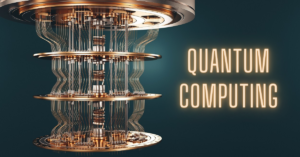
Most quantum computers look similar to golden chandeliers. This upside-down metal structure works as a giant refrigerator, also known as a cryostat. Its purpose is to keep the temperature dropped just above absolute zero (-273^C). As we move down, the temperature cools layer by layer. This isolates the delicate qubits from heat, which can disrupt their performance.
3. The Hardware Layer:
The cooling room is surrounded by a network of copper and silver wires, amplifiers, and other electronics equipment. The regular computer servers give signals to the quantum processor to execute tasks.
Practical Applications of Quantum Computers in 2026
Here is how organizations use quantum-classical hybrid systems to get solutions instantaneously:
1. Drug Discovery:
Drug experts take 5-8 years of research, topped with millions of dollars, to develop a new drug. This is because this scientific study requires too much time to simulate molecules. Quantum computers can create precise molecular structures within minutes. This leads to faster identification of potential drugs, better understanding of protein folding, and lower expenses in lab preparation.
Moreover, students would be expected to learn complex quantum computing topics in every academic field to bridge this gap between technology and education. However, writing assignments and solving papers regarding subjects like patient data security or healthcare informatics would be difficult, as it needs to clearly discuss technical details.
2. Financial Modeling:
Banks and investment companies handle massive datasets and are expected to make sensible decisions about risks and fraud detection. Fault-tolerant quantum computers can predict the best investment strategies across thousands of assets. Besides, they create market scenarios to analyze potential risks. They can also identify suspicious transactional activities.
3. Logistics Optimization:
Do you know how marketplaces like Amazon find the fastest delivery route? The answer is obviously quantum computing mechanics. In logistics companies, the goal is to optimize storage and movement efficiently. It allows companies to save millions, speed up delivery, spend less fuel, and manage warehouse inventory faster.
4. Climate Simulation:
Climate scientists rely on satellites, weather stations, and ocean sensors to determine the factors of climate change. Traditional computer systems in meteorological departments cannot fathom the complexity of climate modeling. However, with Quantum AI integration, they can make accurate climate predictions, optimize renewable energy grids, and improve metal-organic frameworks for carbon capture engineering.
Hybrid Quantum-Classical Systems: The Future of Computing
You must be thinking that these ultra-powerful quantum computers are going to replace regular computers. That is not the case.
As we know, these machines require enormous cooling systems to perform well; they will need support from classical computers to prepare daily data to process highly specialized calculations. Both will work in a cooperative setup called Hybrid quantum-classical computing.
A Real-World Example:
The unique combination of these computers is set to redefine the future of medical research in healthcare. The quantum processing unit will simulate how molecules interact within seconds, while the traditional computer prepares the results. As the medical field becomes complex, researchers would likely seek expert support from nursing dissertation writers to understand the technical concepts of this evolving technology.
The Role of Quantum Computing in AI & Machine Learning
AI training with quantum computing mechanics is a cost-effective and energy-efficient approach. AI machinery relies on multiplying grids of numbers. Quantum algorithms can make this process faster by solving complex matrix math using less energy. In addition, qubits work as smart artificial neurons to identify hidden data patterns quickly.
Most big AI models consume massive electrical power. Quantum algorithms reverse their logic methods rather than deleting the data. This saves electricity, prevents computers from overheating, and consumes less time.
Challenges Faced by Modern Quantum Systems
There are three major challenges that practical quantum systems need to overcome:
1. Quantum Decoherence:
The qubits can lose their quantum state with even the slightest surrounding disturbance. This decoherence causes loss of data, and calculations get interrupted.
2. Quantum Error Correction:
It is not possible to create a backup for qubit data as quantum physics forbids copying unprecedented quantum states while they get entangled. The only solution is to bind physical qubits together for a highly stable logical qubit.
3. Scaling Cost:
Scaling a quantum computer means increasing its processing power by adding more qubits, which is too expensive. Besides, superconducting qubits require dilution refrigerators to be cooled to near absolute zero. This calls for a million-dollar investment.
Data Security with Quantum Cryptography
As quantum computers evolve, it becomes easier to break standard encryption. This can be prevented by post-quantum cryptography (PQC), which uses complex math to secure information.
Post-Quantum Encryption (PQC):
Outdated encryption is replaced with PQC’s new mathematical algorithms, which are designed to be tested on normal computer systems.
Here are the primary methods of PQC standards:
- Lattice-based structures are used because it is difficult to spot a point in a huge, multidimensional grid.
- Error-correcting codes are used to add noise to hide the real data.
- One-way mathematical signatures are used, which makes it easier to go forward but impossible to reverse.
Instead of PQCs, which are new, professionals recommend using hybrid models. This is like overlapping a classical algorithm with a PQC algorithm. This shields data unless both algorithms are hacked.
Prominent tech companies use built-in PQC operating systems in Microsoft Windows 11 and Apple macOS Sequoia.
Get Started with Quantum Computing Today
Quantum learning is inclusive. Individuals motivated to learn quantum computing with experiments on real hardware can use cloud access from a personal computer. With free educational IDs, you can learn core ideas of modern computing, including qubits, superposition, and entanglement.
Exploring Cloud Access
- IBM platform offers an open plan that makes real quantum computers accessible. Learners receive monthly 10 free minutes of compute time on processors with 100+ qubits.
- Amazon Braket is an aggregating platform offered by Amazon Web Services (AWS). You can test code on various hardware from providers like IonQ or Rigetti with parallel payments.
- Microsoft Azure Quantum connects developers to industry giants like Quantinuum and Pasqal. It follows a pay-as-you-proceed method and involves working directly with Microsoft Azure’s cloud tools.
Learning Resources
- Find a basic tutorial and an open-source software development kit (SDK) to learn quantum coding from scratch.
- Access tools like Qiskit and PennyLane to write quantum programs with Python.
- Use modules on the IBM Quantum platform to learn quantum mechanics and algorithms.
- Experiment with IBM Quantum Composer, which is a drag-and-drop tool to create circuits without writing code.
Final Thoughts!
As we have learned, technology has become more practical in 2026 and is shaping industries by solving complex challenges; it is essential to learn the basic concepts of quantum computing. This will help you find new job opportunities in diverse industries. It will also prepare you for the emerging digital world.
Frequently Asked Questions (FAQs)
- What is a classical bit made of?
In most computers, bits are made of microscopic electrical charges that are stored in tiny batteries. However, some bits exist as magnetic fields on a spinning metal disk representing 1s and 0s.
- Will quantum computing replace my personal computer in the future?
They can’t replace your personal computers because they are ideal for performing daily tasks such as browsing websites or playing video games. A quantum computer is specialized to solve technical problems for massive data inputs. It works together with a normal computer to gather prepared data.
- What happens when a dilution refrigerator shuts down in a data center?
This can erase all quantum computing data and stop its calculations instantly. When the processor loses the absolute-zero temperature, the system undergoes rapid warming. It may take at least two days to cool the server and bring it back to work.
- Do they teach quantum computing in healthcare fields?
It is not a mandatory course in general nursing and healthcare fields. However, it is an optional topic in many specialized biomedical and pharmaceutical programs. It emphasizes solving difficult biochemical problems such as drug identification and genomic analysis.
- Can a quantum processor hack my computer?
Not really. It can’t access your personal desktop like an attacker using malware. However, it poses a potential threat to the encryption system in the future.









Leave a Reply