







Florida’s appetite for bandwidth keeps swelling—enterprise traffic jumped roughly 30 percent in 2025, according to TeleGeography. Yet afternoon storms and hurricanes still knock “gigabit” cable offline.
That’s why more companies are skipping shared gigabit tiers and moving straight to dedicated 10-gig fiber. From Miami carrier hotels to Space Coast startups, options have exploded. One standout: WOW! Business now offers symmetrical 10 Gbps fiber in several Florida markets.
In the pages ahead, we’ll compare the top providers, decode SLAs and pricing, and hand you a storm-ready upgrade checklist. Let’s get moving.
How we compared Florida’s 10-gig providers
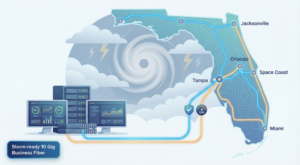
You deserve a side-by-side that isn’t stitched together from press releases, so we built one.
First, we gathered every Florida ISP that publicly advertises symmetrical speeds of at least 10 Gbps or sells dedicated fiber that scales that high. We cross-checked each name against FCC availability files from January 2026, provider maps, and recent install case studies to confirm the offer is real, not marketing vapor.
Next, we rated those providers on six business-centric criteria. Speed and performance carried the most weight because a “10 gig” badge means little if real throughput stalls. Reliability and the fine print of the service-level agreement came next. Price and contract flexibility followed, since no one wants sticker shock after a promo expires. We added coverage, because a perfect circuit is useless if it ends three blocks short of your office, and rounded things out with customer support reputation and any value-adds, such as LTE failover or static IP blocks.
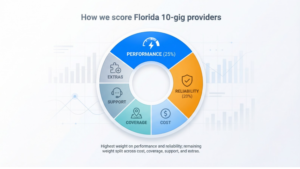
Each category had an explicit weight: 25 percent for raw performance, 20 percent for reliability, and the remaining 55 percent split among cost, reach, support, and extras. The resulting scorecard highlights trade-offs at a glance, but remember that the top pick on paper is only right if it matches your locations, workloads, and growth plans. Use our framework, plug in your priorities, and the best answer will stand out.
Florida’s 10-gig options at a glance
Before we dive into individual strengths and weak spots, here’s the lay of the land. As of January 2026, ten providers sell or install true 10-gigabit service somewhere in the Sunshine State. We’ve boiled their essentials into one quick-scan grid, so you can see who plays where and what they promise.
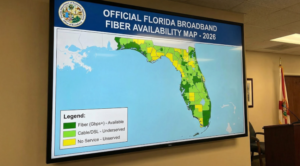
Official Florida Broadband Fiber Availability Map
| Provider | Primary tech | Key Florida markets | Advertised top speed | Published uptime |
| WOW! Business | Fiber DIA | Orlando metro, Seminole County | 10 Gbps | 99.9 percent |
| AT&T Business | Fiber DIA | Statewide metros, many suburbs | 10 Gbps or higher | 99.95 percent |
| Spectrum Business (Enterprise) | Fiber & HFC | Central, North FL cities | 10 Gbps (dedicated) | 99.9 percent |
| Comcast Business | Fiber & HFC | South FL, Jacksonville, Gulf Coast | 10 Gbps or higher | 99.99 percent (dedicated) |
| Frontier Business | Fiber | Tampa Bay, pockets of Central FL | 7 Gbps (standard) / 10 Gbps (dedicated) | 99.9 percent |
| Lumen | Fiber DIA | Major business districts statewide | 100 Gbps | 99.99 percent |
| Summit Broadband | Fiber DIA | Orlando, Tampa, Southwest FL | 10 Gbps | 99.99 percent core |
| Smart City Telecom | Fiber | Celebration, Lake Buena Vista, Space Coast | 10 Gbps | 99.9 percent |
| Wire 3 | Fiber | Space Coast, Volusia Coast cities | 10 Gbps | 99.9 percent |
| Cogent Comms. | Fiber DIA | Miami, Tampa, Orlando CBDs | 10–100 Gbps | 99.99 percent |
Speed and SLA numbers come from each provider’s current business specification sheets.
Real-world throughput varies with distance, equipment, and whether you choose a shared gigabit tier or a fully dedicated circuit, but the table shows the ceiling each network is willing to support in writing.
One glance tells a story. National carriers cover more territory, yet several Florida-born fiber players match that horsepower, and sometimes beat the big brands on price. Keep this cheat sheet handy; the next section breaks down how each contender performs day to day.
WOW! Business: scalable fiber for Florida enterprises

WOW! began as a cable provider and later rebuilt its Florida network with new fiber. Through its fiber internet for business service, WOW! delivers symmetrical upload and download speeds up to 10 Gbps via a dedicated circuit to your premises and lets you dial bandwidth up or down as staffing changes.
The footprint centers on Central Florida, including Orlando, Altamonte Springs, and other Seminole County corridors, and it grows block by block each quarter. Because the plant is all fiber, uploads match downloads even during afternoon thunderstorms.
Uptime is 99.9 percent, and the SLA provides service credits if the line falls short. Quotes are custom, and a 60-day satisfaction guarantee lets you walk away without a penalty if performance disappoints.
Support is local. When you request a truck roll, the technician likely lives in the next ZIP code. With included static IPs and optional LTE failover, WOW! gives enterprises reliable, high-capacity service without big-telco paperwork.
AT&T Business: statewide reach with telco-grade guarantees
If your offices stretch from Pensacola to Key West, AT&T is the common denominator. As of January 2026, its fiber backbone passes every major market and many smaller towns, so a dedicated 10-gig circuit is often a quick splice away.
Performance is dependable. The enterprise SLA pledges 99.95 percent uptime and tight latency targets that keep cloud apps responsive. Paired with a national IP backbone, you get consistent speeds when teammates shift between Florida and out-of-state hubs.
The trade-off is cost and contract length. AT&T rarely waives construction or install fees unless you commit to a three-year term, and list pricing sits at the premium end. For many IT leaders, the extra spend buys peace of mind, a single bill across sites, and 24 × 7 access to one of the industry’s largest support teams.
If you need uniform connectivity across dozens of addresses, or boardroom assurance that the line stays up when a backhoe slips, AT&T is the safe—though not the cheapest—choice.
Spectrum Business: budget-friendly and everywhere
Walk any strip mall in Central or North Florida, and you will likely spot a Spectrum fiber node behind the drywall. As of January 2026, that ubiquity is Spectrum’s advantage: almost every storefront can secure a gigabit install within days, and larger sites can upgrade to a 10-gig enterprise circuit without digging a new path.
Pricing is direct. Promotional rates place 500-meg or 1-gig coax plans well under one hundred dollars, with contracts optional. Move to dedicated fiber and the monthly fee climbs, yet still beats most telcos on a per-gig basis.
Service targets 99.9 percent uptime, and Spectrum supports that goal with one of the state’s largest field teams, useful when afternoon lightning damages a pole-mount amplifier. J.D. Power ranked Spectrum Business number one in the South for small-business internet in 2025, highlighting customer satisfaction.
If you need fast, low-cost bandwidth backed by local crews, Spectrum offers an easy path. Keep in mind that uploads remain asymmetrical unless you choose the enterprise fiber tier.
Comcast Business: muscle in South Florida and beyond
When your headquarters overlooks Biscayne Bay or your warehouse sits off I-95 in Jacksonville, Comcast is often the incumbent drop. Its hybrid fiber-coax network already delivers 1.25-gig downloads to most addresses, and in 2025 the company expanded its Dedicated Internet footprint, promising 10-gig symmetric service with 99.99 percent reliability to another one million businesses nationwide.
That reaches pairs with a deep feature set. Comcast bundles LTE failover, SecurityEdge filtering, and a cloud portal that lets you reboot the modem from your phone at 2 am. Connection Pro, a backup unit with battery power, keeps tills ringing during outages, a valuable option in hurricane season.
Pricing follows the cable model: attractive promotions tied to two-year terms. When those discounts end, your bill rises, so set a reminder to renegotiate. Dedicated fiber quotes usually land higher than Spectrum’s but below most telcos, especially when little construction is required.
Choose Comcast if you need big-city capacity, integrated security tools, and a clear path from coax to full 10-gig fiber without changing providers.
Frontier Business: multi-gig value in Tampa Bay
Frontier inherited Verizon’s FiOS network and has since accelerated fiber upgrades across Tampa Bay. As of January 2026, storefront sales reps quote 2-gig, 5-gig, and 7-gig symmetric plans off the shelf. Need the full 10? Frontier’s enterprise team can light a dedicated wavelength over the same fiber with room to grow.
Most of the plant is buried, keeping outages shorter than those on aerial cable. The published target is 99.9 percent uptime, and regional network-operations technicians monitor lines around the clock. Customers remember a rocky hand-off several years ago, yet the refreshed fiber has changed that story; churn has fallen while net additions rise each quarter.
Frontier’s standout advantage is disciplined pricing. Its 2-gig tier often costs less than some rivals’ 1-gig coax, and contract terms are flexible: one-year agreements are common, and month-to-month is available on smaller circuits. If your office sits inside Frontier’s footprint, the cost-per-gig math is hard to beat.
Lumen: enterprise-grade fiber with room to reach 100 gig
Lumen, formerly CenturyLink and Level 3, serves midsize firms that operate like enterprises, including those with data replication needs, private-cloud on-ramps, and multiple sites that cannot tolerate downtime.
As of January 2026, Lumen’s metro rings cover every downtown core in Florida, and its long-haul backbone follows the Turnpike and I-4 corridors to Atlanta and Houston. Order a dedicated circuit, and engineers build two physically diverse routes when possible, then support the link with a 99.99 percent uptime pledge. That final nine equals fewer than five minutes of annual downtime.
Speed headroom is substantial. You can start at 10 Gbps today and move to 40 Gbps next budget cycle using the same fiber and new optics. Lumen offers DIA up to 100 Gbps, plus wavelength services for point-to-point data-center connections.
Pricing is custom, and contracts are typically multi-year. The higher fee secures a named account team, advanced security add-ons, and a network-operations center that treats your ticket with Fortune 500 urgency. If revenue depends on continuous connectivity, Lumen delivers the reliability and scale you need.
Summit Broadband: Florida-rooted fiber with a personal touch
Summit does not run national television ads, yet inside its home territory the company delivers impressive performance. The network links Orlando’s tech corridor, Tampa’s downtown towers, and the growing business parks of Naples, Fort Myers, and Cape Coral, all tied together on a 400-Gbps core verified in December 2025.
Every business circuit is pure fiber, symmetrical up to 10 Gbps, and supported by a carrier-grade design that targets 99.999 percent backbone availability. A ring topology reroutes traffic in milliseconds if a backhoe cuts a spur.
Customers praise access to real people. You receive a dedicated account manager who answers the phone, knows which crews are on your street, and can escalate a splice at 9 pm if the neighbor’s Disney guest network drops. Contracts usually run one to three years, and pricing lands in the middle of the pack: higher than promotional cable offers, lower than national telco rates.
If your headquarters sits in Summit territory and you value face-to-face support over call-center scripts, this Florida-grown carrier deserves serious consideration.
Smart City Telecom: niche fiber built for hospitality hubs
Smart City began inside Walt Disney World, wiring resorts and convention halls for week-long bandwidth surges. That experience shapes its business service today: symmetrical fiber up to 10 Gbps, designed for venues that refuse to risk a buffering keynote or a glitchy point-of-sale system.
Coverage is focused and deliberate. As of January 2026, offices in Celebration, Lake Buena Vista, and the Space Coast tech clusters are squarely in range. Those outside the footprint need another option, but inside it you gain a provider that knows every manhole and easement by heart.
Support is hands-on. Engineers live locally, drive their own bucket trucks, and answer calls without scripts. Contracts run standard three-year terms, and seasonal bandwidth boosts are available, a nod to hotels that swing between quiet weekdays and conference surges.
Choose Smart City when location aligns and you value extreme uptime during tourist season over nationwide reach. It is the boutique alternative among much larger carriers.
Wire 3: 10-gig upstart lighting Florida’s Space Coast
Wire 3 entered the market in 2023 with a direct promise: every business receives 10 Gbps, no contracts, and no data caps. Crews first trenched fiber along Volusia County and, by January 2026, have crossed into Vero Beach, Melbourne, and other Space Coast cities.
The network runs on XGS-PON or better, so uploads equal downloads and latency stays in the teens. Early adopters report full-rate transfers on day one, with no “up to” fine print. Uptime stands at 99.9 percent, and most routes are buried whenever permits allow, protecting lines from intense summer lightning.
Pricing is simple. One tier, one flat rate, and free installation. Businesses can negotiate custom SLAs, but there is none of the sticker shock that trails legacy telcos. Support calls route to a local operations center that knows keeping early reviews positive is mission-critical.
If your office sits along the I-95 corridor and you need bandwidth for real-time 8K renders or large CAD syncs, Wire 3 is worth exploring. Availability is the only caution: serviceable blocks expand each quarter, yet some streets still wait for orange cones and splice trucks.
Cogent and similar carriers: fiber built for downtown offices
Step into a high-rise in Miami or Tampa’s Channel District, and a carrier such as Cogent, Zayo, or Crown Castle likely already owns fiber in the riser. These providers sell uncontended bandwidth in bulk: 1 Gbps, 10 Gbps, and even 100 Gbps if your switch ports can handle the load.
Cogent is a prime example. On-net buildings receive a fast cross-connect, 99.99 percent uptime, and pricing that often undercuts large telcos. The trade-off is a lean experience. You supply the router, manage BGP if you need multihoming, and support teams speak network-engineer language—great for IT staff, less ideal for a five-person law firm.
Zayo and Crown Castle follow similar playbooks, layering dark fiber and wavelength services for companies that need to link data centers or campuses. Contracts run two to three years, and per-gig pricing drops as you scale. If your office is already on-net as of January 2026, construction is free and turn-up can finish within days.
Carrier specialists shine when you work in a multi-tenant building, need the lowest latency to a cloud hub, or plan to exceed 10 Gbps soon. Just be ready to handle routing yourself or hire a managed service to monitor it.
Total cost of ownership: looking past the monthly rate
Sticker price is only the opening act. A $1,500 per month quote looks clear-cut, yet over a three-year term it is often the smallest line on the balance sheet.
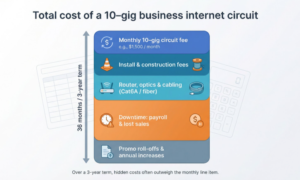
Installation usually leads the hidden-cost list. If your suite sits twenty feet from the carrier splice, drop fees hover around a few hundred dollars. Move three blocks away and a special-construction charge can climb into five figures. Providers waive that bill only when you lock in multi-year revenue for them, so contract length and build cost rise together.
Hardware is next. A ten-gig circuit needs a router or firewall that pushes packets at line rate while inspecting traffic. Many popular SMB boxes top out near 2 Gbps. Enterprise-class gear starts around $4,000 in 2026, plus optics, support licenses, and cabling upgrades to Cat6A or in-building fiber.
Downtime carries a price, too. A single hour offline can burn more payroll and lost sales than the monthly circuit fee. That reality makes a strict SLA, and often a secondary link, part of TCO rather than an optional extra.
Finally, track the calendar. Promotional cable rates tend to rise after year one, and some telcos embed annual increases in the fine print. Build a simple cash-flow model over 36 months, include hardware, install fees, and escalation clauses, and the lowest headline rate may lose its appeal.
Implementation checklist: upgrading to 10 gig without the headaches
A 10-gig circuit touches almost every corner of your tech stack, so a little planning now prevents weekend fire drills later.
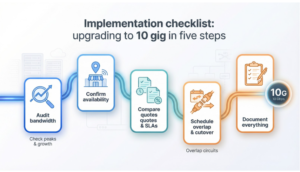
Start with a bandwidth audit. Pull firewall logs, review 95th-percentile peaks, and project growth for at least two years. If you already hit 70 percent of current capacity, it is time to move.
Next, confirm availability. Enter each address into provider lookup tools or the state broadband map, then request a formal site survey. The walk-through identifies conduit paths, power needs, and any hidden construction fees before you sign.
When quotes arrive, line them up in a simple spreadsheet: install cost, contract term, SLA targets, and whether the price escalates after year one. Circle anything missing, such as static IP blocks, LTE failover, or a managed router, then ask sales reps to fill the gaps or sharpen their numbers.
After you sign, schedule overlap. Keep the old line active until the new fiber passes acceptance tests at full load. That cushion lets you troubleshoot routing, VPN tunnels, and cloud whitelists without users noticing the cutover.
Finally, document everything. Store the LOA-CFA, circuit ID, escalation ladder, and a copy of the SLA where the IT team can find them. Set calendar reminders for contract renewal and firmware updates on the 10-gig firewall.
Follow the sequence of audit, verify, compare, overlap, and document, and the upgrade will feel like a routine maintenance window rather than a plunge into the unknown.
FAQs: straight answers to common 10-gig questions
Do we really need 10 Gbps, or is a robust 1-gig line enough?
A single gigabit handles dozens of Zoom calls and terabytes of nightly backups, but growth arrives quickly. If your peak traffic already reaches 70 percent of capacity, or new projects involve 4K video, VR training, or real-time data replicas, moving to 10 Gbps now avoids a second upgrade later. Bandwidth usage has been rising about 30 percent per year, so today’s headroom becomes tomorrow’s ceiling.
What’s the difference between dedicated internet access and “business broadband”?
Dedicated access is a private lane. Your circuit is carved in glass straight to the provider core, so you always receive the speed you purchase, up and down, with a written uptime guarantee. Business broadband rides shared coax or PON segments; speeds can sag at 5 pm, and SLAs are lighter. If revenue depends on predictable performance, DIA is the safer choice even at a higher monthly fee.
How do we stay online during hurricanes?
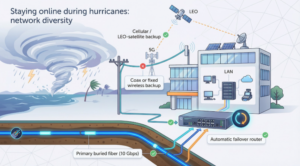
No single link is hurricane-proof. The best defense is diversity: bury your primary fiber if possible, add a coax or wireless backup on a separate path, and keep a cellular or LEO-satellite modem on hand. Pair those links with an automatic failover router and test it before storm season. The extra $50 per month beats hours of credit-card terminals stuck in offline mode.
Can we bond multiple low-cost circuits instead of paying for one large pipe?
Yes. SD-WAN appliances can blend two or three smaller links and steer traffic around trouble. This approach can reach 2 – 3 Gbps while adding redundancy. Remember a single file transfer cannot exceed the speed of one lane, and you still forgo the strict SLA of a dedicated fiber circuit.
Will 5 G or Starlink replace fiber anytime soon?
Both are excellent backups. 5 G fixed wireless already delivers about 300 Mbps in some Florida metros, and Starlink provides roughly 150 Mbps wherever the sky is clear. Physics still matters: wireless spectrum is shared, and latency hovers two to four times higher than fiber. For consistent multi-gig speeds, glass remains the leader for the foreseeable future.
Glossary: decoding the fiber jargon
- Dedicated internet access is a private, non-shared circuit that guarantees the speed you purchase.
- Symmetrical speeds mean uploads move just as fast as downloads, a requirement for cloud backups and real-time collaboration.
- Service level agreement (SLA) is the contract clause that spells out uptime, latency, and the credits you receive if the provider falls short.
- Uptime reflects the percentage of minutes your link must stay live. Ninety-nine point nine percent allows about 43 minutes of yearly outage, while 99.99 percent trims that to fewer than five.
- Latency measures how long a round-trip packet takes, in milliseconds. Lower values produce snappier apps and clearer calls.
- Packet loss is the percentage of data that vanishes en route; a quality circuit keeps this under 0.1 percent.
- Bursting lets a connection exceed its committed rate for short spurts, useful for sudden traffic spikes without paying for a permanent upgrade.
- Ring topology describes a fiber layout with two paths in opposite directions, so traffic automatically detours around a cut.
- Dark fiber is an unused strand you lease and light with your own gear, giving enormous upgrade headroom but requiring technical expertise.
- SD-WAN is software that bonds multiple links and steers traffic dynamically, adding resilience and often lowering costs.
Conclusion
Florida businesses can sidestep weather outages and future-proof their networks by choosing the right dedicated 10-gig fiber option for each location. Use the comparisons, TCO insights, and implementation checklist above to make an informed, storm-ready upgrade.



Leave a Reply