





There was an incident back in early 2023, where the entire area near Taiwan lost internet access for a number of weeks.
At first, it wasn’t clear what had happened or how. But it was soon determined that a couple of fishing vessels unintentionally severed underwater internet cables, resulting in 14,000 people living ‘in the dark’ for a good while.
No one really thinks about this, but it’s events like this one that serve as a reminder that the digital world, in reality, is analog.
The web is not a web in the sky but one on the ground, or more precisely, a web that lies on the ocean floor. More than 95 percent of global data: financial transactions, government communications, video calls, military coordination, and so forth all travel through fiber-optic cables that stretch across sea beds. These cables are the hidden infrastructure of globalization.
And these structures are instrumental in geopolitics.
The World Under The Water
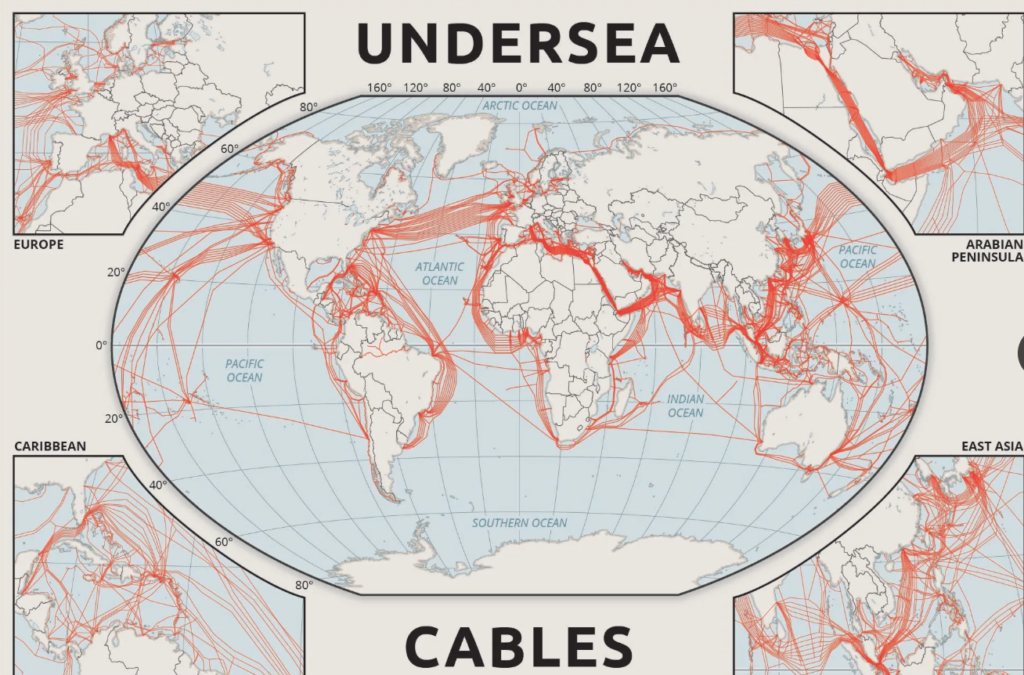
Currently, there are 400+ active internet cables in the world reaching a net length of approx. 800,000 miles (~1.3 million km).
It’s thanks to these cables that people can send/receive data at near-instant speeds. So when you think about a London-based trader doing trades with the NY Stock Exchange based on data received from Singapore, and waiting on the green light from their HQ in California, it’s pretty much these cables that make all this possible.
No cables = no worldwide internet.
The Red Sea and the South China Sea are the densest chokepoints containing these undersea internet cables, which in turn, make these locations the most strategically important when it comes to how well the internet runs.
Basically, even one single disruption (regardless of how small) would quickly become a massive headache – much more than just an inconvenience – disrupting the entire global market (among other things).
And even though it’s very obvious how important this infrastructure is, the way it’s being kept safe is still very lacking (to say the least). Most cables are privately owned. Repair options are limited, and the governmental laws governing them are lax.
They are vulnerable, not only against accidents like the shipping accident mentioned in Taiwan, but also against other factors.
Accidents and Vulnerabilities
Historically, cable damage was due to a mundane accident (e.g., fishing nets, anchors, underwater landslides – things like that). Today, there’s also sabotage.
And in today’s world, where cyber warfare is one of the main ways wars are being fought, it’s more and more clear that this type of infrastructure is more and more valuable.
Even when the cause of a damaged internet cable is unclear, it leads people to speculate, and it raises the question: “What if?”
There’s a clear issue if something so important could be so easily targeted and sabotaged. And there can be a lot of explanations for a cable cut. A lot of plausible deniability. At best, it is speculation.
This ambiguity makes them a grey zone. A vulnerable grey zone.
Big Business Under the Sea and the Conflict of Interest
A decade ago, subsea cables were largely financed by telecoms. Not anymore.
It’s companies like Google and Meta Platforms that now fund or co-own vast stretches of global cable infrastructure. And owning them provides a lot of benefits (e.g., reduced latency, increased reliability, independence from any third party that might hinder them, etc.).
And there’s also influence – after all, they own all that ‘power’ over the world.
And the issue here is, for example, what happens when global security (or any other issue) collides with what shareholders consider valuable?
What happens then? Will shareholders prioritize self-interest, or will they do the ‘right’ thing, whatever that might be?
Weather Forecasts and Cables are More Connected Than Most People Realize
Submarine cables run across the ocean floors. Extreme weather events can damage them indirectly:
- Hurricanes and cyclones stir up underwater sediment.
- Storm-driven anchors from ships can drag across the seabeds.
- Underwater landslides/seismic activity can easily damage (or even snap) the cables.
- Storm surges can damage landing stations on coastlines.
Why is the Weather Forecast Important and How Does It Affect Business?
Talking about the weather was always considered chit-chat.
But the weather is much more important than a simple topic for a pastime. Companies have long discovered that weather is not just an external condition; it is a business variable. One that needs to be measured and predicted as best as possible.
With the rise of real-time data integration into pretty much any type of software, it’s the weather API endpoints that are directing how we forecast demand, manage risk, and optimize operations. An accurate forecast gives insight into a business variable that is essential for efficient decisions.
A decision that has a huge impact.
Conclusion
The world of the internet may seem/feel like it’s something that you can’t touch. But in reality, it’s entirely dependent on physical infrastructure. And one of those is undersea internet cables. And if you’re here to make sure the internet connection stays open at all times, then this is the first step to tackling this issue.
Sure, you might say that a bit of internet downtime would do the world much good because it would steer us away from all the social media brain rot and infinite doom scrolling. And yes, there IS some truth to that.
But what would also be affected are systems that keep our world running (e.g., the global economy, military, information access, communication, etc.) – and we don’t want that happening any time soon.



Leave a Reply