






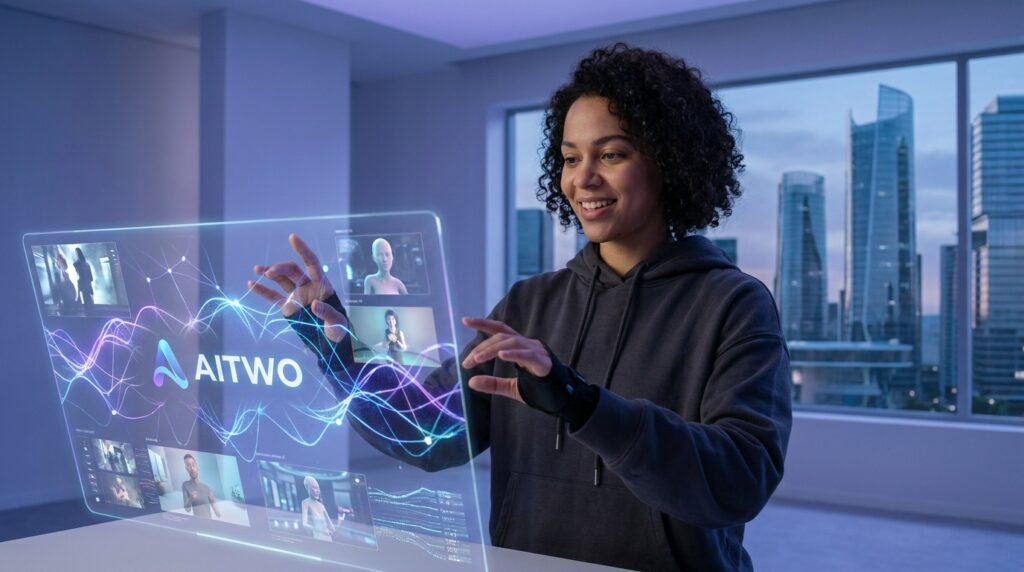
The shift to video-first content isn’t a trend anymore—it’s just how the internet works now. Every platform algorithm favors video. Every engagement metric confirms video outperforms static content. Every successful brand uses video extensively.
The barrier? Actually making that video. For most people and organizations, the gap between understanding that video works and being able to produce it consistently has been insurmountable.
That’s changing dramatically, and if you’re not paying attention, you’re missing something significant.
What’s Actually Happening Here
Let me explain this in the clearest possible terms, without any technical complexity.
AI video generation creates original moving footage from text descriptions. You write something like “a mechanic inspecting an engine in a busy auto shop, fluorescent lights overhead, tools spread across workbench, oil stains on concrete floor”—and the system generates that exact scene as usable video footage.
The technology works by learning from enormous collections of existing video. These systems have studied how mechanics work with engines, how fluorescent lighting affects workshop environments, how tools are naturally arranged, how oil stains appear on concrete. They’ve absorbed these visual patterns so deeply they can generate new scenes that follow the same realistic principles.
This isn’t assembling clips from libraries or applying effects to templates. It’s creating genuinely original content based on learned understanding of how visual reality operates.
Perfect every time? No. Good enough for practical applications right now? Absolutely.
The Real Value Beyond Cost Savings
Everyone fixates on cost reduction—yes, generating video costs dramatically less than traditional production. That’s true and meaningful. But the deeper strategic benefits actually matter more in the long run.
- Experimentation becomes risk-free. When testing ideas costs minutes instead of thousands of dollars, you test exponentially more options. That expanded testing leads to finding superior solutions because you’re willing to try approaches you’d never risk with expensive production.
- Communication becomes unambiguous. Showing people actual video removes interpretation problems that plague descriptions and proposals. Everyone sees identical content rather than imagining their own version. Decisions happen faster when communication is inherently visual.
- Changes become effortless. Traditional production makes revisions painful—scheduling, coordinating, re-editing. AI generation makes changes simple—adjust descriptions, regenerate, done. What used to block progress now enables rapid improvement.
- Volume becomes manageable. Current strategies demand constant content across platforms with different requirements. AI generation makes producing that volume realistic without destroying team morale or depleting budgets.
- Reality becomes flexible. Need conditions you can’t access? Specific locations, perfect weather, ideal lighting, scenarios that don’t exist? Generate exactly what serves your purpose regardless of practical constraints.
Different Methods for Different Situations
“AI video generation” covers multiple distinct approaches, each useful for different creative challenges.
- Text-based generation creates everything from descriptions alone. No source materials needed—just instructions. This excels when visualizing things that don’t exist yet, creating impossible scenarios, or testing concepts before resource commitment.
- Image animation brings photographs to life. Give it still images—products, places, architecture, people—and it adds motion. Cameras move, subjects animate, environments develop movement and energy.
- Video transformation reimagines existing footage through different styles. Take standard video and apply dramatic aesthetic changes—artistic rendering, period looks, emotional atmospheres, branded treatments. Motion persists while appearance transforms.
- Camera direction provides precise cinematography control. Specify exact movements—zooms, pans, orbits, tracking—and the AI executes them professionally. You’re directing virtual camera operators.
Knowing which method fits your situation saves massive amounts of wasted effort.
Who’s Really Using This
Everyone assumed this was exclusively for tech startups and ad agencies. The actual user base tells a much richer story.
- Community land trusts promoting affordable housing models. Development project visualizations, resident testimonials, governance explanations, application processes—advancing housing justice through accessible communication.
- Refugee resettlement organizations creating orientation and support materials. Cultural adjustment guidance, service navigation, legal process explanations, community connection resources—serving newcomers through compassionate visual communication.
- Independent bookstores promoting authors and events. Reading demonstrations, author interviews, store atmosphere showcases, community program highlights—building literary communities through engaging content.
- Bike advocacy organizations promoting cycling infrastructure and safety. Route demonstrations, safety technique examples, infrastructure benefits visualization, community ride promotions—advancing cycling through effective advocacy.
- Homeschool cooperatives developing educational resources. Lesson demonstrations, curriculum showcases, socialization opportunities, parent support resources—serving homeschool families through collaborative content.
- Repair cafes and right-to-repair movements demonstrating fixing skills. Repair technique demonstrations, tool usage examples, success story sharing, community building—advancing repair culture through practical instruction.
The common thread? Groups doing important work without major production budgets.
Understanding Model Options
Different AI models produce distinctly different results from the same prompt. These differences significantly affect your outcomes.
- Fast-processing models sacrifice some polish for speed. Great for rapid testing, high-volume content, quick concepts—when time matters more than perfection.
- Premium-quality models take longer but deliver superior visuals. Use these for important work, public campaigns, critical presentations—where quality directly affects perception.
- Artistic models prioritize distinctive style over photorealism. Perfect when you want memorable branding, creative differentiation, or expressive interpretation.
- Balanced models offer middle-ground versatility for general use. Solid defaults for everyday content needs.
Having multiple models means choosing the right tool for each specific job.
Boosting Results Through Image Enhancement
Sophisticated users combine video generation with Photo enhancement for substantially better outcomes.
- Enhance inputs first. Before animating photos or using references, enhance them. Sharper details, better colors, higher resolution—superior inputs produce superior outputs.
- Extract and enhance frames. Pull key moments from generated videos and enhance them individually for thumbnails, posts, promotional use. Even if video has minor quirks, stills look excellent.
- Smart upscaling. Generate at normal resolution for speed, then upscale selectively when higher resolution becomes necessary. This balances efficiency with quality requirements.
- Platform-specific versions. Create optimized variations for different platforms through targeted enhancement—punchy for Instagram, professional for LinkedIn, dramatic for TikTok.
- Selective fixing. Sometimes generated video is nearly perfect except small frame-specific issues. Enhancing just those frames saves regeneration time.
Using both technologies together produces results neither achieves alone.
Real Applications Creating Real Value
Forget hypotheticals. Here’s where this technology delivers measurable value now.
- Workplace injury prevention training reducing accidents. Hazard identification, proper technique demonstration, equipment usage, emergency response—improving safety through effective visual instruction.
- Tenant rights education empowering renters. Rights explanations, documentation guidance, negotiation strategies, resource navigation—advancing housing justice through accessible information.
- Circular economy showcases promoting reuse and recycling. Process demonstrations, business model explanations, environmental impact visualization, participation encouragement—advancing sustainability through compelling communication.
- Peer support program promotion building mental health resources. Program structure explanations, participant testimonials, facilitator training, community building—expanding support networks through authentic representation.
- Indigenous language revitalization preserving cultural heritage. Language instruction, cultural context, elder interviews, youth engagement—advancing language preservation through multimedia resources.
- Maker space demonstrations promoting creative community resources. Equipment usage tutorials, project showcases, safety training, membership promotion—building maker communities through practical demonstration.
These aren’t someday possibilities—they’re happening now with real impact.
What Makes Platforms Worth Using
Not all AI video tools deliver equivalent value. These factors distinguish good options from poor ones.
- Reliability matters. Can you depend on consistent quality and availability, or is every use unpredictable? Reliability enables planning and professional use.
- Control matters. Can you adjust specific parameters to refine results, or are you stuck with basic presets?
- Understanding matters. Do you learn what works and improve systematically, or is success basically random?
- Pricing matters. Are costs clear and fair? Do mistakes cost you? Can you budget accurately?
- Formats matter. Can you export in needed formats, resolutions, and aspect ratios for your actual use cases?
- Progress matters. Is the platform actively improving, or has development stalled?
Being Realistic About Limitations
Let’s talk honestly about what doesn’t work well yet.
- Text rendering fails. Generated text looks garbled and unreadable. Add text in post-production, don’t depend on generation.
- Exact branding is hard. Generic representations work, but perfect logos or precise colors usually need adjustment.
- Long sequences are tough. Individual scenes work great, but maintaining consistency across multiple connected scenes remains challenging.
- Extreme close-ups can be rough. Wide and medium shots work reliably, but extreme close-ups sometimes show imperfections.
- Complex interactions look awkward. Simple scenarios work well, but complicated multi-person choreography often appears unnatural.
Knowing these limits helps you choose appropriate applications.
Prompting Techniques That Work
Better prompts produce better results. Here’s what actually helps.
- Lead with priorities. Start with what matters most. The AI emphasizes early information more heavily.
- Find the sweet spot. Too vague gets generic results. Too detailed creates confusion. Balance guidance with flexibility.
- Describe atmosphere. Include mood, energy, feeling—not just physical elements.
- Use standard terms. Cinematography vocabulary works because the AI learned professional language.
- Iterate deliberately. Generate, analyze, adjust, regenerate. Learn and improve progressively.
- Keep a library. Save prompts that work well for future reference and pattern recognition.
Where This Is Clearly Going
Can’t predict exact timing, but the direction is obvious.
- Longer videos. Current limits will extend from seconds to minutes to longer.
- Higher resolution. 4K is coming standard. 8K after that.
- Better realism. Complex elements like water, fire, fabric will render more convincingly.
- More control. Increasingly precise parameter adjustment and predictable results.
- Faster processing. What takes minutes will soon take seconds.
- Lower costs. What costs money now will become progressively cheaper.
How to Actually Start
Want to try this but unsure where to begin?
- Pick one thing. Don’t transform everything at once. Focus on one specific use case.
- Study examples. Look at what others have created to understand capabilities and quality levels.
- Start simple. Begin with straightforward concepts to learn how the system works.
- Plan to iterate. First attempts won’t be perfect. That’s normal. Learn and improve.
- Mix approaches. Combine AI-generated content with other assets for better results.
- Track results. Measure performance and let data guide your decisions.
Why This Fundamentally Matters
Strip away all hype and here’s what’s real: video works better than other content types, but making video has been too difficult for most people.
AI video generation makes it dramatically easier and more affordable. Not perfect, not free, but accessible enough that far more people can now produce professional-quality video.
For small businesses, educators, nonprofits, professionals, activists—video amplifies effectiveness measurably.
Being able to create that video yourself, quickly and affordably, fundamentally changes what’s possible.
The technology keeps improving. What seems impressive now will look basic soon. But waiting for perfection means missing current opportunities. Today’s tools already solve real problems.
Whether you’re skeptical or excited—this technology deserves your attention. Not because it’s fashionable, but because it genuinely expands possibilities and removes barriers that have frustrated people for years.
That kind of practical utility matters beyond trends and headlines. AI video generation delivers value now, with continuous improvement coming.
That’s a shift worth understanding, exploring, and potentially integrating into how you work. The barriers to professional video content are coming down. What you do with that expanded access—that’s the interesting question worth exploring.









Leave a Reply