






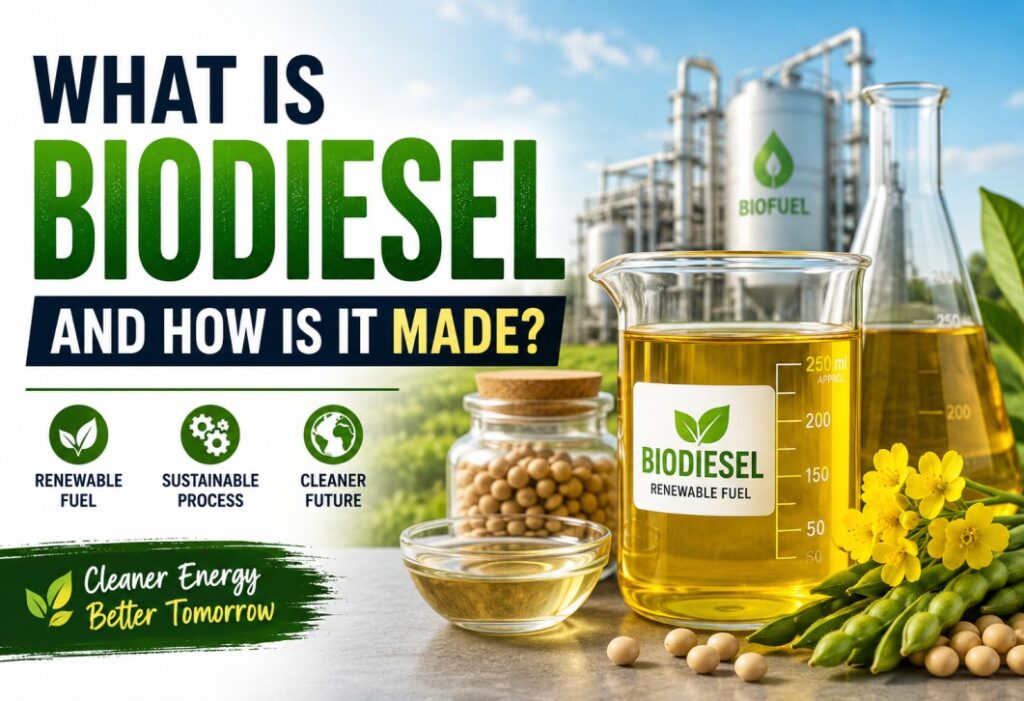
Biodiesel is a renewable fuel made from biological oils and fats rather than crude oil. It can be used in diesel engines either as a blend with conventional diesel or, where the vehicle and fuel specification allow it, in higher concentrations.
For decades, diesel has been an important fuel for transport, agriculture, construction, heating and industrial equipment across the UK. As businesses and vehicle operators look for ways to reduce their dependence on fossil fuels, biodiesel has become an increasingly discussed alternative.
But what exactly is biodiesel? How is biodiesel made from vegetable oils or waste fats? Is it the same as HVO? And can UK farms, businesses and vehicle operators simply switch from ordinary diesel to biodiesel?
The answer is more nuanced than simply calling biodiesel “green diesel”.
This guide explains how biodiesel is produced, how it works, where it can be used, its advantages and limitations, and what UK buyers should understand before choosing a renewable diesel fuel.
What Is Biodiesel?
Biodiesel is a renewable diesel-type fuel produced from biological feedstocks such as vegetable oils, used cooking oil and animal fats.
Unlike conventional diesel, which is refined from crude oil, biodiesel is produced by processing renewable oils or fats into a fuel suitable for compression-ignition diesel engines.
Most conventional biodiesel is a type of FAME, meaning Fatty Acid Methyl Ester. The chemical properties of FAME biodiesel are different from those of petroleum diesel, although it can be blended with conventional diesel for use in suitable diesel engines.
Common biodiesel feedstocks include:
- Rapeseed oil
- Soybean oil
- Sunflower oil
- Used cooking oil
- Animal fats
- Other waste oils and fats
The choice of feedstock can have a significant effect on the environmental benefits and overall sustainability of the finished fuel.
This is particularly important in the UK, where the sustainability of a renewable fuel depends not only on whether it comes from a biological source, but also on where the raw material comes from and how the fuel is produced.
How Is Biodiesel Made?
Biodiesel is generally produced through a chemical process called transesterification.
The process sounds complicated, but the basic principle is relatively straightforward: oils or fats are chemically converted into a fuel with properties that make them more suitable for diesel engines.
A simplified biodiesel production process looks like this:
Feedstock → Pretreatment → Transesterification → Separation → Purification → Quality Testing → Biodiesel
Let’s look at each stage.
1. Biodiesel Feedstock Is Selected
The first stage is choosing the raw material.
Biodiesel can be produced from virgin vegetable oils, waste cooking oils, animal fats and other suitable biological feedstocks.
For commercial production, the feedstock needs to be assessed for factors such as moisture, impurities, free fatty acids and overall composition.
Waste oils can be particularly interesting because they make use of a material that would otherwise require disposal or further processing.
2. Biodiesel Feedstock Is Pretreated
Raw oils and fats are not necessarily ready to go directly into the biodiesel production process.
They may contain water, food particles, contaminants or other substances that can interfere with production.
The feedstock may therefore be filtered, dried or otherwise treated before the main chemical reaction takes place.
Good preparation is important because the quality of the starting material can influence the quality and consistency of the finished biodiesel.
3. Transesterification Produces Biodiesel
This is the key stage of biodiesel production.
The oil or fat is reacted with an alcohol, commonly methanol, in the presence of a catalyst.
The reaction breaks the oil’s triglycerides into smaller molecules called fatty acid methyl esters, or FAME.
Glycerol is also produced as a by-product.
In simplified terms:
Vegetable oil or animal fat + alcohol → Biodiesel + glycerol
The actual industrial process involves careful control of conditions and subsequent purification, but this chemical reaction is at the heart of conventional FAME biodiesel production.
4. Biodiesel and Glycerol Are Separated
After the reaction, the resulting mixture contains biodiesel along with glycerol and other residual substances.
Because the components have different physical properties, they can be separated.
The biodiesel then undergoes further processing to remove unwanted contaminants and remaining reaction materials.
5. Biodiesel Is Purified
Purification is essential.
Poorly processed biodiesel can contain residual alcohol, catalyst, water, glycerol or other impurities. These contaminants can affect fuel quality and potentially cause problems in storage or engine operation.
Commercial biodiesel therefore needs to undergo appropriate purification and quality control before it is supplied as fuel.
6. Biodiesel Is Tested Before Distribution
Fuel quality matters just as much for biodiesel as it does for conventional diesel.
Commercial biodiesel is produced to recognised fuel specifications, with properties such as oxidation stability, viscosity, water content and other characteristics assessed to ensure that the fuel is suitable for its intended application.
For UK users, purchasing fuel from an established supplier is therefore much more sensible than assuming that every product described as “biodiesel” has identical characteristics.
What Is Biodiesel Made From?
Biodiesel can be made from a surprisingly broad range of biological oils and fats.
The most common feedstocks include:
Vegetable Oil Biodiesel
Vegetable oils such as rapeseed, soybean and sunflower oil can be converted into biodiesel.
Rapeseed is particularly relevant in Europe because it is widely cultivated and has traditionally been used as a biodiesel feedstock.
Used Cooking Oil Biodiesel
Used cooking oil can be collected from restaurants, food businesses and other commercial sources and processed into renewable fuel.
This approach has an important advantage: it gives a waste material another useful purpose.
However, collecting, filtering and processing waste cooking oil requires appropriate infrastructure and quality control.
Animal Fat Biodiesel
Certain animal fats can also be converted into biodiesel.
The use of animal-derived feedstocks can help diversify raw material sources, although sustainability, traceability and regulatory requirements need to be considered.
Is Biodiesel the Same as HVO?
No. Biodiesel and HVO are different renewable diesel fuels, even though both can be produced from biological feedstocks.
This distinction is particularly important for UK businesses considering a move away from conventional diesel.
Biodiesel is generally produced through transesterification and consists primarily of FAME.
HVO, or Hydrotreated Vegetable Oil, is produced using a different refining process involving hydrogen treatment. The resulting fuel is chemically much closer to conventional diesel.
The two fuels can therefore behave differently in areas such as storage, cold-weather performance, fuel compatibility and engine applications.
A simple comparison is:
| Biodiesel | HVO |
|---|---|
| Usually FAME | Hydrotreated renewable fuel |
| Produced through transesterification | Produced through hydrotreatment |
| Often made from vegetable oils, waste oils or fats | Can also use waste oils, fats and other renewable feedstocks |
| Different chemical structure from mineral diesel | Chemically similar to conventional diesel |
| Usually subject to specific blend and fuel specifications | Often designed as a diesel replacement where approved |
| Can have different storage characteristics | Generally has strong storage characteristics when handled correctly |
Calling both products “biofuel” can be convenient, but it can also create confusion.
Biodiesel is not simply another name for HVO.
Biodiesel vs Diesel: What Is the Difference?
The biggest difference between biodiesel and conventional diesel is their origin and chemical composition.
Traditional diesel is produced from crude oil. Biodiesel is produced from renewable biological oils and fats.
However, the differences go beyond where the fuel comes from.
Biodiesel can have different characteristics relating to:
- Energy content
- Oxidation stability
- Cold-weather performance
- Storage life
- Solvent properties
- Fuel-system compatibility
- Emissions
- Material compatibility
For this reason, diesel users should always check the manufacturer’s requirements and the specification of the fuel before switching.
The fact that a fuel is renewable does not automatically mean that it is suitable for every diesel engine in every concentration.
What Are the Benefits of Biodiesel?
Biodiesel has several potential advantages, particularly when the fuel is produced from appropriate sustainable feedstocks.
Biodiesel Comes From Renewable Resources
The most obvious advantage is that biodiesel can be produced from renewable biological materials rather than relying entirely on fossil crude oil.
Crops, waste oils and fats can provide feedstocks for production.
However, the environmental performance depends heavily on the feedstock and supply chain.
Biodiesel Can Make Use of Waste Oils
Waste-based biodiesel is particularly interesting because it can turn an unwanted material into something useful.
Used cooking oil, for example, can be collected and processed rather than simply being treated as waste.
This can contribute to a more circular approach to fuel production.
Biodiesel Can Be Used in Diesel Fuel Blends
Biodiesel can be blended with conventional diesel, subject to the relevant fuel specification and engine requirements.
This means renewable content can be introduced without necessarily replacing conventional diesel completely.
Biodiesel Supports Renewable Fuel Development
The production and use of biodiesel contribute to a wider renewable fuel industry.
For farms, transport operators, fuel suppliers and other businesses, biodiesel is one of several options available when considering lower-carbon fuel strategies.
Biodiesel Can Reduce Dependence on Fossil Fuel
Using renewable fuel sources can help reduce reliance on petroleum-derived diesel.
That does not mean biodiesel has zero environmental impact. Growing crops, collecting waste oils, processing feedstocks and transporting fuel all require energy and resources.
The important question is therefore not simply whether a fuel is “bio”, but how sustainable its complete supply chain is.
What Are the Disadvantages of Biodiesel?
Biodiesel is not a perfect replacement for every diesel application.
Understanding its limitations is just as important as understanding its benefits.
Biodiesel Can Have Storage Considerations
FAME biodiesel can be more sensitive to oxidation and storage conditions than conventional diesel.
Water contamination, temperature, contamination and prolonged storage can all affect fuel quality.
Businesses that hold fuel in tanks for extended periods need a sensible fuel-management strategy.
Cold Weather Can Affect Biodiesel
Cold-weather performance can be an important consideration in the UK.
Certain biodiesel blends and feedstocks can behave differently at lower temperatures, potentially affecting fuel flow and filter performance.
This is one reason why fuel specifications and seasonal grades matter.
Biodiesel Is Not Suitable for Every Engine at Every Blend
Engine compatibility should never be assumed.
Many modern diesel vehicles are designed to operate with approved biodiesel blends, but higher biodiesel concentrations may have different requirements.
Always follow the vehicle, machinery or equipment manufacturer’s guidance.
Biodiesel Quality Matters
Not all biodiesel should be treated as identical.
Poor-quality or contaminated fuel can cause problems with injectors, filters, storage tanks and fuel systems.
Buying from a reputable fuel supplier and ensuring the product meets the appropriate specification is essential.
Is Biodiesel Suitable for UK Farms?
Biodiesel can be relevant to the agricultural sector because farms use substantial quantities of diesel for tractors, harvesters, generators, telehandlers and other machinery.
However, farmers should not choose a renewable fuel based solely on the word “biodiesel”.
Before switching, consider:
- What fuel does the machinery manufacturer approve?
- What biodiesel blend is being supplied?
- Does the fuel meet the required specification?
- How long will the fuel remain in storage?
- What are the expected winter temperatures?
- How frequently is the machinery used?
- Does the farm have suitable fuel storage?
- Is the fuel compatible with existing filters and equipment?
- What documentation and sustainability information does the supplier provide?
For a busy farm, fuel reliability can be just as important as the renewable credentials of the product.
A fuel that looks attractive on paper but is poorly matched to the machinery or storage system can create unnecessary operational problems.
Can Biodiesel Be Used in Diesel Cars?
Some diesel vehicles are designed to operate with approved biodiesel blends.
However, compatibility depends on the vehicle, fuel specification and concentration of biodiesel.
Drivers should check the vehicle manufacturer’s handbook or technical guidance rather than assuming that any biodiesel product can be used at any concentration.
This is especially important with older diesel vehicles, where fuel-system materials and manufacturer specifications may differ from modern vehicles.
Is Biodiesel Good for Generators?
Biodiesel can be used in some diesel generators, provided the generator manufacturer permits the fuel and the fuel meets the required specification.
For standby generators, storage is particularly important.
A generator may sit unused for weeks or months before it is required. Fuel stored for long periods therefore needs to be managed carefully.
Businesses relying on emergency generators should consider:
- Fuel age
- Water contamination
- Tank cleanliness
- Fuel quality
- Filtration
- Storage conditions
- Manufacturer requirements
- Regular generator testing
For critical power systems, fuel suitability should always be confirmed before making a change.
Is Biodiesel Better for the Environment?
Biodiesel can have environmental advantages compared with fossil diesel, but the answer depends on how the biodiesel is produced.
A waste-based biodiesel made from a suitable recovered feedstock can have a very different overall environmental profile from biodiesel produced from crops that require significant land, fertilizer, energy and transport.
The carbon impact of biodiesel should therefore be considered across its lifecycle.
This includes:
- Feedstock production or collection
- Processing
- Transport
- Fuel production
- Distribution
- Fuel consumption
This lifecycle approach provides a more realistic picture than simply labelling biodiesel as “carbon neutral”.
What Is the Difference Between Biodiesel, Biofuel and Renewable Diesel?
These terms are often used interchangeably in everyday conversation, but they do not necessarily mean the same thing.
- Biofuel is a broad term covering fuels made from biological materials.
- Biodiesel usually refers to FAME-based diesel fuel produced from oils or fats.
- Renewable diesel is a broader category that can include fuels such as HVO, which are produced through different processing methods and have different chemical properties.
For anyone buying fuel commercially, understanding the specific product rather than relying on general terms such as “biofuel” is important.
How Is Biodiesel Used in the UK?
Biodiesel can have applications across several sectors, including:
- Road transport
- Agriculture
- Construction
- Industrial equipment
- Backup generators
- Commercial fleets
- Certain heating and energy applications
The exact application depends on the fuel specification, equipment approval and applicable regulations.
For commercial fuel users, the right question is not simply “Can I use biodiesel?”
A better question is:
“Which renewable diesel fuel and blend is approved for my equipment, and how should I store and manage it?”
That approach can prevent many avoidable fuel problems.
How Should Biodiesel Be Stored?
Biodiesel should be stored in a clean, suitable fuel tank and protected from contamination.
Good storage practice includes:
- Keep the tank clean and in good condition.
- Minimise water contamination.
- Inspect tanks regularly.
- Monitor fuel age.
- Avoid unnecessary long-term storage.
- Keep dispensing equipment clean.
- Check filters for contamination.
- Follow the fuel supplier’s storage guidance.
- Rotate fuel where appropriate.
For farms and businesses with bulk fuel tanks, regular tank inspections can be particularly valuable.
Water and sediment are problems for diesel fuel generally, and good tank management becomes even more important when storing fuels with different chemical characteristics.
Is Biodiesel Suitable for Winter in the UK?
Winter performance needs careful consideration.
Biodiesel can have different cold-flow properties from conventional diesel, and its behaviour can vary according to the feedstock and blend.
For UK users, especially those operating agricultural or construction equipment outdoors during winter, fuel selection should take expected temperatures and the manufacturer’s requirements into account.
A supplier should be able to explain the fuel specification and its intended seasonal application.
Does Biodiesel Damage Engines?
Properly specified biodiesel used at an approved blend should not automatically be assumed to damage a diesel engine.
Problems are more likely when unsuitable fuel, incorrect concentrations, contaminated fuel or poor-quality products are used.
Older engines may also have different compatibility requirements from modern equipment.
Before changing fuel, check the manufacturer’s recommendations and make sure the fuel meets the appropriate specification.
Is Biodiesel the Same as Red Diesel?
No.
Biodiesel describes the composition and production route of a renewable fuel, while red diesel refers primarily to a rebated diesel fuel identified by its taxation and marking arrangements in permitted applications.
A renewable fuel and a rebated fuel are therefore not interchangeable concepts.
UK businesses and farmers should always check the current rules governing which fuel can legally be used in their particular machinery or operation.
Is Biodiesel the Future of Diesel Fuel?
Biodiesel is likely to remain part of the UK’s wider renewable fuel mix, but it is unlikely to be the only solution.
Different applications have different requirements.
For some users, biodiesel blends may provide a practical way of introducing renewable fuel.
For others, HVO may be more suitable where the equipment manufacturer approves it.
Electric vehicles, battery equipment, hydrogen and other technologies may also become increasingly relevant in sectors where electrification is technically and commercially practical.
The future of diesel isn’t necessarily about finding one fuel that replaces everything. It is more likely to involve choosing the right energy source for each application.
How to Choose the Right Biodiesel Supplier in the UK
If you are considering biodiesel for a farm, fleet, generator or commercial operation, supplier selection deserves as much attention as the fuel itself.
A reliable supplier should be able to explain:
- Exactly what fuel they are supplying
- The fuel specification
- Available blend options
- Feedstock information where relevant
- Storage considerations
- Delivery options
- Seasonal considerations
- Equipment compatibility
- Sustainability credentials
- Documentation and quality information
Price is naturally important, particularly for businesses purchasing fuel in bulk.
But the cheapest fuel is not necessarily the cheapest solution if it results in poor storage performance, equipment problems or unexpected downtime.
A dependable supply and a fuel that matches the equipment can often be more valuable than a small saving on the initial purchase price.
Biodiesel FAQs
What is biodiesel made from?
Biodiesel is generally made from oils and fats such as vegetable oils, used cooking oil and certain animal fats. These feedstocks are processed chemically, usually through transesterification, to create FAME biodiesel.
Is biodiesel renewable?
Yes. Biodiesel is made from renewable biological feedstocks rather than crude oil. However, its overall environmental performance depends on the source of the feedstock, production methods, transport and wider supply chain.
Is biodiesel better than diesel?
Biodiesel can offer environmental advantages over fossil diesel, particularly when produced from suitable waste-based feedstocks. However, suitability depends on the application, fuel specification, engine requirements and storage conditions.
Is biodiesel the same as HVO?
No. Biodiesel is generally FAME produced through transesterification, while HVO is produced through hydrotreatment. Their chemical properties and applications can therefore differ.
Can biodiesel be mixed with diesel?
Biodiesel can be blended with conventional diesel at approved concentrations, provided the resulting fuel meets the relevant specification and is suitable for the equipment.
Can I use biodiesel in my tractor?
It depends on the tractor and the biodiesel blend. Check the tractor manufacturer’s fuel requirements before switching, particularly if you are considering a higher biodiesel concentration.
Can biodiesel be used in generators?
Some diesel generators can use approved biodiesel blends. However, the generator manufacturer’s requirements should be checked first, with particular attention paid to long-term fuel storage.
Does biodiesel expire?
Biodiesel can degrade over time, particularly when exposed to unsuitable storage conditions. Oxidation, water contamination, heat and microbial contamination can all affect fuel quality.
Does biodiesel work in cold weather?
Biodiesel can have different cold-flow characteristics from conventional diesel. The performance depends on the biodiesel feedstock, blend and fuel specification, so winter fuel requirements should be considered carefully.
Is biodiesel suitable for older diesel engines?
Compatibility varies. Older engines may have different fuel-system materials and manufacturer requirements, so users should check the manufacturer’s recommendations before using biodiesel.
Can biodiesel be used in agricultural machinery?
It can be suitable for some agricultural machinery when the equipment manufacturer approves the fuel and the biodiesel meets the required specification. Farms should also consider storage and seasonal operating conditions.
Does biodiesel reduce carbon emissions?
Biodiesel can reduce lifecycle greenhouse-gas emissions compared with fossil diesel, but the reduction varies significantly according to the feedstock and production pathway. Waste-based feedstocks can have different lifecycle impacts from crop-based feedstocks.
Is biodiesel cheaper than diesel?
Not necessarily. Biodiesel pricing depends on feedstock costs, production, availability, taxation, transport and market conditions. The price should be assessed alongside fuel quality, availability and suitability for the equipment.
What is FAME biodiesel?
FAME stands for Fatty Acid Methyl Esters. It is the chemical category that includes conventional biodiesel produced by converting oils and fats through processes such as transesterification.
Is biodiesel a good choice for UK businesses?
It can be, particularly where the equipment is approved for the relevant biodiesel blend and the business has suitable fuel storage and supply arrangements. The best choice depends on the operation rather than simply the renewable label.
Final Thoughts on Biodiesel
Biodiesel is more than simply “diesel made from plants”.
It is a renewable fuel produced from oils and fats through a carefully controlled manufacturing process, most commonly creating FAME through transesterification. Its potential environmental benefits, practical performance and suitability depend heavily on the feedstock, production quality, blend and end use.
For UK farmers, fleet operators, businesses and other diesel users, the decision to use biodiesel should therefore be based on fuel specification, equipment compatibility, storage requirements, supply reliability and sustainability, rather than price or marketing claims alone.
Biodiesel also needs to be understood alongside other renewable fuels, particularly HVO. While both can help reduce dependence on fossil fuels, they are chemically different products with different characteristics.
For anyone considering a change in fuel, the safest approach is simple: identify the equipment’s requirements first, choose the appropriate fuel specification, and then work with a reputable fuel supplier that can provide consistent quality and reliable delivery.









Leave a Reply