






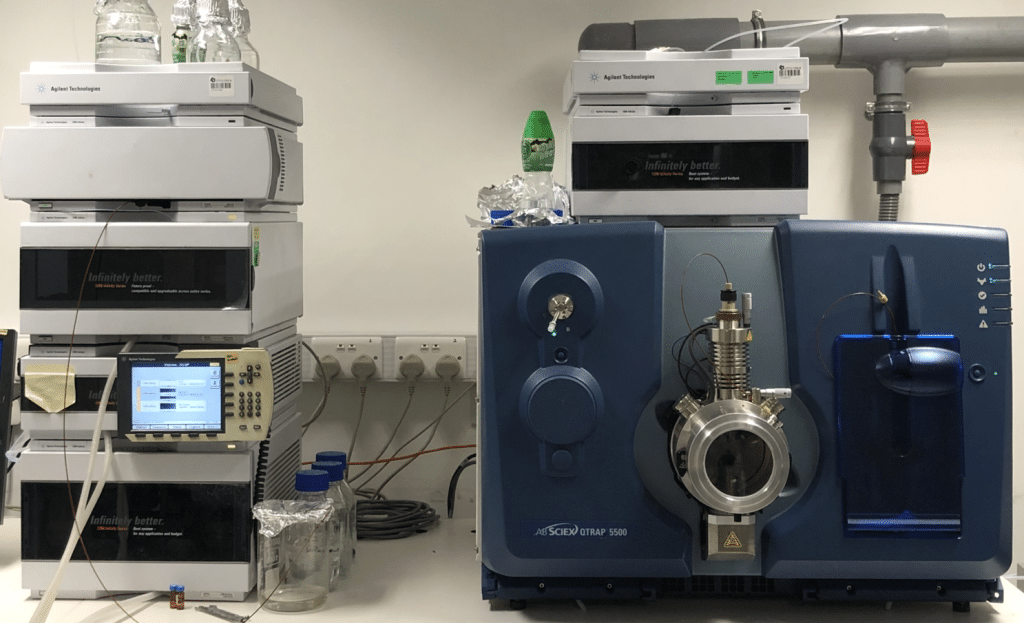
Pesticide residue testing protects public health by finding trace chemical contaminants in the food supply. Farmers rely on synthetic pesticides to defend crops against insects, weeds, and disease, but residues can persist on harvested produce and reach consumers. Regulated laboratories use liquid chromatography-mass spectrometry (LC-MS) to detect and measure those residues inside complex food samples. A single run can screen for hundreds of compounds at once, allowing regulators to enforce safety limits across the food chain.
Why LC-MS Suits Food Testing
A food sample is a difficult thing to analyze. Fruit, grain, and vegetable extracts carry fats, sugars, pigments, and organic acids that can mask the tiny amounts of pesticide you are trying to find. LC-MS handles this in two stages. The liquid chromatography step separates the mixture, pushing it through a column so that individual compounds come off at different times instead of arriving all at once. The mass spectrometer then measures each compound by its mass-to-charge ratio and identifies it from that fingerprint.
Separating first and detecting second is what gives Liquid Chromatography-Mass Spectrometry its specificity. Because the two stages work together, analysts can measure residues at nanogram-per-gram levels, well below most legal limits. Catching contamination at that level keeps unsafe batches out of retail supply.
Sample Preparation and Extraction
Good results start before the instrument. Residue analysis depends on a consistent extraction routine so that recovery is repeatable from sample to sample. Most food laboratories use QuEChERS (quick, easy, cheap, effective, rugged, and safe), which has become the standard approach for a wide range of matrices.
The workflow follows a defined sequence:
- Homogenise the food sample into a uniform mixture.
- Add an organic solvent, usually acetonitrile, to pull the pesticides out of the solids.
- Add a salt mixture to force the water and solvent into separate layers, so the pesticides concentrate in the organic phase.
- Clean up the extract with dispersive sorbents or cartridges to strip out pigments, acids, and lipids.
Clean extracts do two jobs. They lower background noise during the chromatography step, and they protect the mass spectrometer’s ion source and optics from the fouling that shortens instrument life. Skipping the cleanup shows up later as messy data and more downtime.
How Safety Limits are Set
Residue analysis measures what is present. The safety thresholds themselves come from toxicology. Regulators derive an acceptable daily intake (ADI) from animal studies and other toxicological data, then set maximum residue limits (MRLs) for each pesticide on each commodity. Laboratories test against those MRLs. In practice, this means the analytical work and the risk assessment are separate disciplines that meet at the limit value: the lab reports a concentration, and the MRL decides whether that concentration is allowed.
Regulatory Validation
International food trade runs on trust in the numbers. Before a laboratory reports results against an MRL, it has to prove its method works, and validation guidelines such as the EU’s SANTE document set out what to check. The core parameters are:
- Recovery: How much of a known spiked amount the method actually recovers, usually expected in a defined acceptable range.
- Precision: Repeatability within a run and reproducibility across days and analysts.
- Linearity: A detector response that stays proportional across the working concentration range.
- Selectivity: Confirming the target compound is resolved from anything that co-elutes with it.
- Limit of quantification: The lowest level the method can measure reliably.
Documented control over these parameters is what lets importers and regulators accept a result at face value and prevents shipments from being rejected at the border.
Handling Unknowns and Low-Level Detection
Two instrument choices cover most residue work. For targeted analysis, triple quadrupole instruments run selected reaction monitoring: they isolate a target ion, fragment it, and watch for specific product ions. That transition-based detection is highly selective and sensitive, and it is how laboratories quantify known pesticides down to low parts-per-billion levels.
The harder problem is compounds nobody was looking for, including new formulations that appear as farming practices change. PK ADA. High-resolution mass spectrometry helps here. Its accurate mass measurement pins down a compound’s elemental composition and separates isobaric compounds that share a nominal mass but differ slightly in exact mass. This supports non-targeted screening, where the goal is to flag unexpected contaminants rather than confirm a preset list. Note that high-resolution work and triple quadrupole SRM are different tools for different questions; a triple quad does not rely on high mass accuracy.
Summary
LC-MS gives food laboratories the sensitivity to find pesticide residues at trace levels inside difficult samples. Chromatographic separation clears the matrix interference, the mass spectrometer identifies and measures each compound, and a validated method makes the results defensible. Paired with toxicology-based limits, that testing is what keeps the global food supply within agreed safety thresholds and protects the people who eat from it.









Leave a Reply