






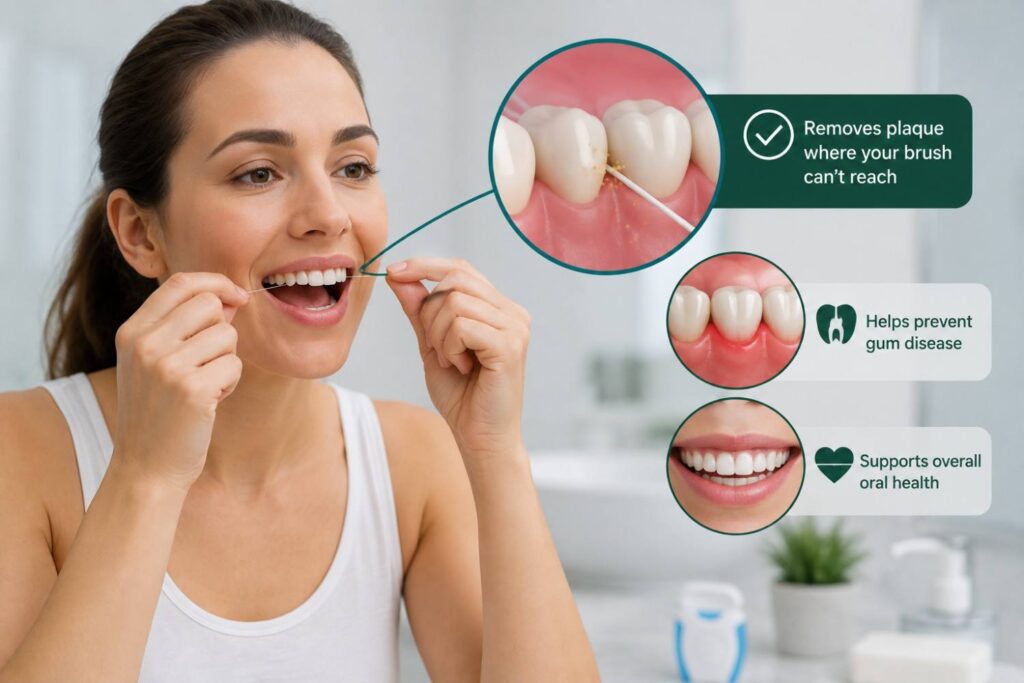
Flossing occupies a strange place in dental care. Dentists recommend it constantly, most people feel vaguely guilty about not doing it enough, and every so often a headline appears claiming there’s no real evidence it works at all. The result is widespread confusion about whether that daily flossing ritual is genuinely worth the effort or just a habit people have been guilted into.
So is flossing really necessary? The honest answer, when the evidence and the reasoning are looked at properly, is yes, cleaning between the teeth matters, but the story is more nuanced than either the dentists’ insistence or the sceptical headlines suggest. Here’s a clear look at what flossing actually does, what the evidence says, and why it remains a worthwhile habit.
Why Cleaning Between the Teeth Matters at All
To understand the flossing debate, it helps to start with a simple physical fact about teeth.
A toothbrush, however good, cannot reach everywhere. The surfaces where teeth touch each other, the areas between them, make up a significant proportion of each tooth’s total surface, and a brush simply can’t get into those contact points. Brushing alone therefore leaves a meaningful part of the teeth uncleaned.
Those between-tooth surfaces are exactly where many problems begin. Plaque accumulates there, and because it’s hard to reach, it’s a common starting point for both tooth decay between the teeth and gum disease, which often begins in the gum tissue between the teeth. This is the fundamental reason cleaning between the teeth is recommended: to clean the surfaces a brush leaves behind.
What the Evidence Actually Says
This is where the headlines come from, so it’s worth addressing honestly.
Some reviews of flossing studies have concluded that the quality of evidence is weak, and that’s a fair reflection of the research. But it’s crucial to understand why. The weakness comes largely from the difficulty of running good flossing studies: they tend to be short, rely on people self-reporting whether they floss (which is notoriously unreliable), and struggle to control how well participants actually floss, since poor technique achieves little. “Weak evidence” in this case means the studies are hard to do well, not that flossing has been shown not to work.
Available evidence suggests that some forms of interdental cleaning, when added to toothbrushing, may reduce plaque and gingivitis, although the certainty of the evidence varies and many studies are short-term. And the underlying logic is sound: plaque causes decay and gum disease, plaque gathers between the teeth, and brushing doesn’t remove it there, so cleaning between the teeth addresses a genuine gap. The limitations of the evidence do not establish that interdental cleaning is ineffective. Current professional guidance continues to recommend cleaning between the teeth as part of routine oral hygiene.
For reliable, non-commercial information on oral hygiene, Healthdirect, the Australian Government’s health information service, is a trustworthy reference.
It’s Not Just About Floss
Part of the confusion is that the debate fixates on floss specifically, when the real point is cleaning between the teeth, by whatever method suits.
Floss is one tool, but not the only one. Interdental brushes, small brushes designed to fit between the teeth, are highly effective and often easier to use, particularly for those with larger gaps or dexterity difficulties. Water flossers, which use a jet of water, are another option that many people find easier to keep up with. The best method is largely the one a person will actually use consistently and correctly.
This reframing matters. The question isn’t really “is floss essential?” but “should the surfaces between your teeth be cleaned?”, and the answer to that is yes. The tool can be chosen to fit the individual.
Technique Makes All the Difference
A key reason flossing sometimes seems ineffective is that it’s frequently done poorly, which achieves little.
Effective flossing means gently guiding the floss between the teeth and curving it around each tooth in a C-shape, sliding it up and down against the tooth surface, including just below the gumline, rather than simply snapping it straight down and back out. Done well, it removes plaque from the tooth surfaces; done carelessly, it barely touches them. A lot of the disappointment with flossing comes down to technique, which is something a dentist or hygienist can demonstrate.
The Sensible Takeaway on Flossing
Putting it together, a reasonable, evidence-informed position emerges.
Cleaning between the teeth daily is a worthwhile habit that addresses a genuine gap left by brushing, targeting the areas where decay and gum disease commonly begin. While the formal studies on floss are admittedly limited in quality, this reflects the difficulty of the research rather than proof that it doesn’t help, and the underlying reasoning strongly supports it. The method matters less than the consistency: Depending on an individual’s oral health, tooth spacing and ability to use a particular device correctly, options may include floss, interdental brushes or oral irrigators, and the best one is whichever gets used properly every day.
Anyone unsure about their between-teeth cleaning would benefit from asking their dentist, who can recommend the most suitable method and technique for them. A practice such as Bradbury Dental Surgery can assess a person’s gum health, show them the most effective technique, and advise on the interdental cleaning approach that best suits their teeth.
The Bottom Line
Is flossing really necessary? Cleaning between the teeth genuinely is, because brushing alone leaves a significant portion of each tooth untouched, precisely in the areas where decay and gum disease often start. The headlines questioning flossing stem from the weakness of the formal studies, but that weakness reflects how hard these studies are to run, not evidence that cleaning between the teeth is pointless.
The practical conclusion is simple: clean between your teeth daily, using whichever method, floss, interdental brushes or a water flosser, you’ll do properly and consistently. Combined with twice-daily brushing and regular dental check-ups, it remains one of the genuinely worthwhile habits for keeping teeth and gums healthy. The ritual isn’t just guilt; there’s real sense behind it.
Frequently Asked Questions
Is Flossing Actually Necessary?
Cleaning between the teeth is genuinely necessary, because a toothbrush can’t reach the surfaces where teeth touch, which make up a significant part of each tooth and are where decay and gum disease often begin. While floss specifically is one option, the key point is cleaning between the teeth daily by some effective method. This addresses a real gap that brushing alone leaves.
Why Do Some Studies Say Flossing Doesn’t Work?
Some reviews have found the evidence for flossing weak, but this reflects the difficulty of running good studies rather than proof it doesn’t help. Flossing studies tend to be short, rely on unreliable self-reporting, and can’t easily control technique. The underlying logic, that plaque between the teeth causes problems and brushing doesn’t remove it there, strongly supports cleaning between the teeth.
What’s the Best Way to Clean Between Teeth?
The best method is the one you’ll use properly and consistently. Floss works well, but Interdental brushes can be an effective alternative, particularly for people with suitable spaces between their teeth. The tool matters less than doing it daily and with good technique. A dentist can recommend the most suitable approach for your teeth and gums.
How Often Should I Floss?
Cleaning between the teeth once a day is generally recommended, which is enough to remove the plaque that accumulates in these areas before it can cause harm. Doing it properly, guiding the floss or interdental brush against each tooth surface including just below the gumline, matters more than doing it multiple times a day. Consistency is the key to the benefit.









Leave a Reply