






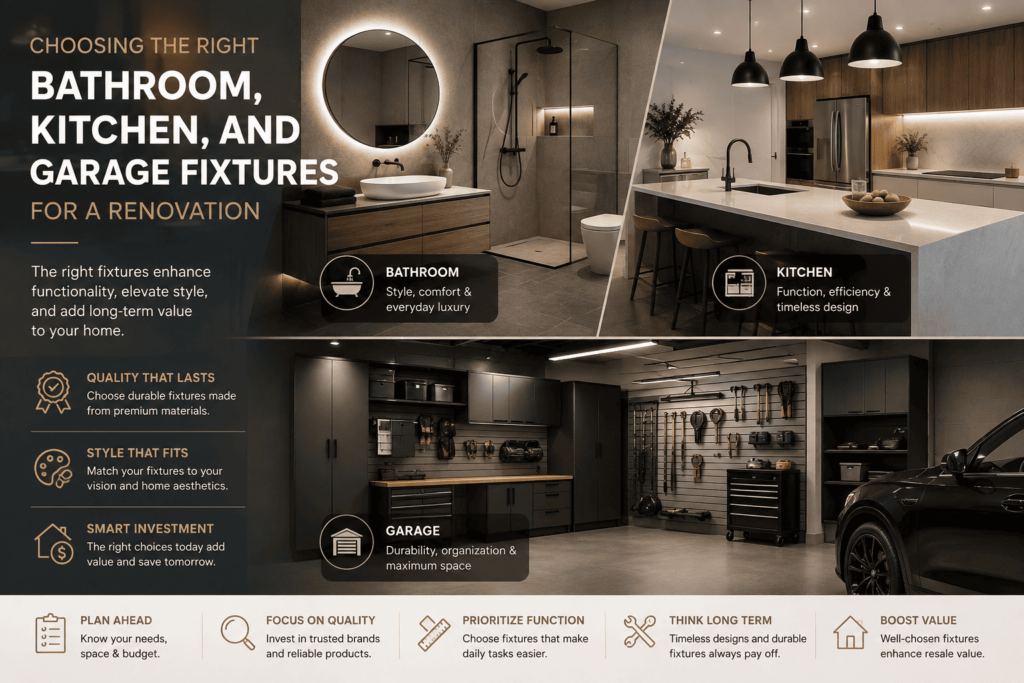
A renovation involves countless decisions, but some choices will affect everyday life long after the project is complete. Bathroom fixtures, kitchen fittings and major exterior components such as garage doors are used or seen regularly for years, making their selection more important than simply choosing what looks attractive in a showroom.
Getting these decisions right requires balancing function, material quality, compatibility, maintenance, durability and design against the initial purchase price. Taking a more considered approach can help homeowners avoid products that look impressive when new but become inconvenient, difficult to maintain or unsuitable for the property over time.
1. Prioritize Function Before Style
Quick Answer: Start by considering how a fixture will be used, cleaned and maintained before comparing colours, shapes and finishes.
Appearance matters in any renovation, but good design should support everyday use rather than work against it. An intricately designed tap, for example, may complement a particular bathroom style but require more effort to keep clean. Similarly, a visually appealing fixture may not be the best choice if its dimensions, water performance or maintenance requirements do not suit the household.
Before selecting a product, consider:
- Water efficiency: For relevant products in Australia, check the WELS (Water Efficiency Labelling and Standards) information to compare water consumption and efficiency.
- Ease of maintenance: Consider how easily surfaces, joints and components can be cleaned.
- Frequency of use: A family bathroom used several times each day may require different products from an occasionally used guest bathroom.
- Accessibility: Think about who will use the fixture and whether its height, controls and operation are practical.
- Long-term convenience: Consider whether components can be serviced or replaced without replacing the entire product.
Style can then be considered within those functional requirements.
2. Understand How Material and Finish Quality Affect Longevity
Quick Answer: Products that appear similar can perform differently over time because durability depends on their underlying materials, components, finishes, manufacturing quality and operating environment.
Showroom appearance alone provides limited information about how a fixture will perform after years of regular use.
For taps and other fittings, buyers should ask about the underlying material as well as the visible finish. Brass components and quality ceramic surfaces, for example, are commonly valued for durability, while the performance of plated and coated products can depend heavily on the quality and thickness of the finish.
Environmental conditions matter too.
Coastal properties may experience greater exposure to salt-laden air, while humid environments can place additional demands on metal components and finishes. High-use households can also place greater mechanical stress on fittings.
For properties exposed to demanding conditions, ask whether the material and finish are suitable for the specific environment. Material grade, protective coatings, cleaning requirements and manufacturer recommendations should all be considered rather than assuming that appearance or price alone indicates durability.
3. Check Compatibility Before Ordering
Quick Answer: Confirm dimensions, plumbing requirements, mounting arrangements and existing infrastructure before purchasing fixtures or fittings.
Compatibility problems can quickly add cost and delays to a renovation.
A basin tap may look perfect but require a different mounting arrangement. A new toilet may not align conveniently with existing plumbing. A replacement garage door may require changes to the opening, tracks, electrical supply or surrounding structure.
Before ordering, verify relevant specifications such as:
- Product dimensions
- Existing plumbing configuration
- Water-pressure requirements where applicable
- Mounting points
- Required clearances
- Electrical requirements
- Structural support
- Existing openings
- Installation instructions
Providing these details to an experienced installer or supplier before purchase can help identify potential problems while they are still relatively easy to resolve.
4. Match Product and Supplier to the Scale of the Project
Quick Answer: A single-room renovation and a multi-property development have different purchasing requirements, particularly around supply consistency, lead times and replacement availability.
A homeowner renovating one bathroom may prioritize individual design preferences, comfort and long-term usability.
Builders and developers working across multiple properties face additional considerations. Products may need to remain available across different construction stages, and variations in colour, finish or specification can create unnecessary complications.
For larger projects, consider factors such as:
- Product availability and lead times
- Consistency between batches
- Ability to supply required quantities
- Warranty procedures
- Replacement-part availability
- Technical documentation
- After-sales support
The best supplier is not necessarily the largest. It is the one capable of reliably meeting the requirements of the particular project.
5. Don’t Treat Garage Doors as an Afterthought
Quick Answer: On homes with street-facing garages, the garage door can occupy a substantial part of the visible façade while also affecting security, access, weather protection and everyday convenience.
Garage doors are sometimes considered late in the renovation process because attention naturally concentrates on kitchens, bathrooms and interior finishes.
However, a garage door performs several important functions and can strongly influence the appearance of a home’s exterior.
When comparing options, consider:
- Construction material
- Finish and colour
- Insulation requirements
- Weather resistance
- Opening mechanism
- Automation
- Security features
- Noise during operation
- Maintenance requirements
- Compatibility with the existing garage structure
A garage door should therefore be evaluated as a significant exterior building component rather than simply another decorative finishing choice.
6. Consider Climate and Environmental Exposure
Quick Answer: Products should be selected for the conditions in which they will actually operate, not simply how they perform in a controlled showroom environment.
Australia’s varied climates can create very different demands on renovation products.
Coastal environments may expose exterior components to salt. Humid areas can increase moisture exposure, while products installed in direct sunlight may face prolonged heat and ultraviolet exposure.
Indoor conditions matter as well. Bathrooms regularly experience moisture and condensation, making suitable materials, ventilation and installation important.
Before purchasing, ask whether the manufacturer’s specifications cover the intended installation environment and what maintenance is recommended to preserve the product’s finish and operation.
7. Look Beyond Purchase Price: Warranty and Replacement Parts Matter
Quick Answer: A slightly cheaper fixture may become more expensive over its lifetime if replacement parts are unavailable or warranty support is difficult to access.
Purchase price is only one part of long-term value.
Fixtures contain components that can eventually require servicing. Tap cartridges, seals, hinges, handles and other parts may need attention during the life of the product.
Before purchasing, ask:
- What does the warranty actually cover?
- How long does the warranty last?
- Who manages warranty claims?
- Are replacement components readily available?
- Can individual parts be replaced?
- Is local servicing available?
- What maintenance is required to preserve warranty coverage?
A product that can be repaired easily may provide better long-term value than one that must be completely replaced when a relatively minor component fails.
8. Separate Common Fixture Myths from Practical Reality
Several assumptions can lead homeowners toward unsuitable choices.
Myth: “If two fixtures look the same, they’ll perform the same.”
Reality: Appearance reveals relatively little about internal components, base materials, coating systems, manufacturing quality or serviceability. Ask for specifications before comparing products.
Myth: “The most expensive product will always last longest.”
Reality: Price can reflect design, branding, manufacturing, materials and other factors. A higher price does not automatically establish greater durability. Compare specifications, warranty and serviceability rather than relying on price alone.
Myth: “Garage doors are a minor renovation decision.”
Reality: Where a garage faces the street, its door can form a substantial part of the visible exterior. It also performs important access, security and weather-protection functions.
Myth: “Once a fixture is installed, there is nothing else to consider.”
Reality: Cleaning, maintenance, servicing and replacement-part availability can influence both product performance and lifespan.
9. Use a Step-by-Step Fixture Selection Checklist
Before committing to a purchase, work through a consistent decision process.
- Define the function. Identify what the product needs to accomplish and how frequently it will be used.
- Confirm compatibility. Check dimensions, plumbing, mounting, electrical and structural requirements.
- Review material specifications. Look beyond the visible finish and understand the underlying construction.
- Consider the environment. Account for humidity, coastal exposure, sunlight, traffic and other relevant conditions.
- Compare efficiency. For applicable Australian water-using products, review WELS information.
- Understand maintenance. Find out how the product should be cleaned and serviced.
- Review the warranty. Understand both coverage and exclusions.
- Check parts availability. Determine whether commonly serviced components can be obtained later.
- Consider the supplier. Evaluate product knowledge, availability, technical support and after-sales assistance.
Then compare appearance and price. Once the practical requirements are satisfied, select the design that best complements the renovation.
Frequently Asked Questions
How can I tell whether a renovation fixture is genuinely durable?
Start with its specifications rather than its appearance. Ask about base materials, internal components, finish or coating process, recommended installation environment, warranty and replacement-part availability. Durability depends on the complete product and how it is installed, used and maintained.
Should I always buy the most expensive fixture I can afford?
Not necessarily. Higher prices can sometimes reflect better materials or manufacturing, but they can also reflect branding or design. Compare functionality, construction, warranty, maintenance and serviceability alongside price.
How important is water efficiency when choosing bathroom fixtures?
It can be an important consideration because fixtures such as taps, showers and toilets may be used repeatedly every day. In Australia, WELS information can help consumers compare the water efficiency of relevant products.
Should garage doors be considered alongside the rest of a renovation?
Yes, particularly where the garage is prominent from the street. The door contributes to the property’s exterior design while also affecting access, security, weather protection and convenience.
When should fixtures be selected during a renovation?
Ideally, major products should be considered early enough for dimensions, plumbing, electrical requirements and installation details to be incorporated into the renovation plan. Leaving important selections until the last minute can create compatibility problems or delays.
Conclusion
Choosing renovation fixtures thoughtfully can make a significant difference to how a home functions long after construction is complete. The strongest decisions rarely come from appearance or price alone.
Start with function, verify compatibility, understand materials and finishes, account for environmental conditions, and investigate warranties and replacement parts. Once those requirements are satisfied, style becomes a much easier—and safer—decision.
For homeowners and building professionals comparing renovation products, suppliers such as Vogue Fixtures in Adelaide offer bathroom and kitchen fixtures, fittings and garage-door options. Regardless of supplier, buyers should compare product specifications, compatibility, efficiency, warranties, maintenance requirements and long-term parts availability before making a final decision.










Leave a Reply