






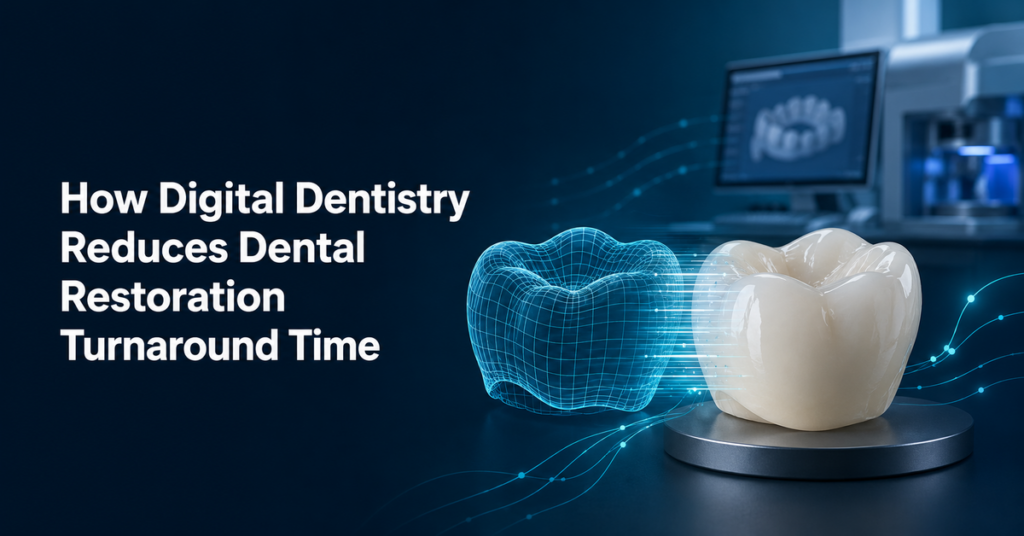
When a patient needs a crown, bridge, implant restoration or full-arch prosthesis, turnaround time affects much more than the delivery date. It influences appointment planning, provisional management, team workload and the patient’s overall experience. Delays can lead to rescheduled visits, longer use of temporary restorations and additional communication between the dental practice and laboratory.
Digital dentistry can make this process more efficient. Intraoral scanning, digital case transfer, computer-aided design and manufacturing, and centralized communication allow information to move through the restorative workflow with fewer physical handoffs. However, faster technology alone does not guarantee a faster or better restoration. The greatest improvement occurs when the dental practice and laboratory use a coordinated, quality-controlled digital process.
This article explains where traditional workflows commonly lose time, how digital systems address those delays and what dentists can do to make restoration delivery more predictable.
Where Time Is Lost in a Conventional Restoration Workflow
A conventional case may involve taking an elastomeric impression, disinfecting and packaging it, arranging transportation, pouring a stone model, trimming dies and manually entering case information. Each step can be completed successfully, but every physical transfer adds time and creates another point where a case may be delayed.
Common causes of delay include:
- An impression with an unclear or incomplete margin
- Distortion, bubbles, tears or contamination in the impression
- Damage to an impression or model during transportation
- Missing shade, material, occlusal or implant-component information
- Time spent shipping the case to the laboratory
- Delayed clarification between the technician and dental office
- The need to repeat an impression after the laboratory receives it
Digital dentistry does not eliminate the need for sound clinical technique. It changes how quickly information can be captured, reviewed, corrected and delivered to the laboratory.
1. Intraoral Scanning Allows Immediate Case Transfer
One of the clearest time-saving opportunities is the replacement of a physical impression with a digital scan when the clinical situation is appropriate.
After scanning, the practice can securely submit the case data to the laboratory without waiting for pickup or shipping. The laboratory can receive the files within minutes and begin its intake and review process sooner. This may remove several non-production steps, including impression packaging, transportation, model pouring and physical model preparation.
Research supports the potential efficiency of this approach. A systematic review involving fixed prosthodontic and implant cases found that intraoral scanning was generally faster than conventional impression procedures and was commonly preferred by patients. The review also reported comparable prosthodontic outcomes between the evaluated digital and conventional workflows.
The benefit is not limited to faster file delivery. A digital scan can be enlarged and inspected on-screen before the patient leaves. The clinician can review the preparation margin, proximal surfaces, occlusal clearance and opposing dentition. If a localized area is incomplete, it may be possible to rescan only that section rather than repeat the entire impression.
2. Digital Quality Checks Can Identify Problems Earlier
The most valuable saved time is often the time that would otherwise be lost to restarting a case.
With a physical impression, an unclear margin may not be discovered until the material reaches the laboratory. By that point, the patient may have left, the case may have spent time in transit and a new appointment may be required.
A well-managed digital workflow creates two opportunities for early review:
- Chairside review: The dental team checks the scan before dismissing the patient.
- Laboratory intake review: The technician evaluates the files and prescription before production begins.
This early review can reveal missing scan data, insufficient clearance, uncertain margins, incorrect scan bodies, incomplete bite records or conflicting prescription details. Quick identification does not guarantee that every issue can be fixed remotely, but it prevents a questionable case from quietly progressing through production.
3. CAD Streamlines Restoration Design
Once the case is accepted, computer-aided design software gives the technician a structured environment for designing the restoration. Depending on the indication and system, the technician can evaluate margins, contacts, occlusion, emergence profiles, material thickness and anatomy within the digital file.
Digital design can improve workflow speed through:
- Reusable design parameters and laboratory protocols
- Immediate visualization of occlusal and proximal relationships
- Faster modification of contours, contacts or emergence profiles
- Efficient duplication or adaptation of an approved design
- Easier sharing of design previews for complex cases
- A consistent digital record for future reference
Automation can accelerate routine design tasks, but technician judgment remains essential. Software proposals still need to be evaluated against the prescription, preparation, restorative material and clinical objectives. A restoration produced quickly from an unsuitable design is not an efficient outcome.
4. CAM Technology Makes Production More Direct
After design approval, computer-aided manufacturing converts the digital design into a physical restoration or model. Milling systems are commonly used for materials such as zirconia, lithium disilicate, PMMA and other restorative materials, while 3D printing can support models, patterns, surgical guides, provisionals and selected prosthetic applications.
An integrated workflow allows the approved design to move directly to the appropriate manufacturing equipment. This reduces dependence on some manual production stages and makes scheduling easier, particularly when the laboratory manages design, milling or printing, finishing and quality control in-house.
Production speed still varies by material and indication. Zirconia may require sintering and characterization. Lithium disilicate may require crystallization. Implant and full-arch cases may require additional verification, component checks, esthetic review or clinician approval. Digital manufacturing shortens and organizes parts of the process; it does not make necessary material and quality-control steps optional.
5. Digital Communication Reduces Waiting Between Decisions
Cases are frequently delayed not because manufacturing is slow, but because one missing detail stops production. A technician may need confirmation of the shade, stump shade, material, margin, implant platform, tissue contour or requested design.
Centralized digital communication can keep the prescription, scans, photographs and case messages connected. When the laboratory identifies a concern, the dental office can review the same information and respond without shipping additional physical materials.
For complex cases, the laboratory may also share screenshots or design previews before manufacturing. This gives the dentist an opportunity to confirm important features before material and production time are committed.
The result is not simply faster messaging. It is a shorter interval between identifying a question and making the clinical or technical decision needed to move the case forward.
6. A Complete Digital Record Simplifies Case Management
A digital case creates a traceable record that can include:
- Upper and lower arch scans
- Buccal bite records
- Digital prescriptions
- Shade information and clinical photographs
- Implant system and component details
- Design notes and approvals
- Submission and production timestamps
- Previous designs or provisional contours
Keeping this information together can reduce time spent searching emails, locating paper prescriptions or confirming which file belongs to a case. It also helps the practice and laboratory discuss a concern while looking at the same record.
When a patient later requires a related restoration, the archived digital information may provide a useful reference. Whether it can be reused directly depends on changes in the patient’s oral condition, the age and quality of the scan, and the requirements of the new restoration.
7. Digital Workflows Can Improve Overall Time Efficiency
Clinical evidence suggests that digital workflows can reduce working time for appropriate cases, although the amount saved varies.
In a randomized controlled trial involving 40 posterior single-implant crown cases, the digital protocol required less total treatment and laboratory time than the conventional protocol. The researchers reported similar clinical try-in and delivery times, with most of the time savings occurring during data acquisition and laboratory procedures. A separate clinical study of single lithium-disilicate crowns also found that intraoral scanning required less impression time than the conventional technique, while the measured fit did not differ significantly in that study.
These findings should not be interpreted as a universal turnaround promise. Operator experience, case complexity, scanner performance, software compatibility, laboratory capacity, material selection and required quality checks all affect the final timeline. Digital dentistry creates the conditions for greater efficiency, but the workflow must still be managed correctly.
What Digital Dentistry Does Not Automatically Solve
Technology cannot compensate for incomplete clinical information or poor execution. A case may still be delayed when:
- Soft tissue or fluid obscures the preparation margin
- The scan strategy is inconsistent or important anatomy is missing
- Interocclusal records are inaccurate
- The prescription omits the material, shade or design requirements
- The wrong implant scan body or component information is supplied
- File formats or scanner platforms are incompatible with the laboratory
- Complex esthetic or full-arch cases begin without adequate planning
- The laboratory lacks the staff or capacity to process the case promptly
Some situations may also benefit from a conventional or hybrid workflow. Deep subgingival margins, difficult moisture control, extensive edentulous spans and certain full-arch or implant cases can present additional scanning challenges. The appropriate method should be selected according to the individual case—not simply because one method is newer.
A Practical Checklist for Faster Digital Case Submission
Before sending a digital restoration case, the dental team should confirm the following:
Scan quality
- The complete margin is visible and captured clearly.
- Adjacent contacts and enough surrounding anatomy are recorded.
- The opposing arch and buccal bite are complete.
- The digital articulation appears clinically accurate.
- There are no major stitching errors or missing surfaces.
Prescription details
- Tooth number and restoration type are correct.
- Material and shade are specified.
- Stump shade and clinical photographs are included when relevant.
- Implant manufacturer, platform, connection and component details are accurate.
- The requested delivery date is realistic for the case type.
Communication
- The laboratory knows whom to contact with clinical questions.
- The practice monitors the submission platform after sending the case.
- Design approval expectations are clear for complex restorations.
- Any urgency is discussed before—not after—the case enters production.
This checklist may add a few minutes at submission, but it can prevent days of avoidable delay later.
How to Evaluate a Fast Digital Dental Laboratory
A laboratory should not be evaluated by turnaround claims alone. Predictability, accuracy and communication are more useful than an aggressive deadline that cannot be maintained consistently.
Before establishing a new laboratory relationship, dentists should ask:
- Which scanners and file formats does the laboratory accept?
- When and how are incoming scans reviewed?
- Are design and manufacturing performed in-house?
- What is the normal turnaround for each restoration type?
- When does the turnaround period begin and end?
- How are weekends, shipping days and holidays counted?
- Which cases require additional planning or approval?
- How quickly will the practice be contacted if information is missing?
- What quality-control checks occur before delivery?
- Is rush service available, and for which indications?
Dentists comparing turnaround policies, digital capabilities and communication standards can consult this guide to choosing a fast-turnaround dental lab in Florida.
Speed Should Be Measured Across the Entire Case
A short laboratory production time has limited value if the restoration requires extensive chairside adjustment, an additional appointment or a remake. The most useful measure is the total time from case capture to successful delivery.
An efficient workflow should therefore aim to:
- Capture complete clinical information the first time
- Transfer the case without unnecessary logistical delays
- Identify questions before production
- Use appropriate digital design and manufacturing processes
- Preserve material-specific production requirements
- Complete documented quality checks
- Deliver a restoration that meets the prescribed clinical requirements
This is the difference between working quickly and working efficiently. True efficiency removes avoidable waiting and repetition while protecting the steps that support restoration quality.
Conclusion
Digital dentistry can reduce dental restoration turnaround time by connecting case capture, transfer, review, design, manufacturing and communication in one coordinated workflow. Immediate file delivery can remove shipping delays. Digital quality checks can identify missing information earlier. CAD/CAM technology can streamline design and production, while centralized communication can prevent small questions from stopping a case for days.
The technology is only part of the solution. Reliable turnaround depends on accurate scans, complete prescriptions, trained clinicians and technicians, compatible systems, appropriate materials, realistic scheduling and consistent quality control.
For dental practices, the goal should not be the fastest possible restoration at any cost. It should be a predictable workflow that delivers the right restoration at the right time with fewer avoidable interruptions for the practice and patient.










Leave a Reply