





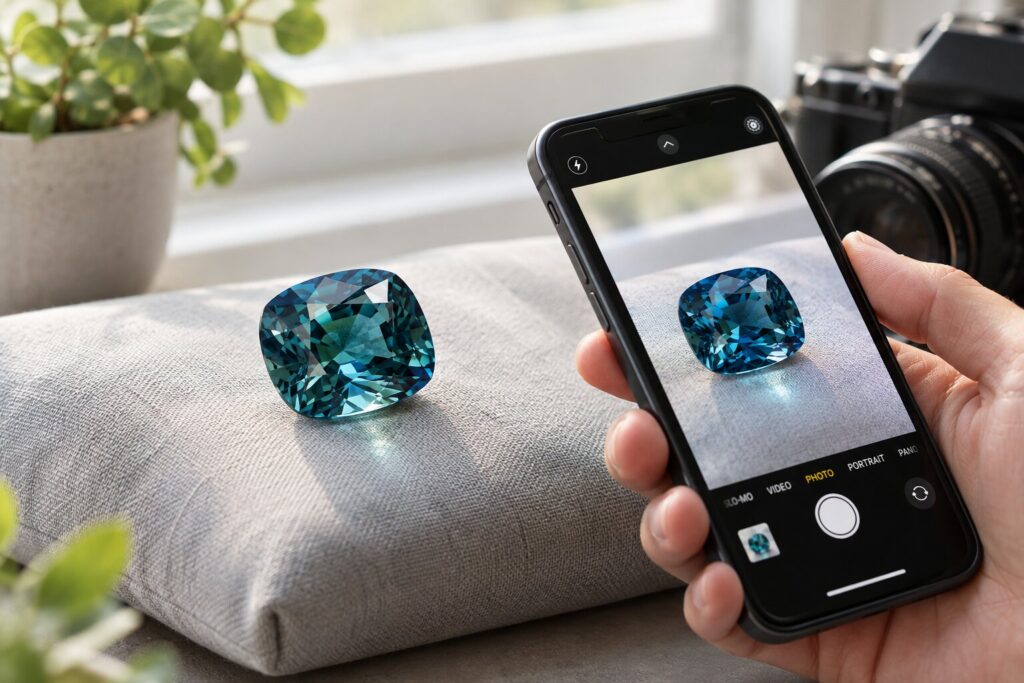
Have you ever ordered a gemstone online because its color looked stunning in the photographs, only to discover that it appeared noticeably different when you opened the package?
Perhaps a sapphire looked brighter on your screen, an emerald appeared more vibrant, or a moonstone displayed an extraordinary glow that seemed less obvious in person.
This experience can be disappointing, but it does not necessarily mean the gemstone is fake, defective, or misrepresented.
Gemstone appearance is influenced by several factors, including lighting conditions, camera settings, screen calibration, viewing angles, and the stone’s natural optical properties.
A photograph captures only one interpretation of how a gemstone interacts with light. The physical stone, however, can display different colors, reflections, and optical effects as you move it or change the lighting.
Understanding these differences can help you evaluate gemstone photographs more accurately and make informed purchasing decisions.
Why Gemstone Photographs May Look Different From Reality
Gemstones interact with light in complex ways.
Their appearance depends on how light enters the stone, interacts with its internal structure, and returns to the observer.
Unlike a flat, opaque object, a transparent or translucent gemstone may reflect, refract, absorb, and scatter light.
Its cut, clarity, color, and internal features can all influence what you see.
A camera captures this interaction under specific conditions, while your eyes observe the gemstone across changing angles and lighting environments.
This difference explains why even professionally photographed gemstones may look different when viewed in person.
1. Human Vision and Digital Cameras Interpret Color Differently
One of the main reasons gemstones appear different in photographs is the way human vision and digital cameras process light.
How Human Vision Works
Human vision involves specialized light-sensitive cells in the retina.
The brain interprets signals from these cells and adjusts its perception according to surrounding lighting conditions.
This process, known as visual adaptation, helps people perceive colors across different environments.
For example, a white object may continue to appear approximately white under various lighting conditions, even when the light illuminating it changes.
However, human color perception is not perfectly consistent. Surrounding colors, brightness, viewing conditions, and individual differences can influence what a person sees.
How Digital Cameras Capture Gemstone Color
Digital cameras use sensors to measure incoming light.
The final image depends on several factors, including:
- Sensor sensitivity
- Exposure settings
- White balance
- Image processing
- Color profiles
- Lighting conditions
- Editing adjustments
Automatic white balance attempts to compensate for the color of the light source.
However, it may not always reproduce gemstone colors as a viewer would perceive them in person.
For example, a gemstone photographed under warm artificial lighting may appear more yellow or orange than it does under daylight.
Likewise, certain blue, violet, and red gemstones can be challenging to reproduce accurately because camera sensors and human eyes do not respond identically to every combination of wavelengths.
What buyers should know: A photograph can provide useful information about a gemstone, but it should not be treated as a perfect representation of its color under all conditions.
2. Lighting Conditions Can Change Gemstone Appearance
Lighting is one of the most important factors affecting how a gemstone looks.
Different light sources have different spectral characteristics, meaning they contain different proportions of visible wavelengths.
Because gemstones absorb and transmit light selectively, their apparent colors can change depending on the illumination.
Gemstones Under Natural Daylight
Daylight is commonly used when evaluating gemstone color because it provides a useful viewing reference.
However, daylight itself varies.
Its appearance can change depending on:
- Time of day
- Weather conditions
- Direct or indirect sunlight
- Atmospheric conditions
- Surrounding surfaces
A gemstone viewed near a window under indirect daylight may look different from the same stone exposed to direct midday sunlight.
Direct sunlight can create strong reflections and bright flashes, sometimes making it harder to judge the gemstone’s overall body color.
For a more balanced evaluation, indirect daylight is often a useful starting point.
Gemstones Under Indoor Lighting
Indoor lighting can also influence gemstone appearance.
Warm lighting may emphasize yellow, orange, or red tones, while cooler lighting can alter the appearance of blue, green, and violet stones.
However, the effect depends on the specific light source and gemstone.
Modern LED lights, for example, vary widely in color temperature and spectral output.
It would therefore be inaccurate to assume that all LED lighting makes gemstones appear cooler or that all indoor lighting reduces brilliance.
Why Multiple Lighting Conditions Matter
A gemstone that looks appealing under one light source may appear different under another.
This is not necessarily a defect.
It reflects the interaction between the stone’s optical properties and the light illuminating it.
Buying tip: Ask sellers to show the gemstone under at least two clearly identified lighting conditions, such as indirect daylight and typical indoor lighting.
3. Gemstone Color Can Change With Viewing Angle
Some gemstones display different colors or optical effects depending on the direction from which they are viewed.
This happens because of their internal crystal structure and interaction with light.
A single photograph may capture only one of these appearances.
Pleochroism: Different Colors From Different Directions
Pleochroism is an optical property found in certain gemstones that absorb light differently along different crystallographic directions.
As a result, the gemstone may display different colors or shades when viewed from different orientations.
The effect can be subtle or pronounced.
Tanzanite is a well-known example of a gemstone that can display different color appearances depending on its orientation.
Other gemstones may show variations in color intensity rather than dramatically different hues.
The visibility of pleochroism also depends on how the gemstone has been cut and oriented.
A photograph taken from one angle may therefore emphasize one color while concealing another.
Why This Matters When Shopping Online
A gemstone that appears strongly blue in one photograph may display violet or other color components when rotated.
This does not automatically indicate inaccurate photography.
However, buyers should understand that a single image cannot fully communicate the gemstone’s appearance from every direction.
Buying tip: Request a short video showing the gemstone rotating slowly under consistent lighting.
4. Optical Effects Are Difficult to Capture in Still Photographs
Certain gemstones are valued for distinctive optical phenomena that become visible as the stone or light source moves.
These effects can be difficult to represent accurately in a single image.
Adularescence in Moonstone
Adularescence is the soft, floating glow associated with certain moonstones.
It results from the interaction of light with internal structures in the gemstone.
As the viewing angle changes, the glow may appear to move across the stone.
A photograph may capture the effect at its strongest point or miss it almost entirely.
Play-of-Color in Opal
Precious opals can display flashes of different spectral colors as light interacts with their internal structures.
This phenomenon is known as play-of-color.
The appearance may change significantly with viewing angle and lighting.
A photograph showing an intense flash of red or green may represent only one moment in the gemstone’s visual behavior.
Chatoyancy in Cat’s-Eye Gemstones
Chatoyancy produces a narrow band of reflected light resembling a cat’s eye.
The effect is associated with appropriately oriented internal features and the way the gemstone is cut.
Its visibility depends on the position of the light source and observer.
Why Videos Are Helpful
Videos can provide additional information about how optical effects move and change.
However, videos are still affected by camera processing, lighting, compression, and screen settings.
They are useful supplements to photographs, not perfect substitutes for examining the gemstone in person.
5. Color-Change Gemstones Have Special Lighting Characteristics
Some gemstones exhibit a specific phenomenon known as color change.
This occurs when a gemstone shows distinctly different color appearances under light sources with different spectral characteristics.
Alexandrite is a well-known example.
Depending on its properties and the illumination, alexandrite may appear greenish under daylight-like lighting and reddish or purplish under incandescent lighting.
Other gemstone varieties can also exhibit color-change behavior.
It is important to distinguish this phenomenon from ordinary differences caused by lighting, reflections, or camera settings.
Not every gemstone that looks different indoors and outdoors qualifies as a color-change gemstone.
Buying tip: If a seller advertises a gemstone as color-changing, request photographs or videos under identified light sources and consider obtaining an independent gemological report.
6. Gemstone Cut and Facets Influence Photographic Appearance
A gemstone’s cut affects how light enters, travels through, and exits the stone.
Facet arrangement, proportions, and orientation influence brightness, reflections, contrast, and visible color.
Brightness and Dark Areas
Some gemstones display bright reflections alongside darker regions.
These darker areas may result from light leakage, extinction, viewing geometry, or other optical factors.
Photographic lighting can emphasize or reduce the visibility of these features.
A gemstone may therefore appear brighter in a studio photograph than it does under ordinary household lighting.
Reflections and Sparkle
Strong directional lighting can create attractive reflections and flashes.
These effects may help demonstrate a gemstone’s brilliance, but they can also make its overall appearance difficult to judge.
For example, a photograph designed to capture maximum sparkle may not accurately communicate how the stone looks in softer everyday lighting.
Cut Quality Matters
Two gemstones of similar color and weight may look different because of their cut proportions and orientation.
A well-executed cut can improve the distribution of light and enhance visual appeal.
However, the ideal cut depends on the gemstone material, intended appearance, and other characteristics.
Buying tip: Evaluate photographs that show the gemstone both face-up and from additional angles, rather than relying exclusively on highly illuminated promotional images.
7. Your Phone or Computer Screen Can Change Gemstone Colors
Even when a seller captures a gemstone accurately, the image may look different on your device.
Screens vary in:
- Color calibration
- Brightness
- Contrast
- Display technology
- Color gamut
- Automatic color adjustments
Some smartphones use vivid display modes that increase apparent saturation.
Other devices automatically adjust screen colors according to ambient lighting.
As a result, the same gemstone photograph may appear noticeably different on two screens.
How to Reduce Display-Related Differences
Before evaluating an expensive gemstone purchase:
- View the images on more than one device when possible.
- Disable unusually vivid display settings.
- Avoid judging color with the screen at extremely low or high brightness.
- Be aware of automatic night modes or warm color filters.
- Compare multiple photographs rather than relying on one image.
These steps cannot guarantee perfect color accuracy, but they can reduce some sources of misleading visual differences.
How to Judge Gemstone Color Before Buying Online
Understanding gemstone photography is useful, but knowing how to evaluate an online listing is even more important.
The following checklist can help buyers make more informed decisions.
1. Request Photographs Under Different Lighting Conditions
Ask the seller for photographs taken under clearly identified lighting conditions.
Ideally, these should include:
- Indirect daylight
- Neutral indoor lighting
- Additional lighting where relevant to the gemstone’s optical properties
Avoid assuming that a single studio photograph represents the gemstone’s appearance in every environment.
2. Ask for a Video Showing Different Viewing Angles
A rotating video can reveal visual characteristics that static images may not show.
Look for changes in:
- Color
- Brightness
- Reflections
- Dark areas
- Pleochroism
- Special optical effects
If possible, request a video recorded under consistent lighting without strong color-enhancing filters.
3. Confirm Whether Images Have Been Edited
Digital image processing is common in product photography.
Basic adjustments such as cropping and exposure correction do not necessarily indicate deception.
However, excessive saturation, selective color adjustments, or misleading retouching can create unrealistic expectations.
Ask whether the seller has made significant color modifications to the photographs.
4. Verify Gemstone Dimensions
Macro photography can make small gemstones appear much larger than they are.
Always check the stated dimensions, usually provided in millimeters.
Carat weight alone does not determine a gemstone’s visible size because different gemstone materials have different densities and cutting proportions.
For example, two gemstones with the same carat weight may have different face-up dimensions.
Buying tip: Compare the gemstone’s measurements with familiar objects or use a millimeter ruler to understand its approximate size.
5. Ask About Treatments and Enhancements
Many gemstones undergo treatments intended to improve their color, clarity, or appearance.
Common examples include certain forms of heating, filling, and other enhancement processes.
Treatment practices and disclosure expectations vary by gemstone type and jurisdiction.
Before purchasing, ask:
- Is the gemstone natural, laboratory-grown, or an imitation?
- Has it undergone any known treatments?
- Are the treatments permanent or potentially sensitive to heat, chemicals, or cleaning?
- Are the treatment details documented?
A gemstone’s treatment history can influence its value, care requirements, and suitability for certain jewelry settings.
6. Review Independent Gemological Reports
For higher-value purchases, an independent gemological report can provide useful information about a gemstone’s identity and certain characteristics.
Depending on the gemstone and laboratory, a report may address:
- Gemstone identification
- Natural or laboratory-grown origin
- Detectable treatments
- Selected optical or physical characteristics
- Geographic origin, where an opinion is offered
However, not every report covers every characteristic.
A laboratory report should not automatically be interpreted as a guarantee of quality, market value, or authenticity of every seller claim.
Check the issuing laboratory, report number, and the specific conclusions stated.
7. Understand the Seller’s Return Policy
Even careful photographic evaluation cannot eliminate every difference between an online image and a physical gemstone.
Before purchasing, review the return and refund terms.
Consider:
- Whether returns are accepted
- The inspection period
- Any restocking fees
- Return shipping responsibilities
- Insurance requirements
- Conditions that could invalidate a return
A clear return policy can be particularly important when buying expensive gemstones without examining them in person.
8. Compare Multiple Images Instead of One Perfect Photograph
A reliable gemstone listing should help buyers understand the stone rather than showcase only its most flattering appearance.
Look for a combination of:
- Face-up photographs
- Side-angle photographs
- Videos
- Neutral backgrounds
- Multiple lighting conditions
- Accurate dimensions
- Relevant gemstone disclosures
If a listing relies entirely on one highly saturated photograph, consider requesting additional information before making a decision.
Common Mistakes Buyers Make When Evaluating Gemstones Online
Even experienced jewelry enthusiasts can misinterpret gemstone photographs.
Here are several mistakes worth avoiding.
Assuming Every Color Difference Indicates a Fake Gemstone
A gemstone can look different because of lighting, viewing angle, camera processing, or screen settings.
However, unexplained differences should still be investigated rather than automatically dismissed.
Choosing Based Only on Color Saturation
Highly saturated photographs may look attractive, but they do not necessarily represent everyday appearance.
Ignoring Optical Effects
Pleochroism, play-of-color, and other optical characteristics may require movement to evaluate properly.
Confusing Carat Weight With Physical Size
Different gemstones and cuts can produce different visible dimensions at the same carat weight.
Assuming a Laboratory Report Guarantees Quality
Gemological reports have specific scopes and limitations. Buyers should read the findings rather than relying on the presence of a report alone.
Overlooking Return Policies
A reasonable inspection and return process can provide valuable protection when the gemstone cannot be examined before purchase.
Frequently Asked Questions
Why does my gemstone look darker in person than in photographs?
Differences in lighting, camera exposure, background, gemstone cut, and display settings can make a gemstone appear brighter in photographs. Request images under ordinary lighting to better understand its everyday appearance.
Can natural gemstones change color under different lighting?
Yes. Many gemstones show some variation in appearance under different lighting conditions. Certain gemstones also exhibit a distinct color-change phenomenon, which should not be confused with ordinary lighting-related variation.
Are gemstone photographs edited?
Some sellers adjust photographs for exposure, white balance, cropping, or presentation. Such adjustments are not necessarily misleading, but excessive editing can affect color accuracy. Buyers can ask sellers about their photography practices.
Is natural daylight the best way to judge gemstone color?
Indirect daylight can be a useful reference, but daylight varies with time and weather. Evaluating a gemstone under multiple identified lighting conditions provides a more complete picture.
Why do opals and moonstones look different when moved?
These gemstones can display optical phenomena that depend on the interaction between light, internal structures, and viewing angle. Movement can reveal effects that are difficult to capture in a still photograph.
Can a gemstone video show its true color?
A video can reveal changes in appearance across viewing angles, but its color accuracy still depends on lighting, camera processing, compression, and the viewer’s screen.
Should I request a gemstone certificate before buying?
For valuable gemstones, an independent gemological report may be useful. However, buyers should verify the laboratory, understand the report’s scope, and avoid assuming that it guarantees the gemstone’s quality or value.
Final Thoughts
Gemstones are visually complex materials, and their appearance cannot always be represented perfectly in a photograph.
Lighting, camera sensors, display settings, gemstone cut, and natural optical properties all influence how a stone looks.
A photograph that appears different from the physical gemstone does not automatically indicate fraud or poor quality. However, buyers should not ignore unexplained differences or rely entirely on promotional imagery.
Before purchasing a gemstone online, request multiple photographs, review videos, confirm dimensions, ask about treatments, and understand the seller’s return policy.
For higher-value purchases, consider obtaining appropriate independent gemological documentation.
The best way to buy gemstones confidently is to evaluate the stone through multiple sources of information rather than relying on a single attractive photograph.
References and Further Reading
The following independent educational resources provide additional information about gemstone identification, optical properties, treatments, and evaluation.
- Gemological Institute of America (GIA) — Gemstone education, identification, treatments, and research.
- International Gem Society — Educational resources on gemstone properties, cutting, and buying.
- Gem-A — The Gemmological Association of Great Britain — Gemmology education and professional resources.
These are general reference resources. Specific technical claims should be checked against relevant gemological publications during final editorial fact-checking.









Leave a Reply