





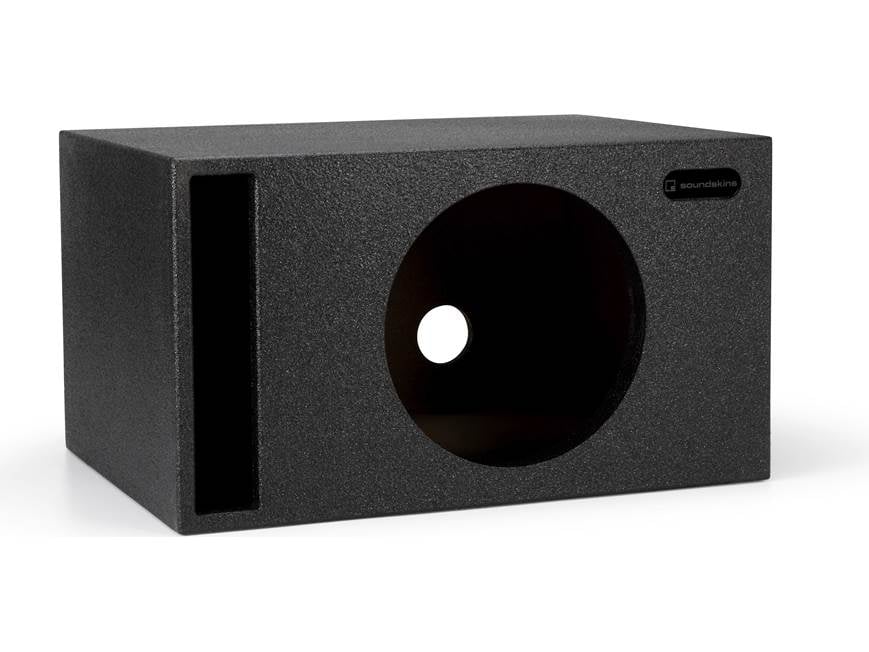
A powerful car subwoofer can still produce disappointing bass when installed in the wrong enclosure. The box surrounding the speaker affects how it responds to low frequencies, how efficiently it produces sound and how much space the installation occupies.
Choosing the right subwoofer enclosure involves more than finding a box that fits a particular speaker diameter. The enclosure must match the subwoofer’s technical requirements, suit the available space in the vehicle and deliver the type of bass the listener prefers.
Whether you are upgrading an existing audio system or installing a subwoofer for the first time, understanding the differences between enclosure designs can help you avoid expensive mistakes.
Why the Right Speaker Enclosure Matters
A subwoofer produces sound by moving its cone back and forth, creating changes in air pressure. The enclosure influences that movement and helps determine how the speaker responds across different bass frequencies.
In a sealed box, the trapped air acts as a spring that affects the movement of the cone. A ported enclosure uses a tuned opening to reinforce output around a selected frequency.
These designs behave differently, even when fitted with the same subwoofer.
An enclosure that is poorly matched to the speaker may produce uneven bass, reduced output or excessive cone movement under certain conditions. A properly designed box helps the subwoofer operate closer to its intended performance.
The best enclosure is not necessarily the largest or most expensive. It is the one designed around the specifications of the particular subwoofer.
Sealed vs Ported Subwoofer Enclosures
Sealed and ported boxes are among the most common enclosure designs used in car audio systems. Both can produce excellent bass, but they have different characteristics.
Sealed Enclosures for Controlled Bass
A sealed enclosure is an airtight cabinet with no intentionally tuned opening.
The air inside the box provides resistance to the movement of the subwoofer cone. This contributes to the system’s overall response and can help produce controlled bass when the enclosure is correctly sized.
Sealed boxes are often chosen by listeners who prefer a balanced sound across different music styles.
They may also be practical for vehicles with limited installation space, although the required volume depends on the subwoofer.
A sealed enclosure generally has a simpler construction than a ported design. There is no port to calculate or tune, but the internal volume and airtight construction still matter.
The main trade-off is output. With the same driver and amplifier, a properly designed ported enclosure can produce more bass around its tuning frequency.
That does not mean a sealed enclosure is automatically quieter at every frequency or unsuitable for deep bass. Its performance depends on the complete system.
Ported Enclosures for Greater Output
A ported enclosure includes an opening, sometimes called a vent, that works with the air inside the cabinet to reinforce output around a chosen tuning frequency.
This design can produce strong bass in its intended operating range without requiring the subwoofer cone to provide all the acoustic output on its own.
Ported boxes are popular in systems where higher output is a priority.
However, the enclosure’s internal volume, port dimensions and tuning frequency must be selected carefully.
A poorly designed port can produce audible airflow noise, particularly at higher listening levels. Incorrect tuning can also create an uneven bass response.
Below the tuning frequency, a ported system may provide less control over cone movement. Depending on the design, appropriate filtering and amplifier settings may be necessary to reduce excessive excursion.
Ported enclosures also tend to require more space than comparable sealed designs, although this varies by driver and tuning requirements.
Which Enclosure Sounds Better?
Neither design is universally better.
A sealed box may appeal to someone looking for a compact installation and a particular bass response. A ported box may be more suitable for a listener who wants stronger output within a selected low-frequency range.
Music preferences can influence the decision, but the enclosure should not be chosen solely because someone listens to hip-hop, rock or electronic music.
The subwoofer’s characteristics, the vehicle cabin and the overall system setup have a greater influence on the final result.
Match the Enclosure to Your Subwoofer
Before purchasing an enclosure speaker box, check the technical information supplied by the subwoofer manufacturer.
Two subwoofers with the same nominal diameter may require very different enclosure designs.
Check Manufacturer Specifications
Most established subwoofer manufacturers provide recommended enclosure volumes and, where appropriate, port dimensions or tuning information.
These recommendations are a useful starting point because they are based on the driver’s characteristics and intended operating conditions.
Important details include the recommended sealed or ported enclosure volume, mounting depth, cutout diameter and any special installation requirements.
If a manufacturer provides several enclosure options, compare their expected performance rather than assuming the largest option will produce the best sound.
For an existing subwoofer, identify the exact model number before shopping for a replacement box.
Understand Thiele/Small Parameters
Subwoofer designers use a set of measurements commonly called Thiele/Small parameters to describe a driver’s behavior.
Some of the most useful parameters include:
- Fs: The driver’s free-air resonance frequency.
- Vas: A parameter related to the driver’s suspension compliance, expressed as an equivalent air volume.
- Qts: The driver’s total quality factor, combining mechanical and electrical damping.
These values help designers predict how a driver may perform in different enclosure arrangements.
They are not simple pass-or-fail rules. A particular Qts value, for example, does not automatically prove that a subwoofer must be installed in a sealed or ported box.
For most buyers, the manufacturer’s tested enclosure recommendations are easier to use than calculating a design from scratch.
Enthusiasts building custom boxes can use enclosure modelling software and the driver’s published parameters to explore different designs.
Calculate Net Internal Air Volume
One of the most common enclosure-buying mistakes is confusing exterior dimensions with usable internal volume.
The air space available to the subwoofer is smaller than the volume suggested by the outside measurements.
Wall thickness, internal bracing, the subwoofer itself and any ports occupy space inside the cabinet.
For example, a box may have a gross internal volume of 40 litres, but the usable air volume will be lower once the necessary internal components are accounted for.
When comparing enclosure specifications, check whether the stated capacity is gross or net volume.
For a ported box, also confirm whether the published volume accounts for the port structure.
If you are building an enclosure, calculate these displacements before finalizing the dimensions.
Check Mounting Depth and Cutout Size
A subwoofer may fit the advertised diameter of an enclosure but still be incompatible with its mounting dimensions.
Check the required cutout diameter, mounting depth and clearance behind the speaker.
Shallow truck enclosures deserve particular attention because their limited depth may restrict which subwoofers can be installed.
A suitable box must provide both the correct acoustic volume and enough physical clearance for the driver.
Match the Amplifier and Subwoofer Correctly
The enclosure is only one part of a car audio system.
The amplifier, subwoofer and wiring configuration must also be compatible.
Continuous RMS power ratings are generally more useful for system matching than prominently advertised peak power figures.
Check the subwoofer’s continuous power-handling specification and the amplifier’s rated output at the intended load impedance.
For dual-voice-coil subwoofers, the wiring arrangement can change the total impedance presented to the amplifier.
An unsuitable impedance or amplifier configuration may cause overheating, distortion, protection-mode operation or equipment damage.
Amplifier gain should also be set correctly. It is not simply a volume control, and excessive gain can contribute to signal clipping.
A correctly designed enclosure cannot compensate for an electrical setup that exceeds the equipment’s operating limits.
If the wiring requirements are unclear, consult the manufacturer’s documentation or a qualified car audio installer.
Choose an Enclosure That Fits Your Vehicle
Even a technically suitable subwoofer box may be impractical if it takes up too much space or interferes with normal vehicle use.
Measure the intended installation area before buying.
Measure the Available Space
Record the height, width and depth of the space where the enclosure will sit.
Remember to account for seat movement, trunk openings, interior trim and other restrictions.
A box that fits inside a trunk may still be difficult to install if it cannot pass through the trunk opening.
Also consider the position of the subwoofer cone and any ports.
The enclosure should not be installed in a way that obstructs necessary airflow through a port or causes the cone to contact nearby surfaces.
Leave appropriate access for wiring and future maintenance.
Consider the Vehicle Type
Sedans, SUVs, hatchbacks and pickup trucks offer different installation possibilities.
A sedan may have sufficient trunk space for a conventional enclosure, while a pickup truck may require a shallow design behind or beneath the seats.
SUVs and hatchbacks can offer greater flexibility, but the enclosure must still be positioned and secured safely.
Custom-fit enclosures can make use of irregular spaces. Universal boxes may be a more economical option when their dimensions and internal specifications are suitable.
For a truck installation, preserving seat movement and passenger comfort may be just as important as maximizing bass output.
Secure the Enclosure Properly
A subwoofer enclosure can be heavy, especially when built from thick panels and fitted with a large driver.
Leaving it unsecured creates a risk during sudden braking, sharp manoeuvres or a collision.
Use mounting hardware and methods appropriate for the vehicle and enclosure.
Avoid drilling into vehicle panels without checking for wiring, fuel-system components or other equipment behind the mounting area.
The installation should not obstruct seat belts, airbags, emergency equipment or access to essential vehicle controls.
If suitable mounting points are unavailable, seek professional installation advice.
Construction Materials and Build Quality
A subwoofer enclosure must be rigid enough to withstand repeated changes in internal air pressure.
Poor construction can introduce unwanted vibration, rattling and air leaks.
Medium-density fiberboard, commonly known as MDF, is widely used because it provides a dense, relatively uniform material for enclosure construction.
Plywood is another option, particularly where weight, moisture resistance or specific structural requirements influence the design.
The choice of material matters, but panel thickness, bracing, joints and overall construction are equally important.
Inspect the Panels and Joints
A well-built enclosure should have secure joints and sufficient structural support.
Large unsupported panels can vibrate when the subwoofer operates, potentially adding unwanted noise.
Internal bracing can improve rigidity without requiring excessively thick walls throughout the cabinet.
The enclosure should also be assembled with suitable adhesives and fasteners.
For sealed designs, unintended air leaks can affect performance.
Ported designs also require appropriate sealing around joints, apart from the intended port opening.
Check the Exterior Finish
Carpet, vinyl, protective coatings and other finishes can help protect the box from ordinary wear.
For enclosures installed in cargo areas, consider whether the finish can tolerate luggage, tools and other items being moved nearby.
The exterior appearance should not distract from more important considerations such as internal volume, structural integrity and mounting compatibility.
Common Subwoofer Enclosure Buying Mistakes
Several avoidable mistakes can reduce the performance of an otherwise capable audio system.
Choosing a Box Based Only on Speaker Size
A 12-inch subwoofer does not automatically fit every enclosure advertised for a 12-inch speaker.
Drivers with the same nominal diameter may have different mounting depths, cutout dimensions and recommended air volumes.
Always compare the exact specifications.
Assuming Bigger Means Better
A larger enclosure can change the response of a subwoofer, but increasing volume beyond the intended design is not automatically an improvement.
An unsuitable enclosure may reduce power handling in some operating conditions or create an undesirable response.
Follow the manufacturer’s recommendations or use a properly modelled custom design.
Ignoring Port Tuning
A ported box should not be selected simply because it has a large opening.
Port dimensions and tuning frequency are part of the acoustic design.
Poorly matched tuning can affect output, cone movement and sound quality.
Overlooking Installation Space
Check the actual dimensions of the box and the route needed to place it inside the vehicle.
Consider cargo access, seat adjustments and whether the enclosure can be securely mounted.
Neglecting Wiring and Amplifier Settings
Incorrect wiring, unsuitable amplifier loads and poorly adjusted gain settings can undermine the performance of a properly built enclosure.
Treat the speaker, enclosure and amplifier as parts of one system.
Frequently Asked Questions
What type of subwoofer enclosure is best for deep bass?
Both sealed and ported enclosures can produce deep bass when properly designed. A ported enclosure can offer greater output around its tuning frequency, while a sealed design generally has a more gradual low-frequency roll-off. The better choice depends on the driver, enclosure alignment and desired response.
Does a bigger subwoofer box produce better bass?
Not necessarily. Enclosure volume must match the subwoofer’s characteristics and intended design. A box that is too large or too small can change the response and may create performance or reliability problems.
Is a sealed or ported box better for a truck?
Both can work. Sealed boxes are often practical where installation space is restricted, while ported enclosures may be suitable when sufficient volume is available. Check the exact subwoofer requirements and the space behind or beneath the seats.
Can I use the same enclosure for different subwoofers?
Only when the enclosure’s internal volume, design, cutout size, mounting depth and other specifications suit the replacement driver. Subwoofers of the same diameter are not necessarily interchangeable.
What is the difference between gross and net enclosure volume?
Gross internal volume is the total space inside the enclosure before accounting for components that occupy that space. Net volume refers to the usable air space after the relevant displacements have been deducted.
Can a poorly designed enclosure damage a subwoofer?
It can contribute to operating conditions that increase the risk of damage, particularly when combined with excessive power or unsuitable amplifier settings. Ported enclosures operated well below their tuning frequency can be especially vulnerable to excessive cone movement without appropriate protection.
Conclusion
Choosing the right subwoofer enclosure starts with the speaker itself.
Manufacturer specifications, internal air volume, enclosure design and mounting dimensions all matter. A sealed box may provide a practical solution for listeners who prefer a particular bass response or need a compact installation, while a properly designed ported enclosure can deliver greater output in its intended frequency range.
The vehicle also influences the decision. An enclosure should fit without interfering with normal use and must be securely mounted.
By checking the technical requirements, comparing construction quality and planning the complete audio system, you can select an enclosure that delivers satisfying bass without sacrificing practicality or reliability.
References and Further Reading
- KICKER — Manufacturer resources covering subwoofer specifications, enclosure recommendations and car audio installation.
- JL Audio — Product specifications and technical information on subwoofer enclosure design.
- Crutchfield — Consumer education on car subwoofers, enclosure types and installation considerations.
- American Bass — Car Subwoofer Buying Guide — Manufacturer guidance on selecting car subwoofers and related equipment.
- SoundSkins Global — Commercial Provider – Commercial collection of subwoofer enclosures and car audio installation products.
Editorial disclosure: SoundSkins Global is included as a commercial reference. Its inclusion does not constitute independent verification or endorsement of its products. Enclosure compatibility, technical specifications and installation requirements should be confirmed with the relevant manufacturers before purchase.









Leave a Reply