







For a researcher living in Dubai, the opportunity to continue developing medical technology in Australia may represent an important step in her career. Years of scientific research, internationally recognised publications and collaborations with medical institutions could provide a strong professional foundation. Yet when she begins exploring Australia’s National Innovation visa, she discovers that a successful career alone does not necessarily meet the immigration requirements.
Australia is increasingly looking to attract individuals whose achievements extend beyond conventional professional qualifications. Researchers developing new technologies, entrepreneurs commercialising innovative products, scientists addressing environmental challenges and distinguished professionals contributing to internationally significant projects may find opportunities through the National Innovation visa.
Known as Subclass 858, this permanent immigration pathway is designed for people who have demonstrated exceptional achievement and possess the potential to make significant contributions to Australia.
Unlike conventional skilled migration programmes, it places greater emphasis on professional distinction, international recognition, sustained achievement and future contribution.
Understanding these requirements is essential before investing time and resources in an application.
What Is Australia’s National Innovation Visa?
The National Innovation visa (NIV) is an invitation-based permanent residence pathway administered by the Australian Department of Home Affairs.
Introduced in December 2024 as the successor to the former Global Talent visa programme, it is intended to attract established and emerging leaders whose expertise and achievements could contribute to Australia’s economic, scientific, cultural and technological development.
Potential candidates include researchers, entrepreneurs, innovative investors, athletes, creative professionals and distinguished specialists.
The programme recognises that individuals with exceptional expertise can contribute to a country’s development in ways that extend beyond filling conventional employment vacancies.
A scientist developing advanced diagnostic technology, for example, may contribute through research collaboration, intellectual property development, commercial innovation and specialist employment creation. An internationally recognised artist may contribute through cultural development and Australia’s standing within the international creative community.
The nature of the contribution varies according to the applicant’s professional field.
Benefits and Limitations of Permanent Residency
A successful National Innovation visa application provides Australian permanent residency.
Permanent residence offers greater long-term flexibility than temporary employment or research visas, although holders must still comply with Australian laws and applicable regulatory requirements.
| Benefit | General provision |
|---|---|
| Residence | Live in Australia indefinitely |
| Employment | Work in Australia |
| Education | Undertake studies in Australia |
| Healthcare | Eligibility to enrol in Medicare |
| Family inclusion | Include eligible family members |
| Family sponsorship | Sponsor eligible relatives under applicable requirements |
| International travel | Initial five-year travel facility |
| Citizenship | Potential eligibility after satisfying citizenship requirements |
Certain government benefits may be subject to waiting periods. Professional registration requirements also continue to apply where relevant.
Permanent residency should not be confused with Australian citizenship. Furthermore, the initial five-year international travel facility does not mean that permanent residency itself expires after five years.
Permanent residents intending to travel internationally after their travel facility expires should investigate the applicable Resident Return visa requirements or their eligibility for Australian citizenship.
Who Can Apply for the National Innovation Visa?
The visa recognises exceptional achievement in four broad areas:
- Professional activities.
- Sports.
- Arts and creative activities.
- Academia and research.
These categories accommodate a wide range of professional backgrounds.
A software engineer responsible for internationally significant technological innovations may have an appropriate professional background. A researcher with influential scientific publications may qualify for consideration through academia and research. An internationally recognised athlete or artist may establish their achievements through competitive results, professional distinctions and independent recognition.
The determining factor is not simply the occupation but the significance of the individual’s accomplishments.
Holding a senior position, possessing postgraduate qualifications or working in a technology company does not independently establish eligibility.
Understanding Subclass 858 Eligibility Requirements
Applicants must consider both the legal requirements for the visa and the competitive nature of the invitation process.
| Eligibility requirement | What applicants need to demonstrate |
|---|---|
| Exceptional achievement | Sustained accomplishments demonstrating distinction within the field |
| International recognition | Credible recognition of professional contributions |
| Continued prominence | Recent and ongoing significant achievements |
| Australian community benefit | Potential economic, scientific, cultural or social contribution |
| Professional establishment | Ability to pursue relevant work or become independently established |
| Eligible nomination | Support from a suitably qualified Australian nominator |
| Invitation | Formal invitation from the Department of Home Affairs |
| Health and character | Compliance with applicable immigration requirements |
| Functional English | Applicable language evidence or additional visa charge |
| Age-related requirements | Additional exceptional benefit evidence where applicable |
Applicants must address other relevant requirements, including outstanding Australian government debts and the Australian Values Statement where applicable.
An invitation is required before lodging a visa application, but receiving one does not establish that every eligibility requirement has been satisfied.
The Department of Home Affairs assesses the formal application and its supporting documentation separately.
What Constitutes Exceptional and Outstanding Achievement?
One of the most challenging aspects of the National Innovation visa is demonstrating the difference between a successful professional career and internationally recognised exceptional achievement.
A professional may have worked for twenty years, managed large teams and received excellent performance assessments. Although these accomplishments are valuable, the immigration assessment considers whether the individual’s achievements demonstrate distinction within the wider professional field.
Evidence of influence beyond an immediate employer or local professional network may be particularly relevant.
| Conventional professional achievement | Potential evidence of exceptional achievement |
|---|---|
| Completion of a university degree | Internationally recognised academic contributions |
| Several years of employment | Sustained professional distinction and documented industry influence |
| Management position | Significant leadership outcomes recognised across an industry |
| Publication of research papers | Research demonstrating substantial influence within its discipline |
| Establishment of a startup | Independently recognised innovation and commercial impact |
| Patent registration | Evidence of technological significance and practical adoption |
| Professional association membership | Distinguished recognition based on competitive professional achievement |
| Internal performance awards | Independently assessed awards of substantial professional standing |
These comparisons are illustrative rather than statutory qualification thresholds.
There is no universal number of publications, patents, employees, customers or awards that guarantees an invitation.
The relevance and credibility of evidence depend on the professional field and the individual applicant’s circumstances.
Australia’s National Innovation Visa Priority Framework
Australia uses a structured framework to prioritise invitations and applications under the National Innovation visa programme.
Ministerial Direction No. 120 establishes the relevant order of consideration and indicators of exceptional achievement.
| Priority | General candidate profile |
|---|---|
| Priority One | International experts with awards representing the highest standing within their field |
| Priority Two | Candidates nominated by an eligible expert Australian government agency |
| Priority Three | Exceptional candidates contributing to Tier One industries |
| Priority Four | Exceptional candidates contributing to Tier Two industries |
Priority One and Priority Two candidates may come from any relevant sector.
The framework reflects Australia’s interest in attracting exceptional individuals who can contribute to national development priorities.
Being associated with a priority industry does not automatically establish eligibility. Applicants must still demonstrate exceptional achievement and satisfy other immigration requirements.
Tier One Priority Sectors
Tier One sectors encompass industries regarded as particularly important to Australia’s technological, economic and scientific development.
Critical Technologies
Critical technologies include innovations capable of influencing industrial development, productivity, national capabilities and technological competitiveness.
Relevant areas include artificial intelligence, quantum technology, advanced manufacturing, biotechnology, cybersecurity, robotics, autonomous systems and advanced communications.
An artificial intelligence specialist, for example, may demonstrate achievements through independently recognised research, significant technological innovation or documented adoption of solutions addressing complex industrial problems.
Simply working in artificial intelligence or software development is not sufficient.
Renewables and Low Emission Technologies
Australia’s transition towards lower-emission economic activity creates opportunities for individuals contributing to clean technology and sustainable industrial development.
Relevant specialisations may include renewable energy generation, battery storage, renewable hydrogen, carbon management, circular economy innovations and low-carbon manufacturing.
Applicants should demonstrate the significance of their work rather than rely exclusively on the growing importance of sustainability.
Health Industries
Health Industries encompass innovation in medical research, therapeutic products, healthcare technologies and medical manufacturing.
Potential areas include precision medicine, genomics, medical devices, pharmaceuticals, biotechnology, infectious disease prevention and artificial intelligence applications in healthcare.
The researcher introduced earlier may potentially fall within this sector if her work in early disease detection demonstrates substantial professional distinction and recognisable scientific or technological contributions.
Tier Two Priority Sectors
Tier Two sectors also play an important role in Australia’s long-term economic and industrial development.
| Priority sector | Illustrative areas of contribution |
|---|---|
| Agri-food and AgTech | Agricultural biotechnology, food technology and sustainable production |
| Defence Capabilities and Space | Space engineering, propulsion and advanced defence manufacturing |
| Education | Distinguished researchers, senior academics and higher education leadership |
| Financial Services and FinTech | Financial innovation, technological infrastructure and data science |
| Infrastructure and Transport | Complex engineering projects and transport innovation |
| Resources | Critical minerals, resource processing and industrial automation |
The classification of an applicant’s work should reflect its actual professional significance.
A researcher employed by a university may, for example, contribute primarily to critical technology or health innovation rather than education alone.
Applicants should explain the nature of their achievements and their relationship to relevant Australian priorities.
National Innovation Visa Invitation Statistics in 2026
Official invitation statistics help illustrate the competitive nature of the programme.
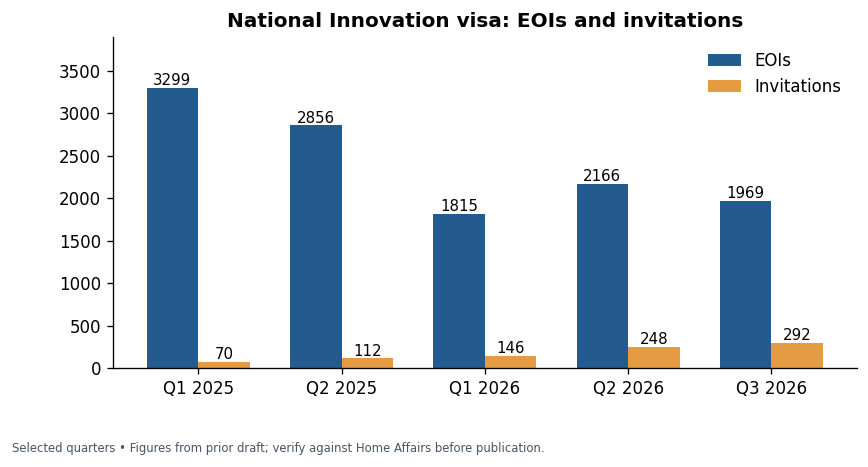
During July–September 2026, the Australian Department of Home Affairs received 1,969 Expressions of Interest and issued 292 invitations.
01_invitation_trends
Figure 1: National Innovation visa EOI volumes and invitations across selected reporting quarters.
Source: Australian Department of Home Affairs, current and previous National Innovation visa invitation rounds.
The figures demonstrate a substantial difference between expressions of interest received and invitations issued.
Across the three reported quarters of 2026, invitation volumes increased from 146 to 248 and subsequently to 292.
However, this does not establish an individual applicant’s probability of receiving an invitation. Invitations issued during one reporting period may relate to EOIs submitted in earlier periods.
The figures should therefore be interpreted as programme activity rather than individual success rates.
Invitations Across Priority Sectors
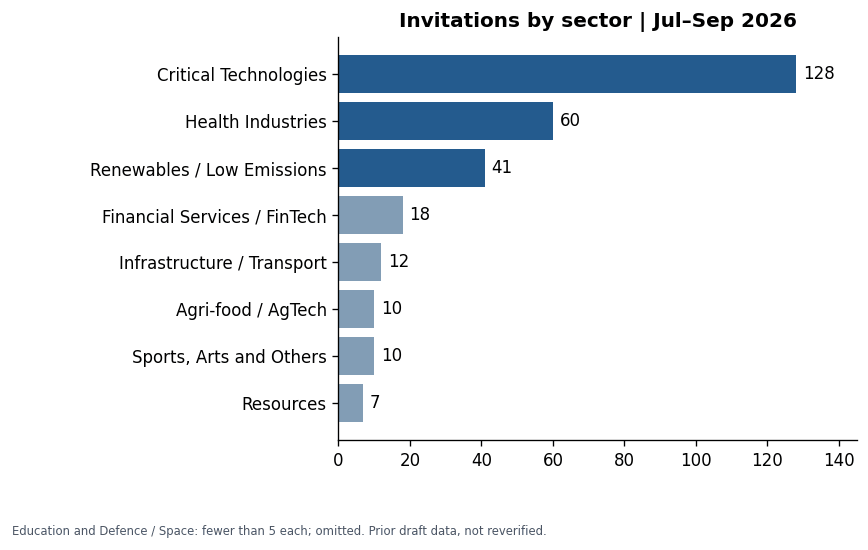
The July–September 2026 invitation statistics also illustrate the distribution of invitations across different industries.
02_sector_invitations
Figure 2: National Innovation visa invitations by sector, July–September 2026.
Source: Australian Department of Home Affairs.
05_tier_one_distribution
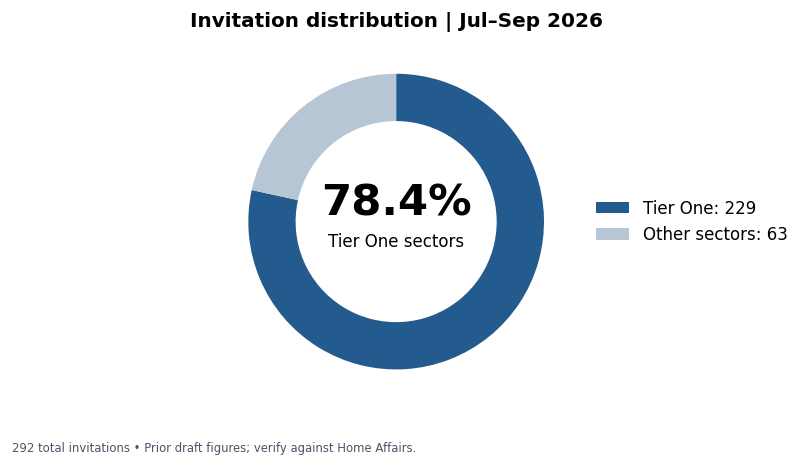
The three Tier One industry categories accounted for 229 of the 292 invitations issued during this period, representing approximately 78.4% of the total.
This includes invitations across different priority levels and should not be confused with the number issued specifically under Priority Three.
The distribution provides useful insight into programme activity, but applicants should not interpret higher sector volumes as a guarantee of favourable assessment.
Preparing Evidence of Exceptional Achievement
An effective application should explain why an applicant’s accomplishments are significant within the wider professional community.
Evidence should establish not only what the applicant has achieved but also the importance, recognition and impact of those achievements.
Researchers and Academics
Academic candidates may demonstrate professional distinction through influential research, competitive grants, international collaborations and significant scientific contributions.
Relevant evidence can include peer-reviewed publications, citation analysis, independent research assessments, prestigious academic awards, invited conference presentations and research commercialisation outcomes.
Publication counts alone provide limited insight. Citation patterns and publication practices differ considerably between academic disciplines.
A strong research portfolio should explain the significance of the work within its particular field and distinguish the applicant’s personal contribution from that of collaborators.
Entrepreneurs and Founders
Entrepreneurs should demonstrate how their business activities extend beyond ordinary commercial operations.
Relevant evidence may include independently recognised innovation, product development, commercial traction, intellectual property, reputable accelerator participation, institutional partnerships and documented market adoption.
A newly incorporated company with an ambitious business plan may have considerable future potential, but projected achievements should not be presented as completed outcomes.
Where financial or commercial figures are included, they should be supported by credible documentation.
Technology Professionals
Technology professionals may demonstrate significant contributions through innovations that have influenced industrial practices, improved technological capabilities or addressed complex challenges.
Evidence could include patents, research collaborations, significant product deployments, independently documented performance improvements and professional recognition.
An applicant responsible for a major technological development should explain their individual role rather than attribute an entire organisation’s achievements to themselves.
Innovative Investors
Innovative investors may demonstrate a record of contributing to the development and commercialisation of innovative businesses.
Evidence may include documented investments, active involvement in company development, independently recognised investment outcomes and contributions to emerging industries.
The assessment should focus on demonstrated innovation-related achievements. Personal wealth or investment capacity alone should not be treated as sufficient qualification.
Artists and Sports Professionals
Creative professionals and athletes may use international awards, competitive achievements, recognised exhibitions, performances, critical reviews and professional rankings to establish distinction.
The importance of the recognition should be explained in the context of the relevant artistic or sporting discipline.
Building an Evidence Portfolio
Applicants frequently accumulate large quantities of certificates, recommendation letters and professional documents.
A well-organised portfolio is generally more useful than an extensive collection of documents whose relevance is unclear.
| Evidence category | Purpose |
|---|---|
| Professional profile | Establish career background and expertise |
| Independent recognition | Demonstrate distinction beyond self-reported claims |
| Awards and honours | Establish recognised professional accomplishments |
| Publications and citations | Demonstrate research contributions |
| Patents and innovations | Document technological development |
| Commercial records | Support business growth and market impact claims |
| Expert assessments | Explain the significance of achievements |
| Recent accomplishments | Establish continued professional prominence |
| Australian opportunities | Support future professional establishment |
| Proposed contribution | Explain the potential benefit to Australia |
Where possible, evidence should establish the date, source, context and significance of each achievement.
Applicants should avoid submitting confidential employer information, commercially sensitive research data or third-party personal information without appropriate authorisation.
Demonstrating Continued Professional Prominence
The National Innovation visa considers whether an applicant remains active and professionally prominent.
An outstanding award received many years ago may retain considerable value, but the applicant should also demonstrate how their expertise and professional contribution have developed subsequently.
A researcher may establish continued prominence through current publications, ongoing scientific investigations and recent international collaborations.
An entrepreneur may demonstrate recent product development, commercial growth or significant partnerships.
An established technology specialist may provide evidence of current leadership in important technological initiatives.
A career interruption does not necessarily invalidate earlier achievements. However, applicants should explain their circumstances accurately and provide appropriate evidence of their current professional standing and intended future activities.
Australian Nominator Requirements
Nomination is an essential part of the formal National Innovation visa application.
The nominator must possess a national reputation in the applicant’s area of achievement and satisfy the relevant eligibility conditions.
An eligible nominator may be:
- An Australian citizen.
- An Australian permanent resident.
- An eligible New Zealand citizen.
- An Australian organisation.
The nominator’s ability to assess the applicant’s professional achievements is important.
A personal connection with an Australian resident does not independently establish that the individual is suitable to act as a nominator.
For a medical researcher, appropriate potential nominators might include distinguished Australian specialists or research organisations working in the relevant discipline.
Understanding Form 1000
Form 1000 is the prescribed nomination document for the National Innovation visa.
A completed and signed form must accompany the formal visa application, together with appropriate evidence of the nominator’s eligibility and national reputation.
Where an organisation provides the nomination, the individual signing on its behalf must have the appropriate authority.
Applicants seeking expert government agency nomination under Priority Two must also provide the prescribed nomination documentation and supporting agency statement at the EOI stage.
Approaching a Potential Nominator
Professionals should approach potential nominators through relevant and credible professional channels.
A preliminary discussion may include the applicant’s professional profile, documented achievements, existing collaborations and proposed activities in Australia.
Potential nominators should be given sufficient information to make an independent assessment.
Commercial arrangements offering guaranteed nominations should be approached with particular caution. Applicants must ensure that nomination documents and professional claims are genuine.
Demonstrating How Your Work Could Benefit Australia
Past accomplishments establish professional standing, but the proposed contribution to Australia is equally important.
Consider an entrepreneur who has developed technology for monitoring agricultural water usage.
Rather than simply promising to create jobs or support Australian innovation, the entrepreneur could explain how the technology addresses agricultural water management challenges, identify relevant industry applications and provide evidence of previous results.
A credible contribution statement should connect the applicant’s established expertise with realistic Australian opportunities.
| Professional background | Potential Australian contribution |
|---|---|
| Artificial intelligence researcher | Research capability and responsible technology development |
| Medical technology innovator | Diagnostic innovation and healthcare research |
| Renewable energy specialist | Energy efficiency and clean technology development |
| Agricultural entrepreneur | Sustainable production and resource management |
| Advanced manufacturing expert | Industrial productivity and technical capabilities |
| Distinguished academic | Research collaboration and higher education development |
| Creative professional | Cultural development and international artistic recognition |
These examples are illustrative and do not establish automatic eligibility.
Plans should remain proportionate to the applicant’s actual experience, available resources and professional opportunities.
Establishing Yourself Professionally in Australia
Applicants must demonstrate their ability to find relevant work or establish themselves independently within their field.
This requirement can be addressed through credible employment or business opportunities, research collaborations, professional networks and evidence of relevant experience.
A confirmed employment offer is not the only means of demonstrating professional establishment.
A researcher planning to continue scientific work may provide correspondence with Australian universities or research institutions. An entrepreneur may present evidence of prospective commercial partners and realistic market opportunities.
Applicants intending to work in regulated professions must investigate the relevant registration requirements.
Permanent residency does not automatically provide permission to practise medicine, nursing or other regulated professions without the necessary professional registration.
Expression of Interest and Invitation Process
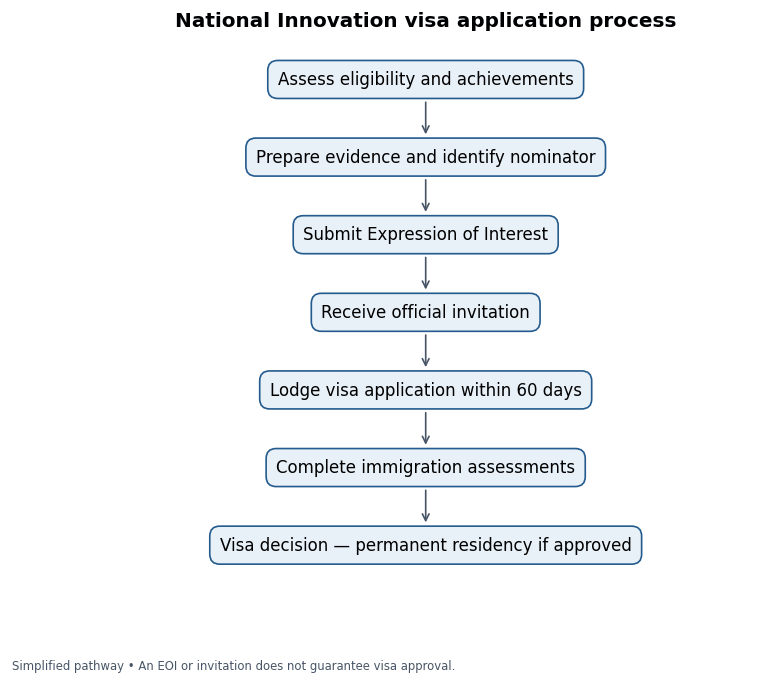
The National Innovation visa application involves two distinct stages: the Expression of Interest and the formal visa application.
An EOI allows the Department of Home Affairs to consider whether an individual should receive an invitation.
It does not independently confer immigration status, employment rights or permission to enter Australia.
Preparing the Expression of Interest
Applicants should first evaluate their eligibility, identify relevant achievements and prepare a coherent professional profile.
The EOI requires supporting materials such as passport identification, a curriculum vitae and evidence of the applicant’s highest qualification.
Documents must be submitted in English, with translations where necessary, using accepted file formats.
Applicants should ensure that the information accurately reflects their accomplishments before submission. Information cannot subsequently be added to an already submitted EOI through the same form.
Waiting for an Invitation
Expressions of Interest remain active for two years from submission.
During this period, applicants may be considered through invitation rounds administered by the Department of Home Affairs.
Submitting an EOI does not guarantee an invitation. Applicants should continue evaluating their professional opportunities and other immigration pathways rather than assume that an invitation will eventually arrive.
A materially changed professional profile may warrant consideration of a new EOI in accordance with current departmental guidance.
Lodging the Formal Application
Successful EOI candidates receive an official invitation containing the information required to lodge the visa application.
The formal application must be submitted through ImmiAccount within 60 days of the invitation.
Applicants must provide the required nomination documentation, evidence of eligibility and applicable government charges.
The Department may subsequently request additional information or undertake health, character and other verification procedures.
03_application_process
Figure 3: National Innovation visa application and decision-making process.
Documents Required for a Subclass 858 Application
Document requirements vary according to the applicant’s circumstances and professional field.
| Documentation | General purpose |
|---|---|
| Passport | Establish identity and nationality |
| Curriculum vitae | Document career and professional history |
| Qualification certificates | Establish educational background |
| Achievement portfolio | Demonstrate professional distinction |
| Form 1000 | Establish formal nomination |
| Nominator credentials | Demonstrate eligibility and national reputation |
| Recent professional evidence | Establish continued prominence |
| Australian contribution statement | Explain intended national benefit |
| Employment or business evidence | Support professional establishment |
| English language evidence | Address applicable language requirements |
| Police certificates | Support character assessment |
| Health examinations | Address applicable health requirements |
| Family documents | Establish eligible family relationships |
| Certified translations | Support assessment of non-English documents |
Applicants should follow the current document checklist available through official Home Affairs resources.
Inconsistencies between the EOI, application, professional profile and supporting evidence can create additional questions during assessment.
National Innovation Visa Fees and Financial Planning
Immigration costs extend beyond the government visa application charge.
As of November 2026, the Department of Home Affairs lists the standard primary applicant charge for the National Innovation visa as starting from AUD 6,235.
Additional charges apply for eligible family members included in the application.
Applicants aged 18 or above who do not demonstrate functional English may be required to pay a second instalment charge of AUD 4,890 per applicable applicant.
From 1 July 2026, eligible citizens of specified Pacific Island countries and Timor-Leste may qualify for reduced visa application charges under applicable conditions.
Applicants should verify current charges through the official visa pricing estimator before applying.
Illustrative Immigration and Settlement Budget
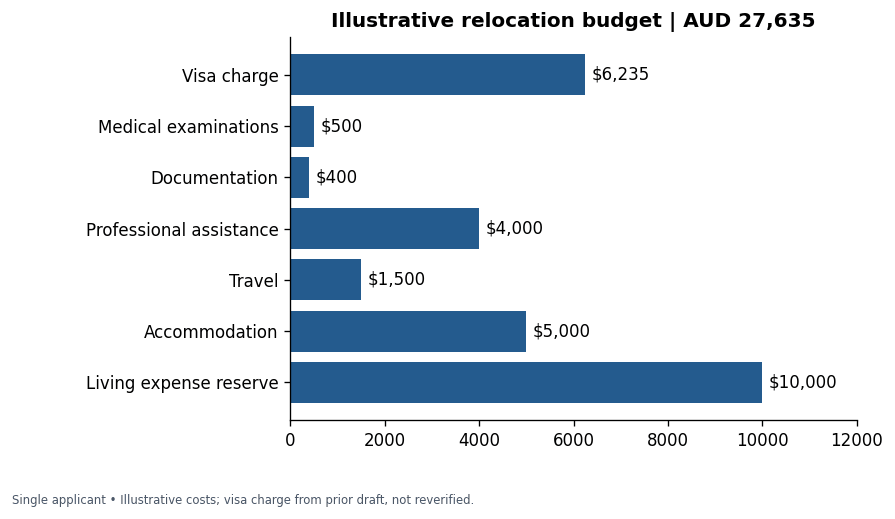
Consider a single professional planning to relocate independently to Australia.
04_relocation_budget
Figure 4: Illustrative budget for a single applicant relocating to Australia.
Except for the stated standard primary applicant charge, these amounts are hypothetical planning assumptions rather than verified market prices or government requirements.
Professional assistance is optional. Accommodation, healthcare assessments and living costs may vary considerably.
The example excludes dependent applicant charges, any applicable English language second instalment and occupation-specific professional registration costs.
A relocation budget should also accommodate unexpected delays and differences in housing costs between Australian cities.
Age, English Language, Health and Character Requirements
Unlike many points-tested skilled migration pathways, the National Innovation visa does not establish a conventional maximum application age.
Applicants who are younger than 18 or aged 55 and above, however, must demonstrate exceptional benefit to the Australian community.
This benefit should be capable of continuing after relocation rather than relying exclusively on historical achievements.
Adult applicants must address the applicable functional English requirement or pay the relevant second instalment charge.
Applicants and relevant family members must also satisfy applicable health and character conditions. Certain requirements may extend to family members who are not accompanying the primary applicant.
Police certificates may be required from countries where applicants have accumulated at least 12 months of residence during the preceding ten years since turning 16, in accordance with departmental instructions.
Individuals with complex residency histories should review these requirements early in the application preparation process.
Including Family Members in the Application
Eligible members of the applicant’s family unit may be included in a National Innovation visa application.
Common examples include spouses, eligible de facto partners and qualifying dependent children.
The Department applies specific definitions concerning dependency and family relationships. Not every relative is automatically eligible for inclusion.
Applicants should prepare the relevant identity, relationship, dependency, health and character documentation.
Family inclusion also affects the overall financial and relocation plan.
Education expenses, housing requirements, employment opportunities for partners and settlement arrangements should be considered before relocation.
Application Processing Times
The time required to obtain a National Innovation visa depends on several factors, including invitation priorities, application completeness and individual verification requirements.
Applicants should distinguish between waiting for an invitation and waiting for a visa decision following formal submission.
The Department’s published processing-time guide relates to recently decided applications. It does not predict how long an individual will remain in the EOI pool.
Applicants should avoid making irreversible employment, property or financial commitments based solely on estimated processing times.
Applying for the National Innovation Visa from the UAE
Professionals living in Dubai, Abu Dhabi or elsewhere in the United Arab Emirates can consider the National Innovation visa without necessarily relocating to Australia before applying.
Applicants must satisfy the applicable location requirements when submitting the formal application and when the visa decision is made.
UAE residence is not a separate eligibility category and does not provide automatic preference.
An expatriate researcher working in Dubai may be able to demonstrate exceptional achievement through collaborations with institutions across Europe, Asia, North America and the Middle East.
Applicants with international careers should pay particular attention to consistency between employment histories, academic records, residency documentation and professional achievements.
Police clearance requirements may involve several countries rather than the UAE alone.
Documents issued in Arabic or another language may require appropriate English translations.
Professionals should also consider existing UAE employment obligations, business commitments and relocation arrangements before making final decisions.
Practical Case Studies
The following hypothetical examples illustrate how candidates might assess their evidence and prepare for the National Innovation visa.
They do not represent actual approved applications.
Medical Technology Researcher Based in Dubai
A biomedical researcher has spent several years developing technology designed to improve early disease detection.
Her work has resulted in peer-reviewed research, international scientific collaborations and a patented diagnostic technology.
She has recently been invited to participate in research with an Australian medical institution.
Her potential application could explore:
- The significance of her scientific contributions.
- Independent recognition of the research.
- Recent achievements establishing continued prominence.
- The potential relevance of her medical technology to Australian healthcare.
- An eligible Australian nominator with an appropriate professional reputation.
- Credible opportunities to continue the research in Australia.
The strength of her case would depend on the quality and significance of the documented evidence, rather than the number of certificates or qualifications alone.
Artificial Intelligence Entrepreneur
A technology entrepreneur has developed software that improves industrial energy efficiency.
The company’s platform has been adopted by international customers and has received independent recognition for its technological contribution.
A potential application could examine the entrepreneur’s individual role, independently documented performance improvements, commercial outcomes and continued innovation.
Possible Australian contributions might involve industrial productivity, software research and relevant employment opportunities.
The entrepreneur should distinguish existing achievements from projected financial performance.
Renewable Energy Specialist
An engineering specialist has contributed to the development of advanced renewable energy storage systems adopted in several international projects.
Their evidence may include technical publications, patent contributions, independent expert assessments and documented operational outcomes.
Potential Australian opportunities could involve energy storage research, renewable infrastructure development and collaboration with engineering organisations.
As with the previous examples, sector alignment alone would not establish eligibility.
Comparing the National Innovation Visa with Other Migration Pathways
The National Innovation visa is not necessarily the most appropriate option for every experienced professional.
Other Australian migration pathways may offer more suitable opportunities depending on an individual’s occupation, qualifications and employment circumstances.
| Visa pathway | Subclass | General purpose |
|---|---|---|
| National Innovation visa | 858 | Exceptional internationally recognised achievement |
| Skilled Independent visa | 189 | Points-tested independent skilled migration |
| Skilled Nominated visa | 190 | Points-tested migration with state or territory nomination |
| Skilled Work Regional visa | 491 | Provisional skilled regional migration |
| Employer Nomination Scheme | 186 | Eligible employer-nominated permanent migration |
| Skills in Demand visa | 482 | Eligible employer-sponsored temporary employment |
Applicants should consider their overall professional and personal circumstances rather than focus exclusively on a single immigration pathway.
Choosing a Qualified Immigration Adviser
Professional assistance may be useful when interpreting complex immigration criteria, evaluating supporting evidence and preparing application documentation.
Applicants should verify the credentials of the individual responsible for providing immigration advice.
For registered Australian migration agents, the Office of the Migration Agents Registration Authority maintains a public register that can be used to verify registration.
Australian legal practitioners may also provide immigration assistance within applicable professional requirements.
Applicants engaging overseas service providers should establish who will provide the immigration advice, under what professional authority and with what contractual responsibilities.
Warning signs include guaranteed invitations, guaranteed visa approval, demands for fabricated achievements and unsupported claims of privileged access to immigration authorities.
No consultancy can independently determine the outcome of a National Innovation visa application.
Common Reasons Applications May Be Unsuccessful
The reasons for immigration decisions depend on individual circumstances. However, applicants may encounter difficulties when their evidence does not sufficiently address the relevant requirements.
| Potential weakness | Why it matters |
|---|---|
| Limited independent recognition | Exceptional achievement may be difficult to establish |
| Weak or outdated evidence | Continued prominence may not be demonstrated |
| Inappropriate nominator | Nomination requirements may not be satisfied |
| Unsupported professional claims | Credibility and verification concerns may arise |
| Inconsistent documentation | Additional scrutiny may be required |
| Unclear Australian contribution | The proposed national benefit may be insufficiently established |
| Weak professional establishment plan | Ability to pursue relevant activities may be unclear |
| Missed application deadline | The invitation may expire |
| Incomplete family documentation | Relevant family requirements may remain unresolved |
Applicants should assess each area critically before proceeding.
An unsuccessful visa application and an EOI that does not result in an invitation are different outcomes and may involve different procedural consequences.
National Innovation Visa Application Checklist
A practical preparation checklist can help applicants organise their evidence and identify areas requiring further attention.
- Confirm that exceptional professional achievements are supported by credible evidence.
- Identify the appropriate professional field and relevant priority sector.
- Document recent accomplishments and continued professional prominence.
- Explain the applicant’s personal contribution to wider organisational achievements.
- Identify a potentially eligible Australian nominator.
- Prepare the applicable Form 1000 documentation.
- Establish realistic professional opportunities in Australia.
- Develop an evidence-supported contribution statement.
- Review age, English language, health and character requirements.
- Prepare identity documents and required translations.
- Evaluate family inclusion and financial considerations.
- Verify current visa application charges.
- Review the dedicated EOI submission requirements.
- Maintain accurate copies of all correspondence and submitted documentation.
- Prepare to lodge the formal application within 60 days if invited.
The checklist is intended as a preparation resource and does not replace the official document requirements.
Permanent Residency and Settlement Planning
Receiving permanent residency is an important milestone, but successful relocation requires careful preparation.
Researchers should investigate suitable academic institutions, funding opportunities and professional collaborations. Entrepreneurs should consider Australian company regulations, potential customers, business partners and sector-specific requirements.
Professionals entering regulated occupations should review registration and recognition requirements before commencing work.
Other settlement considerations include housing, transport, healthcare, schooling, banking, taxation and retirement arrangements.
Australian permanent residence for immigration purposes should not automatically be equated with Australian tax residency. Tax residency is determined under separate rules and requires consideration of individual circumstances.
A well-prepared relocation plan should address both professional opportunities and the practical needs of the applicant and accompanying family members.
Frequently Asked Questions
Is Australia’s National Innovation visa a permanent visa?
Yes. Subclass 858 provides Australian permanent residency to successful applicants who satisfy the applicable requirements.
Has the National Innovation visa replaced the Global Talent visa?
Yes. The National Innovation visa was introduced in December 2024 as the successor to the former Global Talent pathway.
Is there a maximum age limit?
There is no conventional maximum application age. Applicants younger than 18 or aged 55 and above must satisfy additional exceptional community benefit requirements.
Is an Australian job offer mandatory?
A confirmed job offer is not the only way to demonstrate professional establishment. Applicants may also provide evidence of credible research, employment or independent business opportunities within their field.
Does the National Innovation visa use a points test?
The programme is not a conventional points-tested skilled migration pathway. Assessment focuses on exceptional achievement, professional recognition and other applicable eligibility requirements.
How much does the National Innovation visa cost?
As of November 2026, the standard primary applicant charge starts from AUD 6,235. Additional applicant charges, possible concessions and other expenses should be checked through official Home Affairs resources.
Does applying for an EOI guarantee an invitation?
No. Expressions of Interest are considered according to programme priorities and the achievements presented by candidates.
How long does an Expression of Interest remain active?
An EOI remains active for two years from submission under the published programme arrangements.
How quickly must an applicant submit the formal visa application?
Invited candidates must submit their formal visa application within 60 days of receiving the invitation.
Can an applicant nominate themselves?
No. The formal application requires nomination by an eligible individual or organisation possessing the necessary national reputation in the relevant field.
Can startup founders apply without substantial revenue?
Revenue is only one potential indicator of entrepreneurial achievement. Founders must nevertheless demonstrate exceptional recognised accomplishments through appropriate evidence. Future potential alone may be insufficient.
Can applicants include their families?
Eligible members of the family unit may be included, subject to the applicable relationship, dependency, health and character requirements.
Can professionals apply from Dubai?
Yes. Eligible professionals may apply from outside Australia, including the UAE, subject to applicable immigration requirements.
Does receiving an invitation mean the visa will be approved?
No. The formal application is independently assessed against the relevant immigration requirements and supporting documentation.
Conclusion
Australia’s National Innovation visa offers a distinctive permanent residency pathway for individuals whose achievements have established them as exceptional contributors within their professional fields.
The programme differs considerably from conventional skilled migration. Professional experience, academic qualifications and senior job titles may form part of an application, but they do not independently demonstrate exceptional achievement.
A credible application should connect sustained accomplishments, independent recognition, current professional prominence and realistic Australian opportunities.
For researchers, entrepreneurs and technology innovators, preparation involves more than assembling documents. It requires a clear understanding of what their achievements represent, how they have influenced their field and why their expertise could make a meaningful contribution to Australia.
Prospective applicants should begin with official government requirements, evaluate their evidence carefully and obtain qualified professional guidance where necessary.
References and Further Reading
- Australian Department of Home Affairs — National Innovation Visa (Subclass 858) Official eligibility criteria, visa charges, permanent residency conditions, family inclusion and supporting documentation requirements. https://immi.homeaffairs.gov.au/visas/getting-a-visa/visa-listing/national-innovation-visa-858
- Australian Department of Home Affairs — National Innovation Visa Programme Programme overview, Expression of Interest procedures and invitation requirements. https://immi.homeaffairs.gov.au/visas/working-in-australia/visas-for-innovation/national-innovation-visa
- Australian Department of Home Affairs — National Innovation Visa Priorities Ministerial Direction No. 120, priority sectors and relevant achievement indicators. https://immi.homeaffairs.gov.au/visas/working-in-australia/visas-for-innovation/national-innovation-visa/priorities
- Australian Department of Home Affairs — Current Invitation Round Official invitation statistics for July–September 2026. https://immi.homeaffairs.gov.au/visas/working-in-australia/visas-for-innovation/national-innovation-visa/current-invitation-round
- Australian Department of Home Affairs — Previous Invitation Rounds Historical National Innovation visa EOI and invitation statistics. https://immi.homeaffairs.gov.au/visas/working-in-australia/visas-for-innovation/national-innovation-visa/previous-invitation-rounds
- Federal Register of Legislation Australian immigration legislation and associated legislative instruments. https://www.legislation.gov.au/
- Office of the Migration Agents Registration Authority Migration agent registration and professional information. https://www.mara.gov.au/
- Australian Trade and Investment Commission — Austrade Australian commercial opportunities, industry information and international investment resources. https://www.austrade.gov.au/
- Services Australia Medicare, government services and applicable settlement information. https://www.servicesaustralia.gov.au/
- Australian Taxation Office Australian taxation and tax residency information. https://www.ato.gov.au/
Immigration and legal disclaimer: This article is intended for general educational purposes and does not constitute personalised immigration, legal, taxation or financial advice. Immigration requirements, invitation priorities, application charges and processing arrangements are subject to change. Prospective applicants should consult current Australian Department of Home Affairs guidance and appropriately qualified immigration professionals before making decisions.










Leave a Reply