






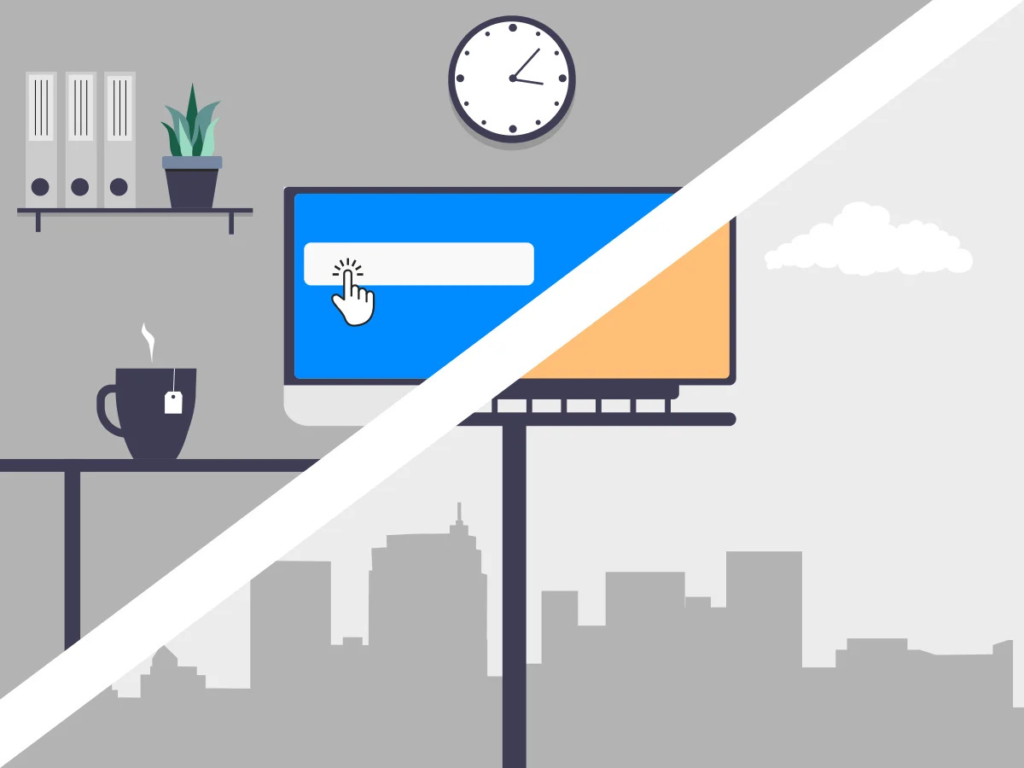
In a fully crowded market, businesses tend to measure the strength of traditional and digital advertising channels to stand out. Two different approaches to capture major attention are billboard advertising and social media ads. They are advantageous for higher reach and engagement. Understanding the format performance can help marketers make informed decisions about where to invest their advertising budgets, in an environment where visibility and interaction equally matter.
While social media platforms promise measurable engagement and targeting precision, billboards deliver unmatched public exposure.
This article states the difference between billboard advertising and social media ads in terms of reach and engagement, outlining their strengths, limitations, costs, and how businesses can use both effectively.
Understanding Reach vs Engagement in Advertising
Reach and engagement are two core metrics to evaluate advertising effectiveness, but they serve different purposes. Reach refers to how many people watch an advertisement, while engagement measures the way the audience interacts. Both metrics play a crucial role depending on campaign objectives, brand maturity, and target audience behaviour.
What Reach Means for Advertisers
Reach is about visibility and awareness. The broader the reach, the more people become familiar with a brand or message. Advertising with strong reach is effective for brand recognition, product launches, and reinforcing presence in competitive markets.
Billboards excel in reach because they are placed in high-traffic locations such as motorways, city centres, and commuter corridors. Every day, thousands of people pass by these placements repeatedly. This repetition helps embed messages in consumers’ minds without requiring any active participation.
Social media ads can also achieve a wide reach when campaigns are scaled. Reach on digital platforms is influenced by algorithms, bidding competition, and user behaviour, which can limit consistent exposure.
What Engagement Means in the Digital Age
Engagement focuses on interaction. This includes likes, comments, shares, clicks, and saves. Engagement provides insight into the audience’s response to an ad and whether it resonates enough to prompt action.
Social media advertising is designed for engagement. Users can interact with ads, click through to learn more, or share content with their networks. This level of interaction allows advertisers to gather data, refine messaging, and optimise campaigns in real time.
Billboards, by contrast, are a passive medium. They do not generate direct engagement metrics, but this does not mean they lack impact. Billboards rely on memorability and influence rather than immediate action.
How Billboard Advertising Maximises Reach
Billboard advertising is exposed to physical space where people live, work, and travel. Billboards are unavoidable as they enter a person’s line of sight and cannot be skipped, blocked or scrolled past like digital ads.
Billboards are effective in mass communication, where car travel and outdoor movement are a part of daily life in Australia. Commuters tend to see the same billboard multiple times, which reinforces brand recognition and recall through repetition.
You can also consider the ability of billboard advertising to reach a diverse audience as its greatest strength. Its exposure is not limited by age, profession and digital behaviour, which is an effective tool for campaigns aimed at broad demographics.
Social Media Ads and Engagement-Driven Results
Social media ads thrive on interaction and personalisation. Advanced targeting allows advertisers to reach users based on location, interests, behaviours, and demographics. This makes social media ideal for engagement-focused campaigns such as promotions, lead generation, and content sharing.
Engagement also provides measurable outcomes. Advertisers can track clicks, conversions, and time spent engaging with content. These insights make it easier to adjust campaigns and improve performance over time.
Engagement does not always guarantee attention. Many users interact briefly or scroll past ads without absorbing the message fully. This means high engagement numbers do not always translate into long-term brand recall.
Audience Attention and Message Retention
A key difference between billboards and social media ads lies in how audiences process information. Billboards are designed for simplicity. Short, bold messages paired with strong visuals are easy to absorb quickly, even while driving or walking.
Social media ads try to compete with a constant content stream. Before moving on, users may see an ad for a few seconds. There is a possibility of engagement even if the attention spans are shorter and more fragmented.
Billboards are effective for top-of-funnel marketing, where staying visible and memorable is more necessary than driving immediate action.
Cost Efficiency and Long-Term Impact
Cost efficiency is an important consideration when comparing reach and engagement. There is a fixed cost set for a certain period on billboard advertising, delivering consistent exposure throughout the duration of the campaign.
A bidding model is available for social media advertising, where you can observe the cost fluctuation based on competition and performance. While this allows flexibility, it can also lead to rising costs for sustained reach.
Billboards contribute to creating long-term impact through brand credibility and trust. A strong physical presence supports broader marketing efforts across other channels that signal stability and legitimacy.
Choosing the Right Balance
Rather than viewing billboard advertising and social media ads as competitors, many marketers recognise the value of using both. Billboards build awareness and reinforce brand presence, while social media ads drive engagement and measurable actions.
The best approach is to set campaign goals. Billboards are effective for businesses with the objective of a large audience reach, and that too consistently. Social media ads offer clear advantages if the goal is interaction, feedback, and conversions.
Final Thoughts
The debate between billboard advertising and social media ads comes to reach versus engagement. Billboards dominate in visibility, repetition, and broad audience exposure, while social media excels in interaction, targeting, and data-driven insights. Understanding the strengths of each allows marketers to create more balanced and effective advertising strategies that deliver awareness and engagement in today’s evolving media landscape.



Leave a Reply