






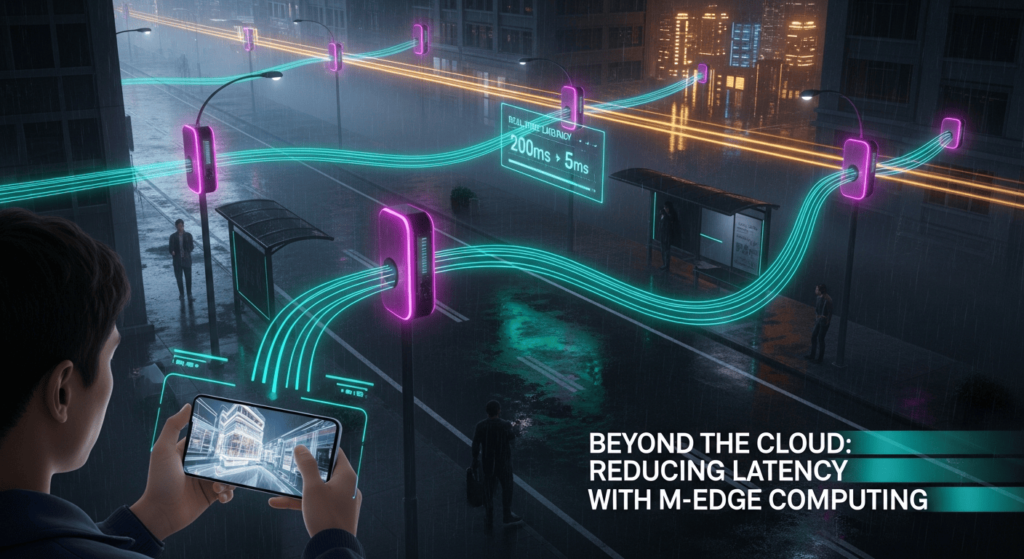
In the early 2020s, “cloud-first” was the gold standard for digital infrastructure. However, as we move through 2026, the limitations of centralized data centers have become a significant bottleneck for high-performance applications. For industries ranging from autonomous logistics to immersive retail, the round-trip delay to a distant server is no longer just a technical nuisance—it is a failure point.
Multi-access Edge Computing (MEC) has shifted the architecture from centralized power to distributed intelligence. By moving compute resources to the very edge of the network—often within the cellular base station or local gateway—MEC reduces the physical distance data must travel. This transition is critical for a 2026 audience that expects instantaneous response times and seamless mobile-first experiences.
This guide explores the strategic implementation of MEC to solve the latency crisis, providing a technical framework for decision-makers and developers alike.
The Current State: Why “Cloud-Only” Fails in 2026
As of 2026, the volume of data generated by mobile and IoT devices has surpassed the processing capacity of many traditional backhaul networks. Centralized cloud servers, while powerful, typically introduce a minimum of 50–150ms of latency due to multiple network hops.
In 2026, this legacy latency is unacceptable for several high-stakes categories:
- Safety-Critical Systems: Autonomous drone delivery and vehicle-to-everything (V2X) communication require sub-10ms response times to avoid collisions.
- Immersive Commerce: Mobile augmented reality (AR) shopping experiences suffer from “motion-to-photon” lag if processing occurs in a distant cloud, leading to user disorientation and abandoned carts.
- Privacy Compliance: Stricter 2026 privacy regulations often favor local data processing at the edge to minimize the exposure of sensitive information during transit.
The MEC Strategic Framework
To reduce latency effectively, organizations must move away from a binary “Cloud vs. Edge” mindset and adopt a tiered compute strategy.
1. The Proximity Principle
The primary value of MEC is the reduction of network hops. By utilizing resources at the network edge, data bypasses the core network entirely.
- Local Breakout: Traffic is terminated at the edge, allowing local applications to process data and send it back to the user without reaching the internet backbone.
- Distributed Offloading: Heavy computational tasks (like video rendering or AI inference) are offloaded from the mobile device to the MEC server, preserving device battery while maintaining high speed.
2. Decision Logic: What Stays and What Goes?
Not every process belongs at the edge. A balanced 2026 infrastructure follows this logic:
- MEC (Edge): Real-time telemetry, instant UI feedback, local safety protocols, and sensitive data anonymization.
- Cloud (Center): Long-term data storage, heavy model training, global analytics, and non-time-sensitive batch processing.
Real-World Application: MEC in Mobile App Infrastructure
In 2025 and 2026, we observed a pattern among high-performing digital agencies where migrating core API logic to MEC reduced latency by up to 60% for regional users.
For example, a logistics application serving the East Coast might utilize edge nodes in major hubs like Charlotte or Raleigh. This localized approach ensures that a driver requesting a route update receives a response in under 20ms, compared to 120ms if the request had to travel to a primary data center in the Midwest. This level of precision is why businesses are increasingly seeking specialized mobile app development in North-Carolina to build edge-compatible architectures.
AI Tools and Resources
- AWS Wavelength: Extends AWS services to 5G networks. It is useful for developers who need to deploy ultra-low latency applications within existing AWS environments. Best for enterprise-level scaling but may be over-provisioned for smaller localized apps.
- Vercel Edge Functions: Allows for running code at the edge without managing servers. It is ideal for frontend developers looking to reduce TTFB (Time to First Byte) for globally distributed users.
- EdgeImpulse: A 2026 leader in “TinyML.” This tool helps engineers deploy machine learning models directly onto edge devices and MEC gateways. Best for industrial IoT and hardware-centric projects.
- Akamai EdgeWorkers: Best for intensive content delivery and real-time data manipulation at the network edge. It is highly suitable for high-traffic media sites but requires a more sophisticated DevOps team to manage effectively.
Practical Application: A 3-Step Implementation Path
Implementing MEC in 2026 requires a disciplined approach to architecture.
Phase 1: Latency Mapping (Week 1-2)
Identify the specific network hops currently slowing your application. Use tools to measure the difference between “Device-to-Cloud” and “Device-to-Edge” response times.
Phase 2: Micro-Service Refactoring (Month 1)
Decompose your application into micro-services. Isolate the “hot paths”—the functions that require the lowest latency—and prepare them for deployment on MEC nodes using containerization (e.g., Docker or Kubernetes edge distributions).
Phase 3: Geographic Pilot (Quarter 1)
Deploy edge nodes in a single high-density geographic region. Monitor performance metrics and user engagement to validate the ROI before a global rollout.
Risks, Trade-offs, and Limitations
While MEC is transformative, it is not a fix-all for performance.
Honest Constraints:
- Resource Scarcity: Edge nodes have significantly less compute and storage capacity than centralized data centers. Overloading an edge node can cause “edge congestion,” leading to higher latency than the cloud.
- Management Complexity: Orchestrating deployments across hundreds of regional edge nodes is significantly more difficult than managing three major cloud regions.
Failure Scenario: The “Synchronicity Trap”
A common failure we’ve seen in 2026 occurs when an app processes data at the edge but still requires a synchronous “handshake” with a central database for every transaction.
- The Warning Sign: Latency remains high despite edge deployment.
- The Cause: The bottleneck moved from “transport” to “logic.”
- The Alternative: Use an asynchronous data eventual-consistency model where the edge node handles the immediate user response and syncs with the central cloud in the background.
Key Takeaways for 2026
- Latency is the New Uptime: In 2026, a slow app is effectively a down app. MEC is the primary tool for meeting the sub-20ms expectations of modern users.
- Strategic Tiering: Don’t move everything to the edge. Use MEC for “active” intelligence and the cloud for “passive” storage and heavy lifting.
- Build Locally, Think Globally: Leverage regional expertise and localized nodes to optimize performance where your users actually live. For those in the Southeast, integrating regional infrastructure with mobile app development in North-Carolina can provide a significant competitive advantage in 2026.
- Verify at the Edge: Always test your edge logic under real-world network conditions. What works in a simulated low-latency environment often breaks when faced with actual 2026 mobile network jitter.



Leave a Reply