





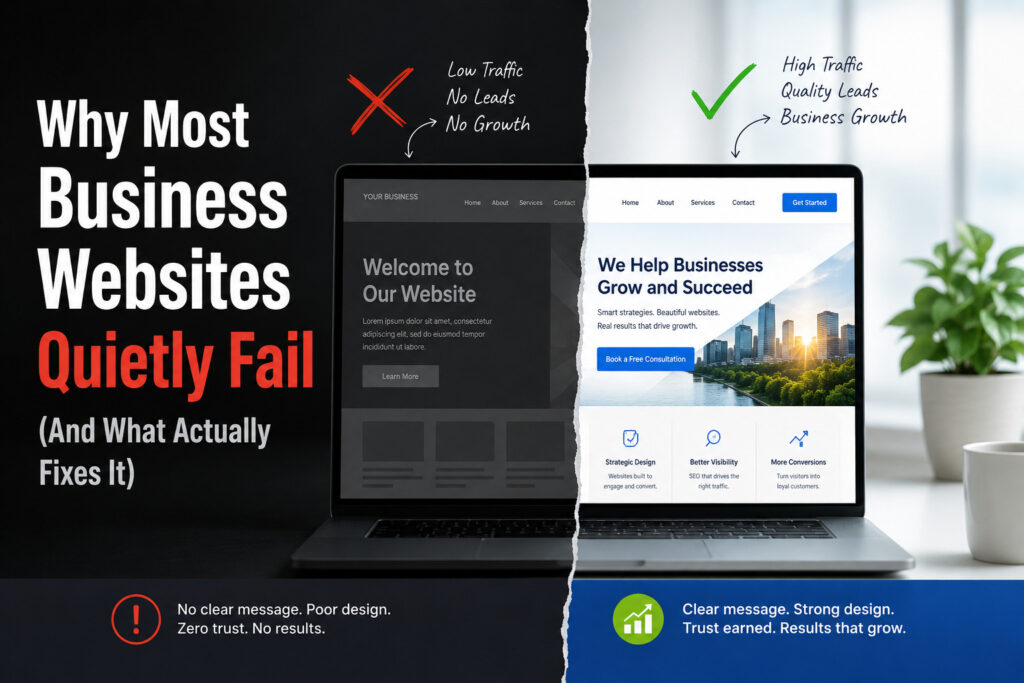
Let me be honest about something. I’ve seen businesses spend good money on websites that looked sharp at launch and did absolutely nothing for six months straight. No calls. No form fills. Barely any traffic. And when you dig into why, it’s almost never the logo or the color palette. It goes deeper than that.
The real issue is usually how the thing was built. Or more accurately, how much thought went into the build before anyone touched a design tool.
Your Website Isn’t a Brochure Anymore
There was a time when having a website just meant having a place people could find your address and phone number. That time is gone. Completely gone.
Today your site is doing sales calls at midnight. It’s answering questions your team doesn’t have time to answer. It’s either convincing someone you’re worth calling or quietly sending them to a competitor who invested more seriously in their digital presence.
Working with a proper website development agency shifts how you think about this. Instead of “we need a website,” the conversation becomes “we need a digital system that supports how our business actually operates.” That reframe matters more than most people realize going in.
What People Mean When They Say “Website Development Services”
This phrase gets thrown around loosely. Worth unpacking it.
Good website development services aren’t just about making pages. They cover the whole picture. How fast does it load on a slow mobile connection? How does Google read the page structure? What happens when a user fills out a contact form on an older Android browser? Does the site stay up when traffic spikes unexpectedly?
Most clients don’t think to ask these questions before signing a contract. Then they find out the hard way that their beautiful new site scores 38 on PageSpeed, breaks on Safari, and sends form data to an inbox nobody checks.
These aren’t small problems. They directly affect how much business the site generates. Performance, accessibility, and reliability aren’t optional extras. They’re part of the job.
The Real Problem With Templates
I want to be fair here. Template platforms have improved a lot. For a simple informational site or a personal blog, they’re genuinely fine.
But if your business has any operational complexity at all, you’re going to hit a ceiling. Custom pricing logic. Client-facing portals. Inventory systems. Multi-step booking flows. Industry-specific integrations your competitors are already using. Templates weren’t designed for any of that, and forcing them to do it means stacking plugins on top of plugins until the whole thing becomes a slow, fragile mess.
This is why the shift toward custom website development companies makes sense for businesses past a certain point. When you’re not constrained by what a theme allows, you can build exactly what your users need. Nothing more, nothing less. The result loads faster, breaks less, and actually does what you built it to do.
Custom web development services also give you cleaner code from day one. That matters for SEO, for security, and for what it costs to maintain the site over the next three years. Technical debt is real and it accumulates fast when shortcuts get taken early.
How to Tell a Good Development Partner From an Average One
This is where people tend to make expensive mistakes.
A lot of agencies present similarly. Good-looking portfolios, confident proposals, competitive pricing. But how they actually work varies enormously. Some are strong designers who outsource the technical work. Some are solid developers who produce sites that function perfectly but feel clinical and cold. Some are great at small projects and completely overwhelmed by larger ones.
Before committing to any website development company, push past the surface level. Ask them to walk you through a project that ran into problems and how they handled it. Ask what the handoff process looks like and whether your internal team will be able to make basic updates without calling a developer. Ask how they approach security. Ask what post-launch support actually includes.
The answers to those questions tell you more than any portfolio page will.
The Real Cost of Cheap Development
Here’s a pattern that plays out constantly. A business owner gets three quotes. Takes the lowest one. Gets a site built. Saves a few thousand dollars.
Then a year later, they’re paying someone else to fix what the first team built. Security vulnerabilities. A codebase nobody wants to touch. Pages that load in six seconds. Features that half-work. The “savings” evaporated and then some.
Custom website development done properly by people who care about their craft costs more upfront. It does. No point pretending otherwise. But the total cost over two or three years almost always comes out lower, because you’re not paying to fix things that should have been right the first time.
There’s also the revenue angle. Every month your site underperforms is a month of lost traffic and leads you never got back. A site built correctly isn’t just an expense. It pays for itself.
Build for the Business You’re Becoming, Not Just the One You Are Today
One quality that genuinely separates experienced development teams from less experienced ones is how they think about where you’re headed, not just where you are.
Any competent team can build something functional for launch day. What’s harder is building something that still works well two years later when your traffic has tripled, your product line has expanded, and your team needs to make updates without filing a ticket every time.
Ask the teams you’re evaluating about this directly. How does the site handle growth? How easy is it to add new features later? Will your content management setup be usable by someone non-technical on your team?
These sound like secondary concerns. They’re not. They determine how useful the site remains over its actual lifespan.
Final Thought
Your website is often the first real impression a potential customer gets of your business. Not the first ad they saw. Not the first search result. The first time they actually sit down and try to understand what you do and whether you’re worth trusting.
Getting that right takes more than a good design. It takes development work done properly, by people who understand both the technical requirements and the business context behind them. The right custom web development services team asks hard questions before writing a line of code. They care whether the thing actually works, not just whether it ships on schedule.
That’s the kind of partner worth finding.









Leave a Reply