






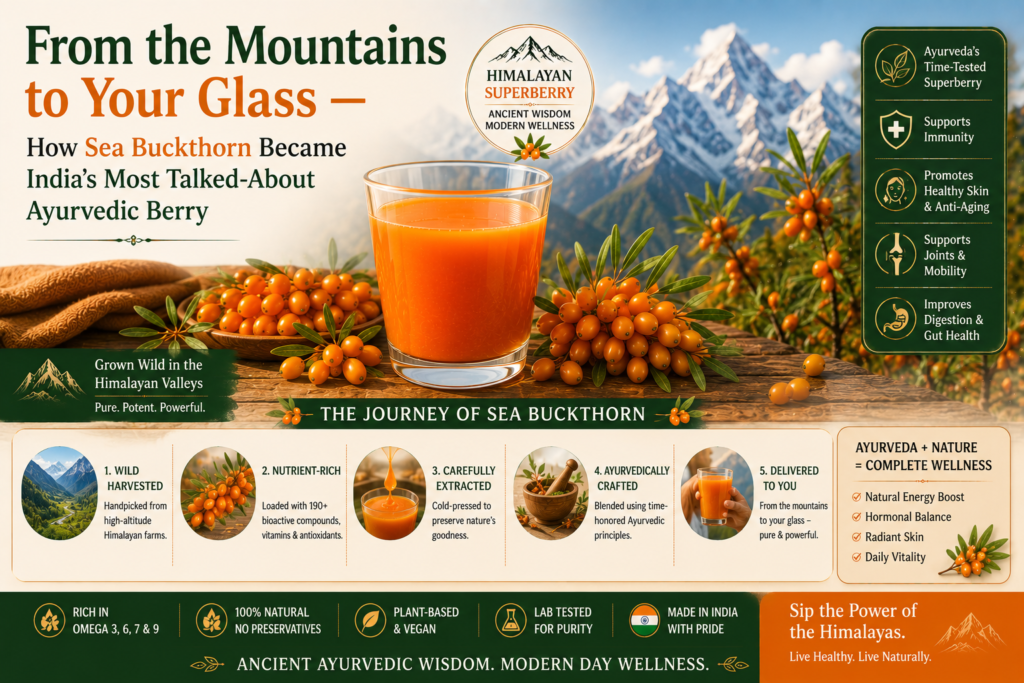
You Have Been Seeing This Name Everywhere — Here Is Why
| A health influencer mentions it. Your colleague brings it up after a doctor visit. A wellness brand you follow has launched a new product line around it. Sea Buckthorn is appearing in conversations across India — in gyms, clinics, beauty routines, and Ayurvedic consultations. But most people are still asking the same question: what exactly is it? |
This is not a new ingredient that arrived from a foreign market. Sea Buckthorn has been growing in the Indian Himalayas for centuries — documented in Ayurvedic texts, consumed by Ladakhi and Himachali communities across generations, and quietly studied by nutrition researchers since the 1980s.
The reason it is suddenly mainstream is simpler than most people realise: India is finally catching up to what its own mountains have been offering all along.
Sea Buckthorn Origin and History — Older Than Most Superfoods
The Sea Buckthorn origin and history trace back thousands of years across the Tibetan Plateau and the cold mountain ranges of Central Asia. Ancient Greek texts reference it as a herb used to maintain the health of horses during long military campaigns — the animals’ coats became noticeably shinier and their recovery from exertion faster.
In Ayurveda, it appears under the name Amlavetasa — a compound meaning ‘sour cane of the mountains.’ Classical texts including the Charaka Samhita reference it in the context of Rasayana formulations: preparations designed not to treat illness but to build the body’s resilience before illness can take hold.
Traditional Tibetan medicine, which shares deep roots with Ayurveda, used it extensively for lung health, skin nourishment, liver support, and as a general restorative during the harsh Himalayan winters. It was never a speciality ingredient — it was a staple.
Where It Grows in India — The Ladakh and Himachal Connection
India’s Sea Buckthorn India growing regions are concentrated along the cold-arid belt of the Himalayas — primarily Ladakh, the Lahaul and Spiti valleys in Himachal Pradesh, and parts of Uttarakhand. The plant thrives in conditions that most crops cannot survive: altitudes between 3,000 and 5,000 metres, sub-zero winters, thin soil, and intense UV radiation.
In Sea Buckthorn Ladakh and Himachal Pradesh communities, the berry was historically harvested once a year — typically between September and October — then dried, pressed into oil, or consumed as a freshly extracted juice before the deepest part of winter. The bright orange colour of the berries, almost luminescent in sunlight, made them easy to identify on the otherwise bare slopes.
The Government of India has recognised Sea Buckthorn as a strategically important plant, particularly in Ladakh, both for its nutritional value and its role in soil stabilisation in ecologically fragile zones. State-level initiatives in Himachal Pradesh have supported its cultivation as a commercial crop for tribal and hill communities.
Why Nutrition Scientists Are Calling It a Superfood — And Ayurveda Already Knew
The term ‘superfood’ is thrown around loosely, but Sea Buckthorn superfood Ayurveda credentials are genuinely backed by phytochemical research. The berry carries over 190 bioactive compounds — a density that is unusual even among well-studied medicinal plants.
What separates it from other Ayurvedic berries is a specific combination: it is one of the only plant sources in the world to carry all four Omega fatty acids — 3, 6, 7 and 9 — alongside high concentrations of Vitamin C, fat-soluble Vitamin E, and a broad carotenoid spectrum.
This matters because most plant-based immunity and wellness ingredients are strong in one or two areas. Sea Buckthorn covers the full spectrum — immunity, skin, joints, digestion, and energy — without needing to be combined with other herbs for basic efficacy.
Sea Buckthorn vs Amla — India’s Two Himalayan Rasayanas Compared
The Sea Buckthorn vs amla comparison comes up frequently, largely because amla is already deeply embedded in Indian wellness culture. Both are classified as Rasayana herbs in Ayurveda. Both are rich in Vitamin C. Both support immunity. So why is Sea Buckthorn generating separate attention?
| Parameter | Amla | Sea Buckthorn |
| Vitamin C content | 600–900 mg per 100g | 400–2,000 mg per 100g (varies by altitude) |
| Omega fatty acids | Negligible | Omega 3, 6, 7 and 9 — all four present |
| Carotenoids | Moderate | Very high — responsible for deep orange colour |
| Ayurvedic classification | Rasayana, Tridoshic | Rasayana, Vata-Pitta pacifying |
| Primary traditional use | Digestion, immunity, hair | Energy, skin, immunity, joint health |
| Availability in India | Widely available, all regions | Himalayan belt — Ladakh, Himachal, Uttarakhand |
The honest answer is that they are not competitors — they address overlapping but distinct needs. Amla is the more accessible daily tonic with a longer track record in Indian kitchens. Sea Buckthorn offers a broader nutritional range, particularly in Omega fatty acids, which amla does not provide in meaningful quantities.
For people dealing with skin dryness, joint stiffness, or persistent fatigue — concerns that Omega-7 and Omega-3 directly address — Sea Buckthorn fills a gap that amla alone cannot.
From Mountain Berry to Your Daily Glass
For most Indians outside Ladakh and Himachal Pradesh, fresh Sea Buckthorn berries are not accessible. The supply chain from remote mountain harvests to urban kitchens is not yet mature enough for fresh produce distribution at scale.
This is where formulated Sea Buckthorn Juice becomes relevant — not as a shortcut but as the practical bridge between what the Himalayas produce and what a household in Pune, Chennai, or Jaipur can realistically consume daily.
Jeena Sikho’s Swaranfalam Amrit is one such formulation — combining Amlavetasa (Sea Buckthorn Berry) with Ashwagandha in a ready-to-use juice available in Apple, Mango, and Orange variants. It brings the Himalayan Rasayana into a format that requires no preparation, no sourcing effort, and no compromise on the core nutritional intent.
The Mountain Always Knew — We Are Just Listening Now
Wellness trends come and go. Most do not survive contact with clinical nutrition research. Sea Buckthorn has lasted thousands of years across multiple traditional medicine systems — Ayurveda, Tibetan medicine, and Central Asian folk medicine — because it delivers consistently, not because it is fashionable.
The current wave of attention in India is not the origin of Sea Buckthorn’s story. It is simply the moment urban India caught up to what the mountains of Ladakh and Himachal Pradesh have known for centuries.
If you have been seeing this name everywhere and wondering whether it deserves the attention — it does. And it did, long before anyone in the wellness industry started talking about it.
Medical Disclaimer
This article is for informational and educational purposes only. It does not constitute medical advice. Readers with existing health conditions or those on prescribed medication should consult a qualified physician or Ayurvedic practitioner before making changes to their wellness routine. Individual responses to herbal preparations may vary.









Leave a Reply