






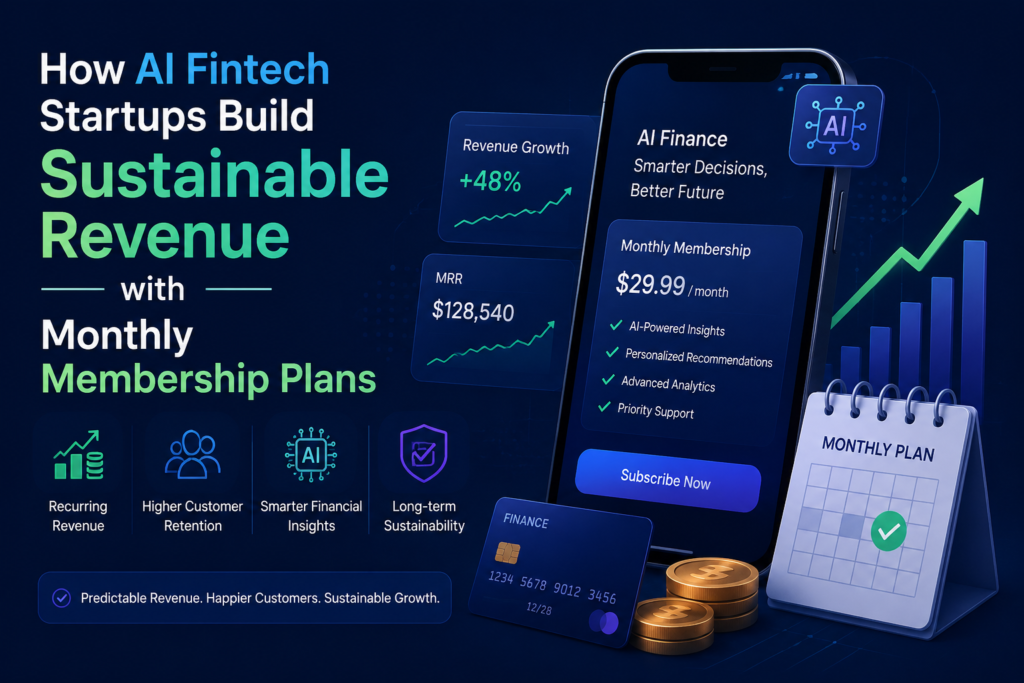
Most people think building a fintech product is the hard part. It’s not. The hard part is getting paid for it consistently, month after month, without chasing new customers every quarter.
That’s where monthly membership plans come in. AI fintech startups are leaning into this model harder than ever, and not because it’s trendy. It works.
A customer who pays once is nice to have. A customer who pays every month is closer to a business partner. The subscription model has quietly become one of the smartest moves in fintech app monetization, and the numbers back it up. A Zuora report found that subscription-based businesses grew nearly 5 times faster than the S&P 500 over the last decade. That kind of growth doesn’t happen by accident.
If you’re building, advising, or investing in a fintech product, it helps to understand why this model keeps winning and how to make it work in practice. A lot of that comes down to how the underlying product is built. Teams that work with an experienced fintech software development company tend to design billing and data infrastructure that can handle recurring revenue without breaking under scale.
Why Fintech App Monetization Works Best with Subscriptions
The satisfaction of making a lump sum once is wonderful. However, once the money hits your bank account, it drains dry, and you have to go back into the mode of working hard for the next round of clients. Subscription business models completely alter that equation.
For AI-driven fintech products specifically, subscriptions make even more sense. These products usually:
- Improve over time as they gather more user data
- Offer personalized insights that get sharper with continued use
- Run on ongoing compute costs, so a one-time charge never really covers the long-term bill
Look at the strongest AI fintech apps out there: budgeting tools, credit score monitors, automated investment platforms. Nearly all of them charge monthly. That’s not a coincidence. It’s a business model built around how the product actually behaves.
Structuring a Membership Plan People Actually Buy
All tiers of subscriptions are not created equal, and many startups fall short on this front. Some underprice themselves into oblivion. Others overprice themselves out of existence. The cure lies in aligning your pricing model with the actual value that a customer derives.
A simple three-tier setup tends to work well:
- Free or Freemium — give something of real value here, not a crippled demo. This tier should show what the product can genuinely do, since it’s what feeds your paid funnel.
- Core or Standard — this is where most paying users land. Price it for individual users or small teams and load it with the features that solve the main pain point.
- Premium or Pro — built for power users or teams who need deeper data, more integrations, or priority support. Price it to match.
One thing that most AI fintech start-ups forget is that the difference between free and paid should be made valuable enough to cross; otherwise, people will just run away from the service. But once they realize what they have been missing out on, they pay voluntarily.
Using AI to Reduce Churn and Improve Retention
Churn is the enemy of recurring revenue, and this is where being an artificial intelligence company actually pays off, because you get to use your own tools to fight it.
The AI model can spot users who seem to be drifting away before unsubscribing them, and prompt nudges that really have some meaning behind them, such as a reminder of a product that they haven’t tried yet, or a small note about how much they’ve saved for the month.
With generative AI, these efforts will become more effective, as instead of getting a generic message saying thank you for being their subscriber, the user will get an email written like it was from a person who understands their situation. “You saved $340 for this month by not using ATM” sounds way better.
The data support this. McKinsey has found that companies personalizing at scale see 40% more revenue than those that don’t. In fintech, that’s not a rounding error.
Fintech Growth Strategies That Support the Subscription Model
Building a subscription business isn’t just about the pricing page. A handful of growth strategies consistently back this model up:
- Annual billing discounts — offer two months free for yearly commitments. This cuts churn fast because users have already committed for the year ahead.
- Referral loops — give users a reason to bring others in. A free month for a referral costs you almost nothing compared to paid acquisition.
- Usage-based upsells — when a user hits a limit on their tier, treat that as a natural upgrade moment instead of a wall. “You’ve reached your transaction limit. Upgrade for unlimited access” does the job.
- White-labeling for B2B — if the product can be sold to other businesses as a platform, the subscription model scales fast. One enterprise contract can be worth 200 individual subscriptions.
Some of these calls are hard to make from inside a fast-moving team. That’s where outside input helps. AI consulting services can point fintech teams toward which features are worth building next and how to price them, saving a lot of expensive pivots down the road.
What Makes a Membership Plan Feel Worth It
There’s one thing separating subscription products that grow from the ones that quietly die: users need to feel the value every single month, not just on signup day.
That means regular updates are something that people actually notice. Monthly summaries that remind them what the product has done for them, support that treats paying customers like paying customers, and real transparency about how their data gets used, which matters even more in fintech than most industries.
AI fintech startups that get this right end up with something rare. A product people don’t want to cancel. Not because canceling is hard, but because the value is obvious every time the bill comes through.
Read this: Top FinTech Software Testing Companies in the USA (2026): A Complete Buyer’s Guide
The Bottom Line
Monthly membership plans aren’t a shortcut. They’re a long-term bet on developing something people genuinely need. For AI fintech startups, the model fits how these products actually work. They get smarter over time, they deliver value continuously, and they cost money to run every single day.
The startups winning right now aren’t just building good AI. They’re building sustainable businesses around it, and subscriptions are a big part of how they’re doing it. If you’re mapping out your monetization strategy, start with the value your product delivers every month. Price it around that. Then build the infrastructure to keep delivering it.









Leave a Reply