







Abstract
Scientific assignments often require accurate calculations, the correct application of scientific formulae, practical analysis, and conclusions, making them challenging for many students. This guide provides a comprehensive overview of the advance study assignment densities of solids and liquids, helping science students understand key concepts, laboratory procedures, density calculations, and data interpretation to produce higher-quality coursework.
Students who require additional academic guidance may also benefit from a professional assignment writing service when tackling complex laboratory-based assignments or scientific reports.
Introduction: Why Density Is More Important Than Students Think
Density is one of the most fundamental physical properties studied in physics, chemistry, engineering, and material sciences. It helps in understanding how substances behave under different physical conditions and has numerous real-world applications. A deep understanding of density enables science students to explain the behavior of solids and liquids, interpret laboratory findings, and apply scientific principles accurately in academic assignments and practical investigations.
Density describes the amount of mass contained within a given volume and provides valuable insights into the composition, structure, and behaviour of different materials. From identifying unknown materials in chemistry laboratories to designing ships in engineering, density plays a crucial role across multiple scientific disciplines.
According to the data published by the Institute of Physics using Higher Education Statistics Agency (HESA) statistics, physics and chemistry continue to represent specialist disciplines within UK higher education, highlighting the importance of developing strong practical and analytical skills for laboratory-based coursework. About 1% of students study physics, which constitutes approximately 22,390 students. Similarly, chemistry students also make up 1% in the UK, which is about 23,995.
There is a common assumption that something heavier must be denser than something lighter. In fact, density is dependent on the mass and volume of the object, so that a large object can be less dense than a smaller object. Understanding this relationship is essential for an accurate scientific analysis, laboratory investigations, and problem-solving. Therefore, this guide explains the theory, practical techniques, and calculations that provide you with an easy way to complete the densities of solids and liquids assignment, enabling students to strengthen both their scientific understanding and academic writing. Students seeking additional support may also consider assignment help online for guidance with complex laboratory reports and scientific coursework so that their concepts are clear and they can write the assignment efficiently.
Understanding Density: The Foundation of Matter
A successful density of solids and liquids assignment requires a detailed understanding of matter, its different states and types, and its relationship with volume. According to Purdue University, density is defined as the amount of mass contained within a given volume of a substance. It is a useful way to explain to scientists how some materials sink and others float, and it has practical applications across chemistry, physics, engineering, and environmental science. The SI unit for density is kg/m³, and the unit used in the laboratory is g/cm³ or g/mL.
When completing a density assignment, it is essential to understand the formula for both solids and liquids:
Density (ρ) = Mass (m) ÷ Volume (V)
ρ = m/V
For example:
ρ = 12 kg ÷ 5 L = 2.4 kg/L
This relationship shows that density increases when mass increases while volume remains constant, and decreases when volume increases while mass remains unchanged. In the solids and liquids density coursework, it is necessary to mention units and convert them appropriately and accurately.
For instance, 1 g/cm³ is equivalent to 1000 kg/m³, and 1 mL equals 1 cm³.
In addition, it has been recognised that density is considered a characteristic property because it remains constant for a pure substance under the same conditions. The density laboratory assignment, comparing different substances, is important. These substances include aluminium, iron, and copper.
The Science Behind Density in Solids and Liquids
The density of a substance is directly influenced by the arrangement, spacing, and packing of its particles. Understanding these factors is essential when completing an advanced density assignment or laboratory investigation. Some solids are denser than others because their particles are packed more tightly together, resulting in greater mass within the same volume.
A density experiment assignment helps students understand how atomic structure, molecular arrangements, and particle concentration influence the density of different materials. Atomic mass also contributes to the density, because the heavier the atom, the greater its mass per unit volume. The crystal structure of a material also influences its density by determining how atoms are arranged in the solid. Materials with the same composition can have different densities because of the different arrangements of atoms in the solid.
Liquids also vary in density because of differences in molecular spacing and intermolecular forces, and temperature. When preparing an advanced density assignment, students should explain how intermolecular forces influence molecular spacing and, consequently, the density of liquids. Liquid density also depends on temperature. As temperature increases, its particles move further apart, causing the liquid to expand and its density to decrease.
Key points to remember!
- In contrast, solids generally have higher densities than liquids because their particles are closely packed in fixed positions.
- Liquids have moderately packed particles that can move past one another.
- Gases have the lowest density because their particles are widely separated and occupy much larger volumes.
- Applying particle theory to density helps explain and predict.
Measuring Density of Regular Solids Step-by-Step
Determining the density of a regular solid is straightforward provided accurate measurements and calculations are carried out. In the density practical assignment, students should identify the density of either a liquid or a solid. The essential laboratory equipment includes:
- A balance for measuring mass
- A ruler for basic dimensions
- A vernier calliper for more precise measurements of length, width, or diameter.
The first step is to measure the mass of the solid using a balance and record the mass in grams (g) or kilograms (kg). Secondly, calculate the volume based on the object’s shape. The volume of a cuboid is calculated by multiplying its length, width, and height. After obtaining both measurements, the density can be calculated using the following formula:
Density (ρ) = Mass (m) ÷ Volume (V)
For example, consider a cuboid with a mass of 120 g and dimensions of 5 cm × 4 cm × 2 cm. The volume is:
Volume = 5 × 4 × 2 = 40 cm³
Therefore:
Density = 120 g ÷ 40 cm³ = 3 g/cm³
In the density calculations assignment, it has been observed that students make mistakes by recording incorrect dimensions. These errors often lead to inaccurate density values and may reduce marks in laboratory reports and practical assessments. Students should therefore verify all measurements before performing calculations.
Measuring Density of Irregular Solids Using Water Displacement
Why Regular Methods Fail
The density of irregular solids is difficult to measure using standard geometric methods because they do not have regular shapes to use standard geometric volume to determine density. Density is the amount of matter in a particular space. In view of this, metal samples, such as stones, metal objects, or natural materials, do not have uniform surfaces or dimensions and cannot be measured accurately using traditional geometric measurement methods.
The Water Displacement Method
In the density of liquids experiment, the volume of irregular solids is determined using the water displacement method. To perform this experiment, the mass of the object needs to be measured first using a balance. Then, measure the initial water level in a measuring cylinder. Carefully immerse the object completely in the water and record the new water level.
Using a Eureka Can
In comparison to the water displacement method, the Eureka Can experiment is an alternative approach. Once the object is placed in the water-filled Eureka can, the water displaced passes through the spout and can then be measured in a measuring cylinder. This technique minimises reading errors and can improve measurement accuracy by reducing reading errors.
Worked Example
If a stone has a mass of 150 g and displaces 50 cm³ of water, its density is:
Density = 150 g ÷ 50 cm³ = 3 g/cm³
Measuring Density of Liquids Accurately
Equipment Needed
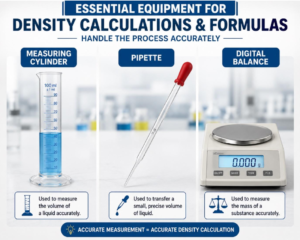
When performing density calculations and formulas, it is necessary to follow each step carefully to obtain accurate results. The following equipment is required:
- Measuring cylinder
- Pipette
- Digital balance
Experimental Procedure
- It is necessary to utilise a digital balance to measure and record the mass of an empty container.
- After that, a pipette or measuring cylinder is used to add a known volume of liquid to the container.
- The third step is to measure the mass of the container and liquid.
- Finally, subtract the mass of the empty container to find the mass of the liquid.
Determine the density using the formula:
Density (ρ) = Mass (m) ÷ Volume (V)
Suppose 100 mL of water has a mass of 100 g:
Density = 100 g ÷ 100 mL = 1.0 g/mL
If 100 mL of oil has a mass of 90 g:
Density = 90 g ÷ 100 mL = 0.9 g/mL
Considering this example, it has been recognised that oil has a lower density than water; that is why it floats on the surface of the water.
Density Investigation Skills That Earn Higher Grades
Identifying Unknown Materials
During a density of solids experiment, students should be able to identify unknown materials. Specific gravity and density are key factors that help identify and differentiate materials accurately. A density similar to 2.7 g/cm³ can mean that it is likely to be made of aluminium, whereas a density close to 8.9 g/cm³ may indicate that the material is made of copper.
Comparing Multiple Samples
Density investigations often involve comparing different materials such as:
- Metals (e.g., aluminium, iron, copper)
- Plastics with varying compositions
- Liquids such as water, oil, and ethanol
Scientific Interpretation
When interpreting the results of this experiment, the appropriate scientific interpretation is to explain the experimental process and acquired findings. Compare the recorded values with expected results, refer to possible experimental errors, and discuss how density affects the behavior of materials.
Data Analysis and Graphs in Density Experiments
If a student is writing an assignment or a laboratory report on density, the analysis should include organising experimental data and interpreting graphs.
Organising Experimental Data
As a student, you need to eliminate calculation errors and use tables to present the findings clearly.
- Record all mass measurements using the appropriate units.
- Ensure every recorded measurement includes the correct unit of measurement.
- Record volume measurements using the appropriate units.
- Present the calculated density values clearly within the result table.
Density from Graphs
While writing a density determination practical assignment, you can analyse graphs showing volume plotted on the x-axis and mass plotted on the y-axis. The density of a substance is equal to mass/volume and represents the density of the substance.
Interpreting Trends
- Showing consistent density values and linear relationships
- Identify any outliers, as they may indicate measurement or recording errors.
Sources of Error and How to Improve Accuracy
In density units and conversions, students commonly make mistakes in unit conversions, data recording, sourcing, and density data analysis. Instrumental errors, human errors, and experimental errors are basic mistakes in the density experiments and laboratory reports.
Instrument Errors
- While writing an assignment or performing an experiment, if you make mistakes when using laboratory instruments, your findings will be affected.
- Calibration errors in balances may lead to incorrect mass measurements.
- Limits in the measuring cylinder may reduce measurement accuracy, particularly for small volume changes.
Human Errors
- Human errors include systematic errors, where students make mistakes in the process, calculations, or measurements.
- Parallax error is a measurement error that occurs when the liquid level is not viewed at eye level.
Experimental Errors
- Experimental errors include contamination of samples, additional substances, etc.
- An air bubble that is adhered to an object may cause the volume to be reported as greater.
- Wet samples could result in added weight and affect calculations.
- The volume of liquids can change with temperature changes, which affects the recorded density values.
Common Mistakes Students Make in Density Assignments
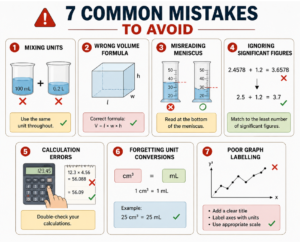
The following are the common mistakes that you must avoid when writing an assignment on the density of solids and liquids.
- Mixing units
- Wrong volume formula
- Misreading meniscus
- Ignoring significant figures
- Calculation errors
- Forgetting unit conversions
- Poor graph labelling
Quick Density Reference Table
| Material | Density (g/cm³) |
| Water | 1.00 |
| Ice | 0.92 |
| Aluminium | 2.70 |
| Iron | 7.87 |
| Copper | 8.96 |
| Mercury | 13.6 |
Conclusion
Scientific assignments can be challenging and require accurate analysis, careful calculations, and scientific understanding. When writing an assignment on the density of solids and liquids, it is necessary to understand basic calculations, measurement techniques, and the behaviour of solids and liquids at the molecular level. In this guide, the advanced study assignment densities of solids and liquids has been explained through practical guidance, worked examples, and laboratory techniques while highlighting common mistakes to avoid so that students can improve both their scientific understanding and academic performance. For accurate results and correct identification of materials, precise measurements are essential. In addition to laboratory environments, density is important in science, engineering, health care, and industry.
FAQs
How is the density of solids measured?
To measure the density of solids, measure the object’s mass using a balance and determine its volume using dimensions or the water displacement method. Density is then calculated by dividing the mass by the volume.
What is the relationship between mass, volume, and density?
Density is a measure of mass per unit volume. It is determined by dividing mass by volume, or more simply, the amount of mass in a given volume.
What units are used to measure density?
Common density units include SI ( Système International d’Unités) units of measurement such as grams per cubic centimetre (g/cm³) and grams per millilitre, as well as the SI unit of kilograms per cubic metre (kg/m³).
What are common sources of error in density experiments?
The most common sources of error are parallax errors when reading volumes, uncalibrated balances, air bubbles, temperature changes, wet samples, and errors in recording data or performing calculations.
What is the difference between density and specific gravity?
Density is the mass per unit volume of a substance and is expressed using standard units such as g/cm³ or kg/m³. Specific gravity is a dimensionless value that indicates the density of a substance in relation to the density of water.









Leave a Reply