






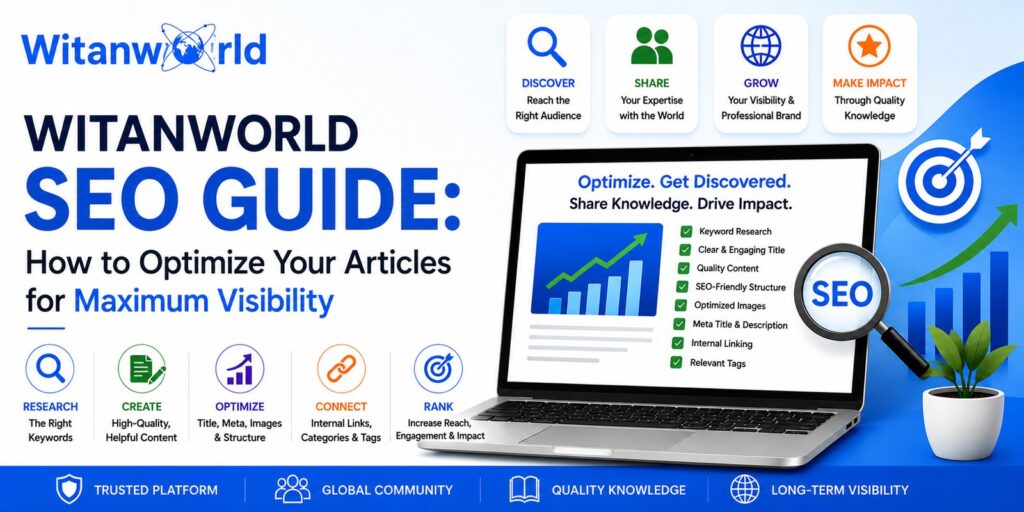
This is a practical guide: Learn how to optimize your Witanworld articles so they are easier for readers and search engines to discover.
Estimated Reading Time: 18–22 Minutes
Introduction
Publishing an article is only the first step toward sharing your knowledge.
The real impact comes when your article is found, read, shared, and referenced by the people who need it most.
Whether you are publishing professional insights, research, tutorials, case studies, or thought leadership, optimizing your content for search engines (SEO) helps increase its visibility both within Witanworld and across the web.
Search Engine Optimization (SEO) is the process of making your content easier for search engines such as Google, Bing, and other discovery platforms to understand, index, and rank.
Well-optimized articles can continue attracting readers for months or even years after publication, making SEO one of the most valuable skills every author should learn.
This guide explains the SEO best practices recommended for publishing articles on Witanworld.
What is SEO?
Search Engine Optimization (SEO) is the practice of improving your content so that search engines can better understand:
- What your article is about
- Who it is intended for
- Which search queries it answers
- Why it is valuable
Good SEO helps connect your knowledge with readers who are actively searching for answers.
SEO is not about manipulating search engines or stuffing keywords into content. Instead, it focuses on creating useful, well-structured, and relevant articles that provide genuine value.
Why SEO Matters on Witanworld
Every day, people search online for:
- Professional advice
- Industry insights
- Tutorials
- Research
- Business strategies
- Technology trends
- Career guidance
- Educational resources
Optimizing your article increases the likelihood that it will be discovered by these readers.
Benefits include:
- Increased article visibility
- More readers
- Higher engagement
- Greater knowledge sharing
- Stronger professional reputation
- Long-term traffic from search engines
Before You Start Writing
Successful SEO begins before writing your first sentence.
Ask yourself:
- What problem does this article solve?
- Who is my target audience?
- What questions are they asking?
- Which keywords would they search for?
Having a clear purpose makes it easier to write focused content.
Choose the Right Focus Keyword
Every article should target one primary keyword.
Examples:
✅ Artificial Intelligence in Healthcare
✅ Digital Marketing Strategy
✅ Supply Chain Optimization
❌ Technology
❌ Business
Broad keywords are extremely competitive.
Specific keywords are more useful and more likely to attract relevant readers.
Write a Clear SEO-Friendly Title
Your title should:
- Explain exactly what the article covers
- Include the primary keyword naturally
- Encourage users to click
- Be clear rather than clever
Examples:
- How Artificial Intelligence is Transforming Healthcare
- Beginner’s Guide to Digital Marketing
- 10 Cybersecurity Best Practices for Small Businesses
Avoid vague titles such as:
- My Thoughts
- Technology Today
- Business Ideas
Create an Effective URL Slug
Keep URLs:
- Short
- Descriptive
- Keyword-focused
- Lowercase
- Hyphen-separated
Good example:
artificial-intelligence-healthcare-guide
Poor example:
article123-new-final-version-updated
Write an Engaging Introduction
The first paragraph should quickly answer:
- What is this article about?
- Who is it for?
- What will readers learn?
Search engines often analyze introductory paragraphs when determining article relevance.
Structure Content Using Headings
Use headings to organize your article.
Recommended hierarchy:
H1
H2
H3
H4 (only when necessary)
Good headings improve both readability and SEO.
Write for Humans First
Never write for search engines alone.
Instead:
- Explain clearly
- Use simple language
- Break up long paragraphs
- Include examples
- Make articles easy to scan
If readers enjoy your article, search engines are more likely to value it as well.
Naturally Use Keywords
Use your primary keyword naturally in:
- Title
- Introduction
- One or two headings
- Throughout the article where relevant
- Conclusion
Avoid excessive repetition.
Keyword stuffing can reduce readability and may negatively affect search performance.
Write Comprehensive Content
Search engines increasingly favor content that answers a topic thoroughly.
Instead of writing:
“What is AI?”
Consider covering:
- Definition
- Benefits
- Challenges
- Applications
- Future trends
- Examples
- Best practices
Comprehensive content provides greater value to readers.
Optimize Images
Images make articles more engaging.
Best practices:
- Use high-quality images.
- Keep file size below 250 KB (recommended for Witanworld).
- Use relevant filenames.
- Add descriptive alt text where supported.
- Avoid blurry or pixelated graphics.
Internal Linking
Link to other relevant Witanworld articles whenever appropriate.
Examples:
- Beginner’s Guide
- Publishing Guidelines
- Editorial Review
- AI Writing Guidelines
Internal links help readers continue learning while strengthening the overall knowledge ecosystem.
External Links
Use external references only when they:
- Improve understanding
- Support factual claims
- Lead to authoritative sources
Avoid excessive promotional links.
Write a Strong Meta Title
A good meta title:
- Includes the primary keyword
- Clearly describes the article
- Is approximately 50–60 characters long
Example:
Artificial Intelligence in Healthcare | Complete Guide
Write an Effective Meta Description
A meta description should:
- Summarize the article
- Encourage clicks
- Include the primary keyword
- Stay within approximately 150–160 characters
Example:
Learn how Artificial Intelligence is transforming healthcare, improving patient care, diagnostics, and hospital operations.
Use Relevant Categories
Choose the category that best matches your article.
Avoid placing articles in unrelated categories simply to gain exposure.
Correct categorization helps readers discover your content more easily.
Use Relevant Tags
Tags help connect related articles.
Use 5–10 relevant tags.
Example:
- Artificial Intelligence
- Healthcare
- Machine Learning
- Medical Technology
- Innovation
Avoid irrelevant or overly broad tags.
Improve Readability
Readers typically scan before reading.
Improve readability by using:
- Short paragraphs
- Bullet lists
- Numbered steps
- Tables
- Examples
- Visual spacing
Readable content keeps readers engaged longer.
Include Practical Examples
Real-world examples make articles more useful.
Instead of explaining concepts only, demonstrate how they are applied.
Examples, case studies, and scenarios improve reader engagement.
Keep Your Content Original
Original insights build credibility.
Avoid copying content from other websites.
Use your own:
- Experience
- Research
- Analysis
- Case studies
- Professional expertise
Original content performs better over the long term.
Review Before Publishing
Before submitting your article:
- Check spelling
- Check grammar
- Verify facts
- Confirm links work
- Review formatting
- Optimize images
- Complete SEO fields
- Read the article aloud
A final review often catches small issues that improve the overall quality of your work.
Common SEO Mistakes to Avoid
Avoid:
- Keyword stuffing
- Misleading titles
- Poor formatting
- Very short articles
- Broken links
- Large images
- Duplicate content
- Missing meta descriptions
- Missing categories
- Irrelevant tags
Witanworld SEO Checklist
Before publishing, confirm that you have:
- A clear, keyword-focused title
- A descriptive URL slug
- A compelling introduction
- Proper heading structure
- Comprehensive, original content
- Relevant internal links
- Appropriate external references (where needed)
- Optimized images under 250 KB
- A strong meta title
- A compelling meta description
- Correct category
- Relevant tags
- Proofread the article
Conclusion
Great articles deserve to be discovered.
By following SEO best practices, you increase the likelihood that your knowledge will reach the right audience, remain discoverable over time, and contribute meaningfully to Witanworld’s growing knowledge ecosystem.
Remember, successful SEO isn’t about trying to “game” search engines—it’s about creating clear, valuable, well-structured content that genuinely helps readers.
Focus on quality, clarity, and usefulness, and your articles will be positioned for long-term visibility.
Related Articles
Continue improving your publishing skills with these guides:
- How to Publish Your First Article on Witanworld
- Witanworld Article Publishing Guidelines & Editorial Standards
- AI-Assisted Writing Guidelines
- Why Was My Article Rejected? Understanding Editorial Review
- Understanding Sapience: Discover Knowledge, Experts & Resources
- Witanworld: Complete Beginner’s Guide









Leave a Reply