






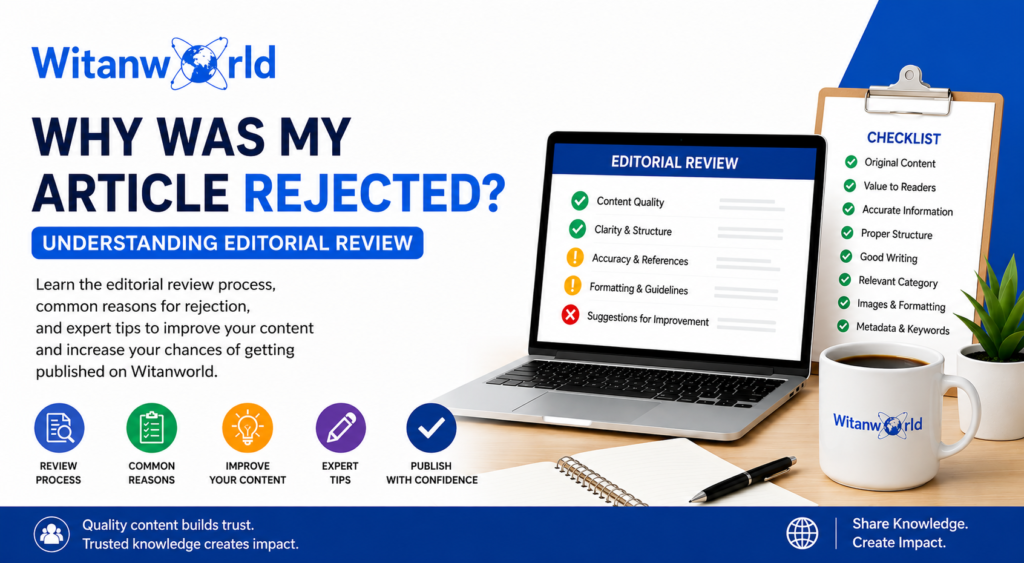
A Complete Guide to Creating High-Quality Content That Meets Witanworld Publishing Standards
Estimated Reading Time: 15–18 Minutes
Introduction
Receiving an article rejection can be disappointing, especially after investing significant time researching, writing, and refining your content. Many authors immediately assume their article was rejected because it lacked quality or because the platform disagreed with their opinions.
In reality, that is rarely the case.
In this guide, you’ll learn:
- Why articles are reviewed
- The 10 most common reasons articles are rejected
- How editors evaluate submissions
- How to improve your approval rate
- What to do if revisions are requested
Editorial review exists to ensure that every published article contributes meaningful value to readers while maintaining consistency, credibility, professionalism, and trust across the platform. Rejection is not necessarily a reflection of an author’s expertise. More often, it indicates that the submission did not fully align with the platform’s editorial standards, publishing guidelines, formatting requirements, or content quality expectations.
At Witanworld, editorial review is designed to improve—not discourage—knowledge sharing. Every article is evaluated to ensure it delivers genuine educational, professional, or practical value to a global audience.
The goal is simple:
Publish knowledge that informs, educates, inspires, and creates meaningful professional conversations.
Whether you’re publishing your first article or your hundredth, understanding how editorial review works can dramatically improve your acceptance rate.
This guide explains:
- Why articles are reviewed
- Why articles may be rejected
- Common mistakes authors make
- How editors evaluate submissions
- How to improve your article before resubmitting
- Best practices that consistently lead to publication
By understanding the editorial process, you’ll save time, improve your writing, and increase the likelihood that your future submissions are approved on the first review.
Add an “Editorial Myth vs. Reality” Section
Example:
| Myth | Reality |
|---|---|
| Editors reject new authors | Editors review every article equally |
| AI content is always rejected | AI-assisted content is acceptable when reviewed and enhanced by the author |
| Rejection means poor writing | Often it simply means revisions are needed |
| Editors change your opinions | Editors focus on quality, clarity, and compliance |
What Happens After You Submit?
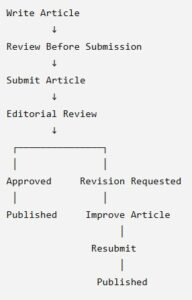
Many authors wonder what happens behind the scenes.
Suggested steps:
- Article Submitted
- Initial Quality Check
- Editorial Review
- Technical Validation
- Metadata Review
- Image Review
- Category Verification
- Approval or Revision Request
- Publication
Why Does Editorial Review Exist?
Anyone can publish content on the internet.
Very few platforms ensure that the published content is accurate, useful, well-written, and beneficial for readers.
Editorial review protects the quality of the knowledge ecosystem.
Without moderation, platforms quickly become overwhelmed with:
- Promotional articles
- AI-generated spam
- Duplicate content
- Low-quality writing
- Clickbait headlines
- Misinformation
- Broken formatting
- Keyword stuffing
- Plagiarized material
None of these help readers.
Instead, they reduce trust in the platform.
Editorial review ensures that every published article contributes meaningful knowledge rather than simply adding more content.
What Our Editors Look For
Every submission is reviewed using several quality criteria rather than a single pass/fail test.
Editors typically evaluate:
1. Originality
Is the article genuinely original?
Does it introduce:
- New ideas?
- Personal expertise?
- Professional insights?
- Case studies?
- Practical experience?
Articles copied from websites, blogs, or AI outputs without meaningful human contribution are unlikely to be approved.
2. Reader Value
The most important question editors ask is:
Will this article genuinely help someone?
- Strong articles answer questions.
- They solve problems.
- They explain concepts.
- They share experience.
Weak articles exist only to promote products or websites.
3. Accuracy
Facts matter.
Editors may reject content that includes:
- Incorrect statistics
- Unsupported claims
- Outdated information
- False medical advice
- Misleading financial guidance
- Fabricated research
Whenever possible, support important statements with credible references.
4. Structure
Readers should be able to navigate an article easily.
Good articles include:
- Clear headings
- Logical flow
- Short paragraphs
- Bullet points
- Numbered lists
- Conclusion
Poor formatting makes even excellent content difficult to read.
5. Writing Quality
Editors review whether the article is:
- Grammatically correct
- Easy to understand
- Professionally written
- Free from excessive repetition
- Appropriate for an international audience
Perfect English is not required.
Clear communication is.
6. Relevance
Your article should fit the selected category.
For example:
Technology articles belong under Technology.
Business articles belong under Business.
Publishing an article in the wrong category reduces discoverability and may delay approval.
The Most Common Reasons Articles Are Rejected
Understanding these common issues can significantly improve your approval rate.
Reason 1: Promotional Content Instead of Educational Content
One of the most common reasons for rejection is excessive self-promotion.
Rejected
- “Buy our software.”
- “Contact us today.”
- “Best company in the world.”
Accepted
- Case studies
- Industry trends
- Tutorials
- Research
- Lessons learned
- Practical frameworks
For example:
Poor:
Our company is the best digital marketing agency. Contact us today.
Better:
Five SEO strategies that increased organic traffic by 200%.
The second teaches.
The first advertises.
Educational content always performs better.
Reason 2: Thin Content
Some submissions contain only a few hundred words with little depth.
Readers expect complete answers.
Editors prefer articles that explore topics thoroughly instead of briefly touching on them.
Ask yourself:
Would someone finish this article feeling they learned something meaningful?
If not, expand it.
Reason 3: AI Content Without Human Expertise
AI is an excellent writing assistant.
It is not a replacement for experience.
Articles that simply repeat generic AI-generated information often lack:
- Original thinking
- Examples
- Personal insights
- Practical recommendations
The strongest articles combine AI-assisted drafting with human expertise.
Reason 4: Duplicate Content
Publishing the same article across multiple websites without modification reduces originality.
Likewise, submitting previously published content without permission or disclosure may result in rejection.
Always strive to provide unique value.
Reason 5: Plagiarism
Copying someone else’s work is one of the fastest ways to have an article rejected.
Plagiarism includes:
- Copying paragraphs
- Rewriting with minimal changes
- Copying research without attribution
- Using copyrighted images
- Republishing articles without authorization
Always cite sources appropriately.
Reason 6: Weak Headlines
A headline should explain what readers will gain.
Poor:
My Thoughts
Better:
10 Leadership Lessons Learned from Scaling a Global Team
Specific headlines attract more readers and better communicate the article’s value.
Reason 7: Poor Formatting
Walls of text discourage readers.
Instead:
Use:
- Headings
- Lists
- Images
- Examples
- Tables
- Quotes
Formatting improves readability.
Reason 8: Unsupported Claims
Statements like:
95% of businesses fail because of poor leadership.
Need evidence.
Whenever possible, cite trusted sources, industry reports, or research.
Reason 9: Excessive External Links
Links should support the article—not dominate it.
Articles containing numerous promotional links, affiliate links, or unrelated websites may be rejected.
Include only links that genuinely help readers.
Reason 10: Incorrect Category Selection
Publishing under the wrong category makes content harder to discover.
Always select the category that best reflects your topic.
Editorial Review Is Not Personal
Many authors assume:
They rejected me.
Editors don’t reject people.
They review submissions.
Even experienced authors occasionally receive revision requests.
Editorial review is about improving published content—not judging the author.
Understanding Revision Requests
Not every article is rejected outright.
Sometimes editors request revisions.
Common revision requests include:
- Improve formatting
- Expand specific sections
- Correct grammar
- Update statistics
- Add references
- Reduce promotional language
- Improve title
- Compress images
- Add metadata
A revision request is usually a positive sign.
It means the article has potential.
The Editorial Checklist
Before approving an article, editors often confirm:
✓ Original content
- ✓ Relevant topic
- ✓ Valuable information
- ✓ Clear structure
- ✓ Accurate facts
- ✓ Proper grammar
- ✓ Appropriate tone
- ✓ Useful title
- ✓ Correct category
- ✓ High-quality images
- ✓ Proper metadata
- ✓ Acceptable links
If any major element is missing, revisions may be requested.
How to Improve Your Acceptance Rate
Authors who consistently publish successfully often follow a repeatable process.
Start with Research
- Understand what readers want to learn.
- Answer real questions.
- Solve real problems.
Create an Outline
Organize ideas before writing.
This improves flow and prevents repetition.
Write for Readers
Avoid writing for search engines alone.
Focus on clarity.
Explain concepts.
Provide examples.
Add Practical Value
Readers appreciate actionable advice.
Include:
- Checklists
- Frameworks
- Tips
- Lessons learned
- Real examples
Edit Carefully
Never publish the first draft.
Review:
- Grammar
- Clarity
- Accuracy
- Flow
- Formatting
Fresh eyes often catch mistakes.
The Role of Images
Visuals improve engagement.
Choose images that:
- Support the topic
- Are high quality
- Are properly licensed
- Enhance understanding
Avoid decorative images that add no value.
Optimize image size for faster loading while maintaining quality.
Metadata Matters
Many authors overlook metadata.
A strong submission includes:
- SEO-friendly title
- Meta description
- Relevant keywords
These improve discoverability in search engines and internal platform search.
Choosing the Right Tone
Professional writing does not have to be formal.
Aim for:
- Clear
- Helpful
- Friendly
- Objective
- Respectful
Avoid:
- Aggressive language
- Personal attacks
- Excessive capitalization
- Clickbait
- Sensationalism
Balancing AI and Human Expertise
AI can assist with:
- Grammar
- Structure
- Brainstorming
- Outlines
- Summaries
Authors should still provide:
- Experience
- Analysis
- Context
- Opinions
- Examples
- Critical thinking
The most valuable articles reflect authentic expertise.
Before You Submit: A Self-Review Checklist
Ask yourself:
- Does my article teach something useful?
- Is the content original?
- Have I supported important claims?
- Is the structure easy to follow?
- Have I removed unnecessary promotional language?
- Is the grammar polished?
- Are headings clear?
- Have I added images where appropriate?
- Have I optimized metadata?
- Would I enjoy reading this article myself?
- Choose the correct Sapience category.
- Add an SEO title and meta description.
- Include relevant keywords.
- Use optimized images (recommended size under 250 KB).
- Follow the AI-Assisted Writing Guidelines.
- Proofread before submitting.
If the answer is “yes” to all of these, your chances of approval increase significantly.
FAQ’s – Frequently Asked Questions
Does rejection mean I cannot publish again?
Absolutely not.
Many successful contributors had early submissions returned for revisions before becoming regular authors.
Can I resubmit my article?
Yes.
Address the editorial feedback carefully and submit the revised version.
Can I use AI to write my article?
Yes.
AI-assisted writing is acceptable when it enhances your work rather than replacing your expertise. Always review, edit, fact-check, and personalize AI-generated drafts before submission.
Why are promotional articles rejected?
Readers visit knowledge platforms to learn—not to read advertisements.
Educational content builds credibility far more effectively than direct promotion.
How long does editorial review take?
Review times may vary depending on submission volume, article complexity, and editorial workload. Ensuring your article meets publishing guidelines before submission can help reduce review time.
Best Practices for Long-Term Publishing Success
Authors who consistently earn approvals generally follow these habits:
- Publish original, experience-based content.
- Focus on solving reader problems.
- Stay current with industry trends and research.
- Update articles when information changes.
- Use clear formatting and professional language.
- Follow platform publishing guidelines.
- Respond positively to editorial feedback.
- Treat every revision as an opportunity to improve.
Building a reputation as a trusted contributor takes time, but each high-quality publication strengthens your credibility and expands your professional influence.
Conclusion
Every revision is an opportunity to become a better writer, a more credible professional, and a more influential knowledge contributor. By understanding the editorial process and embracing constructive feedback, you’ll not only increase your publication success—you’ll help build a trusted global knowledge community where quality ideas create lasting impact.
- Editorial review is one of the most valuable quality assurance processes in professional publishing.
- Rather than viewing rejection as failure, consider it an opportunity to improve your work and better serve your audience.
- Every revision strengthens your writing skills.
- Every editorial suggestion helps refine your communication.
- Every published article contributes to a stronger, more trusted global knowledge ecosystem.
The most successful authors are not those who never receive feedback—they are the ones who embrace it, refine their work, and continue sharing knowledge that educates, inspires, and creates lasting value.
At Witanworld, the editorial process is designed to maintain high publishing standards while supporting authors in producing content that informs professionals, encourages meaningful discussion, and helps build a credible global knowledge community.
Remember: Editorial feedback is intended to improve your article, not discourage you. Many of Witanworld’s most successful contributors revised their first submission before becoming regular publishers.
When you understand the purpose behind editorial review, rejection becomes less of an obstacle and more of a stepping stone toward becoming a stronger, more impactful knowledge contributor.
Related Articles
- How to Publish Your First Article on Witanworld
- AI-Assisted Writing Guidelines
- Witanworld Article Publishing Guidelines
- Witanworld Sapience: How to Use the Global Knowledge Repository
- Complete Beginner’s Guide to Witanworld









Leave a Reply