





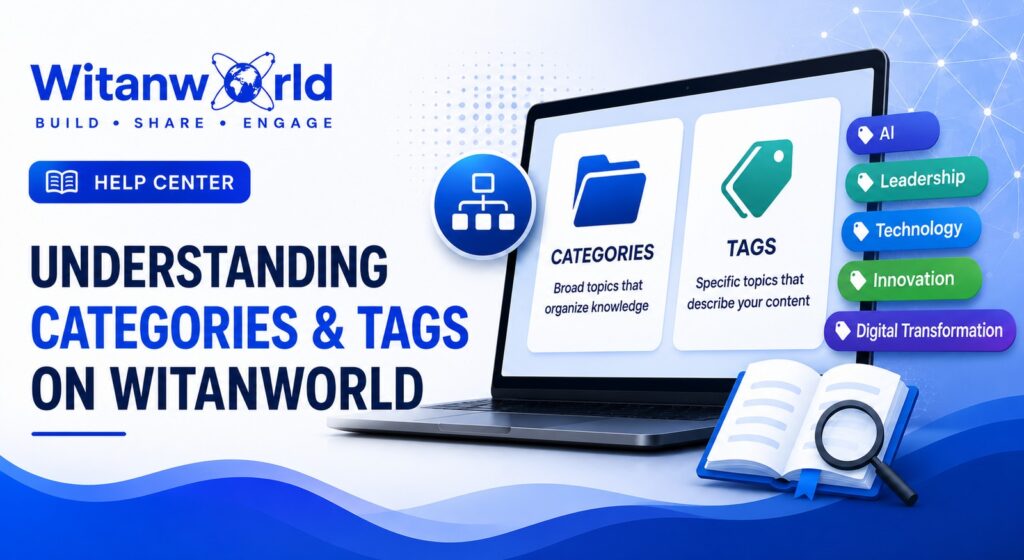
Witanworld Help Center Guide
Estimated Reading Time: 10–12 Minutes
Introduction
Publishing a great article is only one part of sharing knowledge effectively on Witanworld. Helping readers discover that knowledge is equally important.
This is where Categories and Tags play an important role.
Categories help organize your article within a broader subject area, while tags describe the more specific topics, themes, concepts, industries, technologies, or ideas discussed within the article.
When used correctly, Categories and Tags can help make Witanworld content:
Organized → Relevant → Discoverable → Easier to Explore
This guide explains what Categories and Tags are, how they differ, how to select them, common mistakes to avoid, and how they can support a better knowledge-discovery experience across Witanworld.
1. What Are Categories on Witanworld?
A Category represents the broader subject or knowledge area to which an article belongs.
Think of Categories as the major sections of a knowledge library.
For example, an article about how artificial intelligence is changing financial services could potentially belong to a broader category related to:
Technology
while an article about leadership development may belong to a broader category related to:
Leadership or Management
The exact options available to you should be selected from the Categories currently provided within the Witanworld publishing interface.
Simple Rule
Category = Broad Subject
Categories help answer:
What general area of knowledge does this article belong to?
2. What Are Tags?
Tags are more specific.
They identify the important topics, concepts, technologies, industries, ideas, or themes discussed within an article.
For example, consider an article about:
How Generative AI Is Transforming Customer Experience
Its broader Category might relate to:
Technology
Relevant Tags could potentially include:
Generative AI | Artificial Intelligence | Customer Experience | Automation | Digital Transformation
Simple Rule
Tags = Specific Topics
Tags help answer:
What specifically is this article about?
3. Categories vs. Tags: What’s the Difference?
Although Categories and Tags both help organize content, they serve different purposes.
| Categories | Tags |
|---|---|
| Broad subject areas | Specific topics |
| Provide primary organization | Provide detailed context |
| Help classify articles | Help describe articles |
| Usually fewer and broader | More focused and descriptive |
| Think Library Section | Think Index Keywords |
An easy way to remember the difference is:
Category = Where the article belongs
Tags = What the article discusses
4. Why Categories & Tags Matter
Imagine Witanworld as a growing global knowledge library.
As more articles are published, readers need effective ways to move from:
One Article → Related Topics → More Knowledge
Categories and Tags provide useful signals for organizing that knowledge.
Good classification can contribute to:
- Better content organization
- Easier topic exploration
- More relevant discovery
- Clearer understanding of article subjects
- Stronger connections between related knowledge
- A more structured Witanworld knowledge ecosystem
Categories and Tags should therefore be treated as part of the publishing process—not as fields to complete without thought.
5. Choosing the Right Category
When selecting a Category, identify the primary subject of your article.
Ask:
If this article could be placed on one shelf in a knowledge library, which shelf would be the best fit?
Consider an article titled:
The Future of Cybersecurity in Global Banking
The article may discuss:
- Technology
- Banking
- Cybersecurity
- Risk
- Regulation
- Artificial Intelligence
However, the best Category should represent the article’s dominant subject, rather than every topic mentioned.
Best Practice
Choose the category that most accurately reflects the article’s central purpose.
6. Don’t Select Categories Just for Visibility
More categories do not necessarily mean more visibility.
Assigning an article to unrelated categories can make classification less useful and may create a poor discovery experience.
For example, an article about cybersecurity should not be assigned to unrelated categories simply because those categories appear popular.
Avoid:
Maximum Categories = Maximum Reach
Instead think:
Maximum Relevance = Better Classification
The objective is to help the right audience discover the right knowledge.
7. What If an Article Covers Multiple Subjects?
Many knowledge articles are interdisciplinary.
An article titled:
How Artificial Intelligence Is Transforming Healthcare
clearly involves both:
Technology
and
Healthcare
In such situations, identify the article’s primary focus and use the most appropriate available category or categories supported by the publishing interface.
Then use Tags to capture the additional dimensions.
For example:
Primary Category: Technology
Tags: Artificial Intelligence, Healthcare, Digital Health, Machine Learning, Healthcare Innovation
This provides both broad classification and specific context.
8. How to Choose Effective Tags
Good tags are:
- Specific
- Relevant
- Descriptive
- Easy to understand
- Closely connected to the article
- Useful for knowledge discovery
Suppose your article is:
The Role of Blockchain in Global Supply Chains
Potential tags might include:
- Blockchain
- Supply Chain
- Logistics
- Digital Transformation
- Traceability
- Global Trade
Each tag represents a meaningful concept discussed in the article.
9. How Many Tags Should You Use?
There is little value in adding dozens of loosely related tags.
A smaller number of highly relevant tags usually creates a cleaner classification.
As a practical editorial guideline, consider approximately:
3–7 highly relevant Tags
when that number adequately describes the article.
This is a best-practice recommendation, not necessarily a technical platform limit.
A highly specialized article may need fewer. A broad, interdisciplinary article may reasonably need more.
The important principle is:
Use as many tags as necessary to describe the article accurately—but no more than necessary.
10. Use Specific Tags Instead of Generic Words
Avoid tags that are so broad that they provide little useful context.
For example:
Weak Tags
World
Information
Good
Future
Things
Success
Better Tags
Artificial Intelligence
Climate Change
Leadership Development
Cybersecurity
Renewable Energy
Knowledge Management
Specific tags provide clearer information about the article.
11. Don’t Turn Entire Sentences Into Tags
Tags should generally represent concepts rather than complete sentences.
Avoid
How artificial intelligence will completely transform businesses in the future
Better
Artificial Intelligence
Future of Work
Business Transformation
Automation
Short, recognizable concepts make Tags easier to understand and reuse.
12. Avoid Duplicate or Near-Duplicate Tags
Another common mistake is creating several versions of essentially the same tag.
For example:
Artificial Intelligence
Artificial Intelligence Technology
AI Technology
Artificial Intelligence AI
If these terms represent the same concept, unnecessarily duplicating them can make classification inconsistent.
Where an established tag already exists, prefer the clearest and most relevant existing terminology.
Consistency Matters
Artificial Intelligence used consistently across many related articles is generally more useful than dozens of slightly different variations.
13. Use Commonly Recognized Terminology
Choose terms readers are likely to recognize.
For example:
Cybersecurity
is generally clearer than creating an unnecessarily complicated variation such as:
Advanced Digital Cyber Protection Technologies
Similarly:
Digital Transformation
is preferable when that is the recognized concept.
Use terminology that reflects how people naturally describe the subject.
14. Categories & Tags Are Not the Same as SEO Keywords
Categories, Tags, and SEO keywords can overlap, but they should not be treated as identical.
Categories
Organize your article into broad knowledge areas.
Tags
Describe specific topics within the article.
SEO Keywords
Help communicate the subjects and search intent the content addresses.
For example:
Article:
How AI Is Changing Recruitment
Category:
Technology
Tags:
Artificial Intelligence, Recruitment, HR Technology, Automation
Potential SEO Keyword:
AI in Recruitment
Each serves a related but different purpose.
15. Don’t Keyword-Stuff Tags
Adding many keyword variations does not make an article better optimized.
Avoid something like:
AI
AI Technology
Best AI
Artificial Intelligence
Artificial Intelligence Solutions
AI Solutions
AI Business
AI Tools
when most are simply variations added for search visibility.
Tags should primarily improve classification and discovery, not act as a keyword-stuffing mechanism.
Better:
Artificial Intelligence | AI Tools | Business Automation
when those concepts genuinely appear in the article.
16. Match Categories & Tags to the Actual Content
Every Category and Tag should be defensible based on what the article actually discusses.
If an article briefly mentions cryptocurrency once, that does not necessarily justify adding:
Cryptocurrency
as a major tag.
Ask:
Would a reader searching for this topic consider my article genuinely relevant?
If the answer is yes, the tag may be appropriate.
If the answer is no, leave it out.
17. Think From the Reader’s Perspective
When selecting Categories and Tags, don’t think only as the author.
Think as someone trying to discover knowledge.
Ask:
- What subject would I expect this article under?
- Which topics would help me find it?
- What terminology would I naturally use?
- Which tags accurately describe the article?
- Would these classifications help me discover related knowledge?
This simple shift in perspective can significantly improve classification quality.
18. Categories, Tags & Knowledge Discovery
Categories and Tags can help create connections between related content.
For example:
Artificial Intelligence
could connect knowledge across:
Healthcare
Education
Financial Services
Cybersecurity
Manufacturing
Marketing
Research
Tags can help reveal these relationships even when articles belong to different broader categories.
This is particularly valuable for a knowledge-oriented platform because users are not always looking for one isolated article—they may want to explore an entire subject.
19. Categories & Tags Can Support Article Discoverability
Accurate classification can make it easier for content to participate in relevant discovery pathways within a platform.
But Categories and Tags should not be viewed as a shortcut to guaranteed traffic or rankings.
Article visibility depends on many factors, including:
- Content quality
- Topic relevance
- Headline quality
- Search optimization
- Reader engagement
- Internal linking
- Article usefulness
- Authority and credibility
- Featured-image quality
- Overall publishing standards
Categories and Tags are one part of a broader optimization strategy.
20. Categories & Tags and SEO
Well-organized content can also support a clearer information architecture.
However, authors should not select Categories or Tags solely to manipulate search engines.
Focus first on:
Relevance → Organization → Reader Value
rather than:
More Tags → More Keywords → More Rankings
For broader article optimization guidance, refer to:
Witanworld SEO Guide: How to Optimize Your Articles for Maximum Visibility
21. Example: Artificial Intelligence Article
Article
Generative AI: How It Is Changing the Future of Knowledge Work
Possible Category
Technology
Possible Tags
- Generative AI
- Artificial Intelligence
- Future of Work
- Knowledge Work
- Automation
- Digital Transformation
Notice that the Category establishes the broad subject while the Tags explain the article in greater detail.
22. Example: Leadership Article
Article
Building High-Performance Teams in a Hybrid Workplace
Possible Category
Human Resources / Leadership / Management
Possible Tags
- Leadership
- Hybrid Work
- Team Management
- Employee Engagement
- Workplace Culture
- Future of Work
Again:
Category = Broad Classification
Tags = Specific Knowledge Topics
23. Example: Sustainability Article
Article
Renewable Energy and the Transition to a Low-Carbon Economy
Possible Category
Environment
Possible Tags
- Renewable Energy
- Sustainability
- Clean Energy
- Climate Change
- Energy Transition
- Low-Carbon Economy
The classification tells readers both where the article belongs and what knowledge it contains.
24. Example: Multi-Disciplinary Article
Consider:
AI-Powered Diagnostics: The Future of Healthcare
This article sits at the intersection of technology and healthcare.
A sensible structure might be:
Category: Technology or Healthcare, depending on the article’s dominant focus and the Categories available on Witanworld.
Tags:
- Artificial Intelligence
- Healthcare
- Medical Technology
- Diagnostics
- Digital Health
Tags allow you to capture the interdisciplinary nature of the article without unnecessarily classifying it under numerous broad Categories.
25. Review Categories & Tags Before Publishing
Before publishing, perform a quick classification check.
Ask:
Category Check
Does my Category accurately represent the main subject?
Tag Check
Do my Tags represent the important topics actually discussed?
Relevance Check
Would someone interested in these topics find my article useful?
Duplication Check
Have I used unnecessary variations of the same Tag?
Quality Check
Am I classifying knowledge—or simply adding keywords?
This takes less than a minute and can substantially improve publishing consistency.
26. What If You Selected the Wrong Category or Tag?
If you discover that an article has been incorrectly classified, update the article where editing functionality and permissions allow.
For example, you might need to make a change because:
- The wrong Category was selected
- A Tag contains a spelling error
- An irrelevant Tag was added
- A more accurate classification becomes available
- The article was significantly updated
- The subject of the article changed
Keeping classifications accurate helps maintain the quality of the overall knowledge ecosystem.
For article-management instructions, refer to:
How to Edit, Update or Delete a Published Article on Witanworld
27. Common Category & Tag Mistakes
Avoid these common mistakes:
- Selecting unrelated Categories
- Choosing Categories solely because they appear popular
- Adding excessive Tags
- Using generic Tags
- Repeating similar Tags
- Creating sentence-length Tags
- Adding topics barely mentioned in the article
- Treating Tags as a place for SEO keyword stuffing
- Using inconsistent terminology
- Ignoring spelling
- Selecting Categories without considering the article’s primary subject
- Leaving classification until the last second without reviewing it
The solution is straightforward:
Be Relevant. Be Specific. Be Consistent.
28. Recommended Witanworld Classification Workflow
When preparing an article:
Step 1 — Identify the Main Subject
What is the article fundamentally about?
Step 2 — Choose the Best Available Category
Select the broad knowledge area that most accurately represents that subject.
Step 3 — Identify Core Topics
List the most important concepts discussed in the article.
Step 4 — Convert Those Topics Into Tags
Use clear, recognized terminology.
Step 5 — Remove Weak Tags
Delete generic, repetitive, or marginally relevant terms.
Step 6 — Check Consistency
Where appropriate, use established terminology rather than inventing unnecessary variations.
Step 7 — Review Before Publishing
Confirm that every Category and Tag accurately represents the article.
29. Quick Reference Guide
| Element | Category | Tag |
|---|---|---|
| Purpose | Broad classification | Specific topic identification |
| Scope | Broad | Narrower |
| Example | Technology | Artificial Intelligence |
| Another Example | Healthcare | Digital Health |
| Selection Principle | Main subject | Important concepts |
| SEO Role | Supporting | Supporting |
| Should Be Relevant? | Yes | Yes |
| Should Be Keyword Stuffed? | No | No |
| Reader Benefit | Helps browse broad subjects | Helps discover specific topics |
30. Categories & Tags Checklist
Before publishing your article:
I selected the most relevant available Category.
The Category reflects the article’s primary subject.
My Tags represent topics actually discussed.
My Tags are clear and specific.
I avoided irrelevant Tags.
I avoided excessive Tags.
I avoided duplicate or near-duplicate Tags.
I used recognizable terminology.
I checked spelling.
I did not keyword-stuff.
I considered how readers might discover the article.
I reviewed the classification before publishing.
31. Frequently Asked Questions
What is a Category on Witanworld?
A Category represents the broader subject area in which an article is classified.
What is a Tag?
A Tag identifies a more specific topic, theme, technology, industry, concept, or idea discussed within an article.
What is the difference between a Category and a Tag?
Think of it this way:
Category = Broad Subject
Tag = Specific Topic
Can an article discuss topics outside its main Category?
Yes. Many knowledge articles are interdisciplinary. Use appropriate Tags to describe important related topics.
How many Tags should I use?
As a practical editorial guideline, approximately 3–7 highly relevant Tags is often sufficient. This is a best-practice recommendation rather than a stated technical limit.
Should I use popular Tags even when they aren’t relevant?
No. Relevance should always take priority.
Do more Tags improve SEO?
Not automatically. Excessive or irrelevant Tags can reduce classification quality. Focus on useful, accurate terminology.
Are Tags the same as SEO keywords?
No. They may overlap, but Tags primarily help classify specific article topics, while SEO keywords are part of a broader search-optimization strategy.
Can I change Categories or Tags later?
Where Witanworld’s editing functionality and your permissions allow it, article classifications can be updated when corrections or improvements are needed.
32. The Witanworld Categories & Tags Principle
The best way to approach article classification is:
Categorize Broadly. Tag Specifically. Always Stay Relevant.
Your goal should not be to place your article everywhere.
Your goal should be to place it where the right people can discover the right knowledge.
Think of the journey:
Create Knowledge
↓
Classify It Correctly
↓
Describe It Clearly
↓
Help People Discover It
↓
Connect Related Knowledge
↓
Grow the Knowledge Ecosystem
Conclusion
Categories and Tags may seem like small elements of the publishing process, but they contribute to how knowledge is organized and explored across Witanworld.
Remember the fundamental difference:
Categories tell Witanworld where your article belongs.
Tags tell readers what your article is about.
Choose both carefully.
Avoid unnecessary classifications, generic terms, duplicate Tags, and keyword stuffing. Instead, focus on relevance, clarity, consistency, and reader value.
When every article is accurately classified, Witanworld becomes easier to navigate and related ideas become easier to discover.
Better Classification. Better Discovery. Better Knowledge Sharing.
Related Articles
- How to Publish Your First Article on Witanworld
- Witanworld SEO Guide: How to Optimize Your Articles for Maximum Visibility
- Witanworld Image Guidelines: Featured Images, Size, Copyright & Optimization
- How to Edit, Update or Delete a Published Article on Witanworld
- Why Was My Article Rejected? Understanding Editorial Review










Leave a Reply