






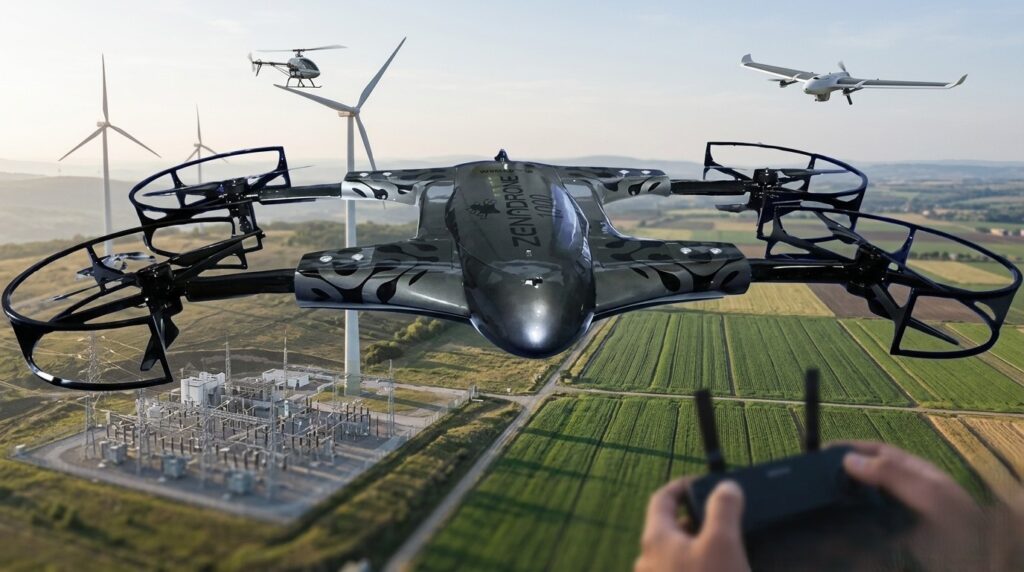
Drones have evolved from specialized aviation systems into practical tools for collecting data, inspecting assets, monitoring land, supporting emergency teams, and carrying equipment. Yet the word “drone” describes a broad family of aircraft rather than a single technology.
Understanding the Types of Drones matters because aircraft configuration directly affects flight endurance, payload capacity, maneuverability, takeoff requirements, and the kind of work a drone can perform efficiently. A compact multi-rotor hovering beside a bridge and a fixed-wing aircraft mapping thousands of hectares may both be unmanned aerial vehicles, but their operating characteristics are very different.
This guide examines the major drone categories, their strengths and limitations, and the real-world Drone Applications for which each configuration is best suited.
What Are Drones and UAVs?
A drone is an aircraft that can operate without a pilot physically onboard. The technical term unmanned aerial vehicle, or UAV, refers specifically to the aircraft, while broader terms such as unmanned aircraft system can include the aircraft, control station, communications equipment, sensors, and supporting systems.
Modern UAVs may be remotely piloted, highly automated, or capable of completing portions of a mission autonomously. Navigation commonly combines satellite positioning, onboard sensors, flight-control computers, and programmed flight paths.
There are several ways to classify the Types of UAVs, including aircraft configuration, weight, range, altitude, propulsion, and degree of autonomy. For most commercial applications, however, airframe configuration provides one of the clearest ways to understand their operational differences.
Major Types of Drones
The most important categories are multi-rotor, fixed-wing, single-rotor, and hybrid vertical takeoff and landing (VTOL) drones. Other specialized designs exist, but these four illustrate the main engineering trade-offs between hovering capability, endurance, payload, speed, and operational flexibility.
Multi-Rotor Drones
Multi-rotor drones generate lift using multiple horizontally positioned propellers. Quadcopters with four rotors are the most familiar configuration, although six-rotor and eight-rotor designs are also used.
By adjusting the speed of individual motors, the flight controller can make the aircraft climb, descend, rotate, or move in different directions. Multi-rotors can take off vertically, hover precisely, and operate within relatively confined spaces.
Their greatest strength is maneuverability. Hovering allows cameras and sensors to remain focused on a particular structure or location, making these drones highly effective for detailed aerial data collection.
The main limitation is flight endurance. Maintaining lift continuously through powered rotors requires substantial energy, so multi-rotors generally have shorter endurance than comparable fixed-wing aircraft. Larger payloads can further increase energy consumption.
Common applications include construction monitoring, photography, thermal imaging, building inspection, telecommunications inspection, public-safety operations, and close-range infrastructure assessment. They are particularly useful when detailed observation is more important than covering large distances.
Fixed-Wing Drones
Fixed-wing drones resemble conventional airplanes. Instead of using powered rotors to generate all their lift continuously, their wings create lift as the aircraft moves through the air.
This aerodynamic efficiency allows fixed-wing UAVs to cover larger areas and remain airborne for longer periods than many multi-rotor platforms with comparable energy resources. They are therefore well suited to missions where coverage and endurance matter.
The trade-off is that traditional fixed-wing aircraft cannot hover. Some also require a runway, launcher, or specialized method for takeoff and landing, although designs vary considerably.
Fixed-wing systems are commonly used for large-scale surveying, mapping, agricultural monitoring, environmental observation, corridor inspection, and land management. For example, a mapping operation covering extensive farmland or a long infrastructure corridor may benefit more from a fixed-wing platform than from an aircraft designed primarily to hover.
Single-Rotor Drones
Single-rotor UAVs operate on principles similar to helicopters. They typically use one large main rotor to provide lift and a smaller tail rotor or another control mechanism to counter rotational forces.
Compared with small multi-rotors, single-rotor designs can offer strong lifting capability and potentially greater endurance, depending on their size, propulsion system, and mission configuration. Their ability to hover while carrying substantial equipment makes them useful for certain specialized operations.
However, mechanical complexity is a significant consideration. Larger rotor systems and more complex components can increase maintenance requirements and operational risk. They also demand careful handling because of the energy associated with larger rotating blades.
Single-rotor drones can be used for specialized surveying, industrial sensing, agricultural operations, and missions requiring heavier payloads. In some applications, they provide an effective middle ground between hovering capability and higher payload requirements.
Hybrid VTOL Drones
Hybrid VTOL aircraft combine characteristics of multi-rotor and fixed-wing designs. They can perform vertical takeoff and landing, then transition into efficient forward flight using wings.
This approach addresses one of the central limitations of conventional fixed-wing UAVs: the need for suitable launch and recovery space. A hybrid VTOL drone can operate from a relatively compact site while still benefiting from efficient wing-borne flight during much of its mission.
The advantage is operational versatility. Hybrid aircraft can be useful for long-range mapping, pipeline or utility inspection, environmental monitoring, and missions conducted in locations where runways are unavailable.
The additional capability also introduces complexity. Transitioning between vertical and forward flight requires sophisticated control systems, and the aircraft may carry propulsion components that are used only during certain phases of flight. This can add weight and engineering requirements.
Other Relevant UAV Configurations
Beyond the four main categories, several specialized configurations are worth recognizing. Blimp- or balloon-based unmanned systems can remain aloft efficiently for persistent observation but have limited speed and can be highly sensitive to weather.
Some aircraft use tilt-rotor or tilt-wing mechanisms that change the orientation of propulsion systems between hovering and forward flight. Others are designed around specific industrial payloads rather than a conventional aircraft category.
The growing variety of Different Types of Drones reflects a fundamental engineering reality: no single airframe is optimal for every mission.
How Drone Types Differ
The most important differences among drone categories involve endurance, maneuverability, operating area, payload, and launch requirements.
Multi-rotor aircraft excel when an operation requires hovering, precise positioning, or repeated movement around a structure. Fixed-wing drones become more attractive when a mission requires efficient coverage of a large geographic area.
Single-rotor aircraft may suit specialized missions involving heavier equipment while retaining helicopter-like flight characteristics. Hybrid VTOL systems are useful when both vertical operation and efficient forward flight are important.
Payload also influences aircraft selection. A lightweight visual camera creates different requirements from a heavier multispectral, thermal, LiDAR, or specialized industrial sensor. Mission planners therefore need to consider the complete aerial system rather than choosing an aircraft solely by range or size.
Drone Types and Their Uses Across Industries
The relationship between Drone Types and Their Uses becomes clearest when examining practical operations.
In agriculture, fixed-wing aircraft can efficiently survey large areas, while multi-rotors may support detailed crop inspection and targeted observations. Depending on local regulations and equipment design, specialized UAVs may also support agricultural application tasks.
Surveying and mapping rely heavily on repeatable flight paths and accurate aerial data collection. Fixed-wing and hybrid VTOL aircraft are valuable for extensive sites, while multi-rotors are often effective for smaller or more complex locations.
Infrastructure inspection frequently favors multi-rotors because hovering enables close observation of bridges, towers, roofs, industrial structures, and utility assets. Sensors can collect visual or thermal information without requiring personnel to access every inspection point physically.
In construction, drones can document site conditions, support mapping, monitor progress, and collect imagery for project records. The appropriate aircraft depends largely on site size and required data.
Logistics presents different challenges. Payload weight, route distance, landing accuracy, redundancy, and regulatory requirements all influence aircraft design. Multi-rotor and hybrid configurations can be particularly relevant where vertical delivery is necessary.
Emergency response teams can use UAVs for situational awareness, search operations, thermal observation, and rapid assessment of areas that may be difficult to reach from the ground. Here, rapid deployment and sensor capability can matter more than maximum endurance.
Environmental monitoring may involve wildlife observation, forestry surveys, coastal assessment, habitat mapping, or tracking changes across large landscapes. Fixed-wing and hybrid platforms can provide efficient coverage, while multi-rotors support detailed local observation.
Industrial operations increasingly demonstrate how Commercial Drone Technology is shaped around specific tasks. Inspection, mapping, inventory observation, security support, and remote sensing may require very different combinations of aircraft and payloads.
How to Choose the Right Drone Type
Choosing among drone configurations should begin with the mission rather than the aircraft.
For close inspection of a tower, building, or confined site, a multi-rotor is often the logical choice because it can hover and reposition precisely. For mapping a large agricultural property or long corridor, fixed-wing efficiency may be more valuable.
If the mission requires both compact takeoff and substantial geographic coverage, a hybrid VTOL platform can offer a useful compromise. Specialized heavy-payload operations may justify considering single-rotor or other purpose-built aerial systems.
Operators should also evaluate weather conditions, available launch space, payload requirements, flight endurance, communications, maintenance, data quality, safety procedures, and applicable aviation regulations.
This decision-oriented approach is more useful than assuming that a larger, faster, or more advanced aircraft is automatically better. The best UAV is the one whose flight characteristics match the operational problem.
The Future of Drone Technology
Future development is likely to make drone categories increasingly capable rather than eliminate the distinctions between them. Improvements in batteries, propulsion, sensors, flight-control systems, communications, and onboard computing can expand what individual platforms accomplish.
Autonomous drones may also perform more sophisticated navigation, data collection, and mission-management functions. Greater onboard processing could allow aerial systems to interpret sensor information during a flight rather than treating the aircraft solely as a data-collection platform.
Even as technology advances, fundamental aerodynamic trade-offs will remain important. Hovering, long endurance, heavy payload capacity, speed, and compact operation impose different design requirements. Understanding those trade-offs will therefore remain essential when evaluating future UAV systems.
Conclusion
The major Types of Drones are best understood as different engineering solutions to different operational needs. Multi-rotors provide precise hovering and maneuverability, fixed-wing aircraft offer efficient coverage, single-rotor systems support specialized hovering and payload requirements, and hybrid VTOL designs combine vertical operation with efficient forward flight.
Across agriculture, construction, surveying, infrastructure inspection, logistics, emergency response, environmental monitoring, and industrial operations, choosing the right UAV depends on matching aircraft capabilities to the mission.
As drone technology continues to mature, understanding these distinctions will help professionals evaluate new aerial systems on practical factors—how they fly, what they can carry, where they can operate, and how effectively they can accomplish the task at hand.










Leave a Reply