






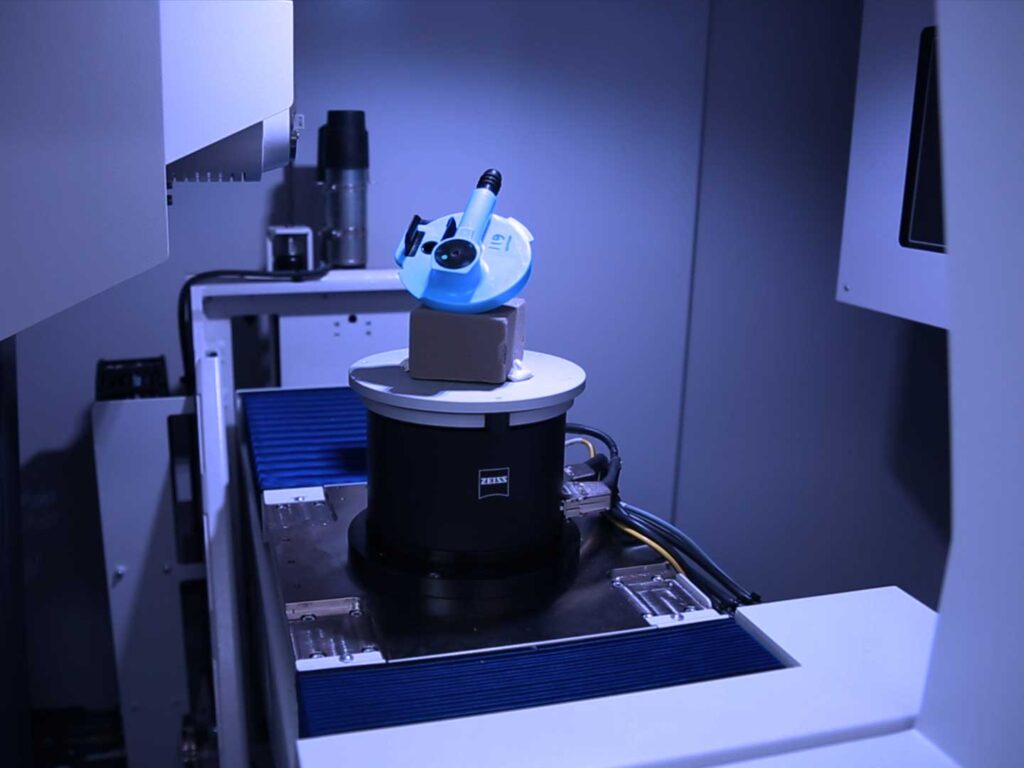
Non-destructive testing (NDT) plays a critical role in modern manufacturing, engineering, and quality control. Businesses need to inspect internal structures, detect defects, and verify dimensions—without damaging components. This is where industrial CT scanning has become one of the most powerful and reliable inspection technologies available.
In this article, we explain what industrial CT scanning is, why it is used for non-destructive testing, and how it delivers unmatched accuracy across industries.
What Is Industrial CT Scanning?
Industrial CT scanning (Computed Tomography) is an advanced inspection method that uses X-ray technology to create highly detailed 3D images of an object’s internal and external structure. Unlike traditional inspection techniques, it allows engineers to examine internal features without cutting, disassembling, or damaging the part.
This makes industrial CT scanning ideal for inspecting complex components, assemblies, and materials where internal integrity is critical.
Why Non-Destructive Testing Is Essential
Non-destructive testing ensures that components meet safety, quality, and performance standards without compromising their usability. Industries rely on NDT to:
- Detect hidden internal defects
- Verify structural integrity
- Maintain product safety and compliance
- Reduce waste and production costs
- Prevent failures before products reach the market
Industrial CT scanning is increasingly preferred because it combines multiple inspection capabilities into one non-destructive process.
Why Industrial CT Scanning Is Ideal for Non-Destructive Testing
1. Complete Internal Visibility
One of the main reasons industrial CT scanning is used for non-destructive testing is its ability to see inside components in full 3D detail. It can identify:
- Internal voids and porosity
- Cracks and inclusions
- Assembly errors
- Wall thickness variations
This level of internal visibility is not possible with many traditional NDT methods.
2. Non-Invasive and Damage-Free
Industrial CT scanning allows full inspection without altering the part. There is no cutting, drilling, or disassembly required, making it ideal for:
- High-value components
- Prototype testing
- Final production inspections
- Safety-critical parts
The component remains intact and usable after inspection.
3. High Accuracy and Measurement Capability
Beyond defect detection, industrial CT scanning provides highly accurate dimensional measurements. Engineers can:
- Measure internal and external features
- Compare scans to CAD models
- Perform tolerance analysis
- Validate complex geometries
This makes it both an inspection and metrology solution in one process.
4. Ideal for Complex and Dense Components
As manufacturing methods evolve, parts are becoming more complex. Additive manufacturing, multi-material assemblies, and intricate internal channels require advanced inspection tools.
Industrial CT scanning excels in these scenarios by inspecting:
- 3D-printed components
- Castings and moulded parts
- Aerospace and automotive assemblies
- Medical and precision engineering components
5. Faster Inspection and Reduced Downtime
Compared to multiple traditional NDT techniques, industrial CT scanning consolidates inspection into a single process. This results in:
- Faster analysis
- Reduced inspection time
- Fewer production delays
- Improved workflow efficiency
For manufacturers, this means faster decision-making and reduced downtime.
Industrial CT Scanning vs Traditional NDT Methods
Traditional NDT techniques such as ultrasonic testing, visual inspection, or 2D X-ray each have limitations. Industrial CT scanning stands out because it:
- Captures complete 3D data, not just surface or partial views
- Identifies multiple defect types in one scan
- Eliminates guesswork through visual clarity
- Provides digital data for documentation and traceability
This comprehensive approach is why industrial CT scanning is increasingly used as a primary NDT solution.
Key Industries Using Industrial CT Scanning for NDT
Industrial CT scanning is widely adopted across industries, including:
- Aerospace – safety-critical internal inspections
- Automotive – castings, assemblies, and failure analysis
- Manufacturing – quality assurance and process optimisation
- Additive Manufacturing – internal structure validation
- Medical Devices – precision and compliance testing
Each of these sectors benefits from non-destructive, high-accuracy inspection.
Supporting Quality, Compliance, and Safety
Regulatory standards demand traceable, accurate inspection results. Industrial CT scanning supports compliance by providing:
- Digital inspection records
- Repeatable and verifiable results
- Clear visual evidence of internal quality
This strengthens quality assurance and reduces the risk of non-compliance.
Conclusion
Industrial CT scanning is used for non-destructive testing because it offers unmatched internal visibility, accuracy, and efficiency—without damaging components. As product designs become more complex and quality standards rise, industrial CT scanning continues to set the benchmark for advanced NDT inspection.
For organisations seeking reliable, detailed, and future-proof inspection methods, industrial CT scanning is no longer optional—it is essential.









Leave a Reply