






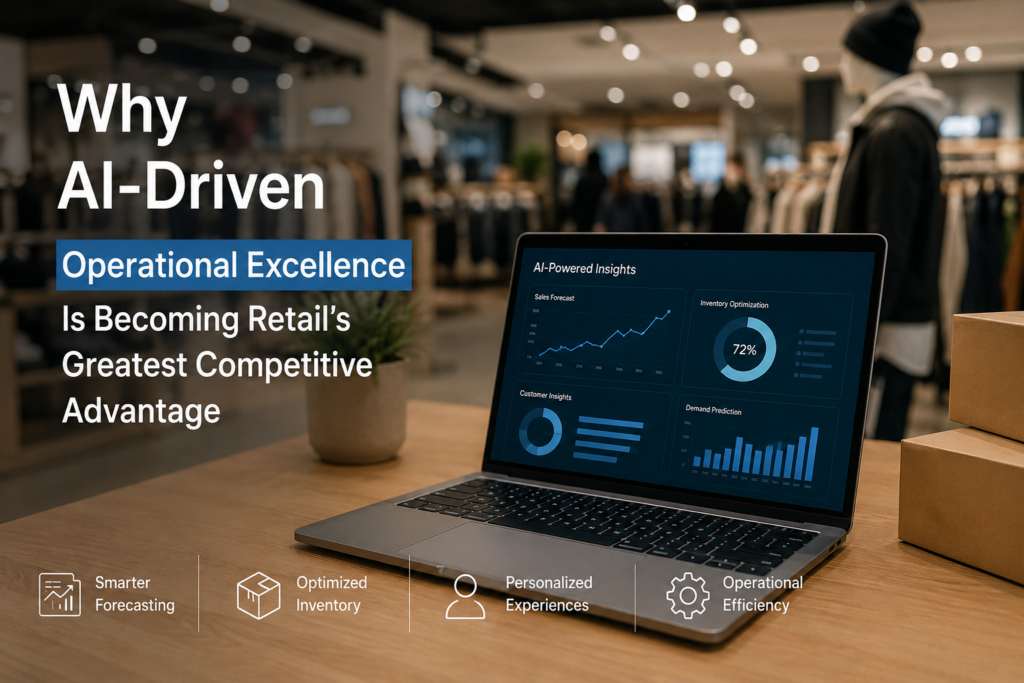
Retailers today operate in an environment where customer expectations are constantly rising, supply chains are becoming more complex, and competition extends far beyond traditional storefronts. To remain competitive, businesses need more than efficient processes. They need intelligent systems that can adapt, predict, and optimize operations in real time.
AI in retail refers to the use of artificial intelligence technologies to improve operational efficiency, enhance decision-making, and deliver better customer experiences across the retail value chain. By analyzing large volumes of data, AI helps retailers forecast demand, optimize inventory levels, automate routine tasks, and personalize customer interactions. The result is a more agile and responsive business that can adapt quickly to changing market conditions.
For enterprise retailers, AI is no longer viewed as an emerging technology. It is increasingly becoming a strategic business capability. Organizations that successfully integrate AI into their operations are improving productivity, reducing operational costs, and creating stronger customer experiences. As retail continues to evolve, AI-driven operational excellence is emerging as a critical factor that separates industry leaders from the rest of the market.
Why Operational Excellence Has Become a Retail Imperative
Retail has always been a fast-moving industry, but the pace of change has accelerated significantly in recent years. Enterprise retailers are now expected to manage multiple sales channels, maintain product availability, deliver personalized experiences, and respond quickly to market shifts. At the same time, they face ongoing pressure to control costs and protect profit margins.
One of the biggest challenges is the growing complexity of omnichannel retail. Customers expect a seamless experience whether they shop online, through a mobile app, or in a physical store. A delay in inventory updates or an inconsistent customer experience can quickly impact brand loyalty and revenue. As a result, retailers must ensure that every part of their operation works together efficiently.
Supply chain disruptions have also highlighted the importance of operational excellence. Fluctuating demand, global sourcing challenges, and changing consumer preferences make it difficult for retailers to rely on traditional planning methods. Businesses need greater visibility into their operations so they can make informed decisions based on real-time data.
This shift is driving a broader wave of retail digital transformation. Rather than focusing solely on front-end customer experiences, leading retailers are investing in enterprise retail technology that improves the efficiency of their entire organization. From inventory management and demand planning to workforce optimization and customer engagement, operational excellence has become a business priority rather than just an operational goal.
In this environment, retailers that can make faster, data-driven decisions gain a significant advantage. This is where artificial intelligence is beginning to play a transformative role.
How AI Is Transforming Retail Operations
Artificial intelligence is changing the way retailers manage day-to-day operations by turning large volumes of business data into actionable insights. Instead of relying solely on historical reports and manual decision-making, retailers can use AI to identify patterns, predict outcomes, and respond to challenges more quickly. This shift allows organizations to operate with greater precision while improving efficiency across multiple functions.
One of the most significant applications of AI in retail is demand forecasting. Retailers often struggle to accurately predict customer demand due to changing buying behaviors, seasonal trends, promotional activities, and external market factors. AI can analyze these variables in real time to generate more accurate forecasts. As a result, retailers can better align inventory levels with customer demand, reduce stock shortages, and avoid the costs associated with overstocking products.
AI is also improving inventory management by providing greater visibility across the supply chain. Intelligent systems continuously monitor inventory movement across stores, warehouses, and distribution centers, helping businesses identify potential issues before they affect operations. This level of retail automation enables organizations to make faster replenishment decisions, optimize stock allocation, and improve overall inventory accuracy. For large enterprises managing thousands of products across multiple locations, these efficiencies can translate into substantial cost savings.
Another area where AI is creating measurable impact is customer personalization. Today’s consumers expect relevant and seamless shopping experiences regardless of the channel they use. AI helps retailers analyze customer preferences, purchasing history, and browsing behavior to deliver tailored product recommendations and targeted promotions. By creating more personalized interactions, retailers can strengthen customer engagement, improve conversion rates, and build long-term loyalty.
These capabilities demonstrate why AI-powered retail operations are becoming a strategic priority for enterprise retailers. Beyond improving individual processes, AI enables organizations to make smarter decisions across the entire business. However, achieving these benefits at scale requires a strong technology foundation that can support data integration, automation, and continuous innovation.
The Technology Foundation Behind Successful AI Adoption
While the benefits of AI are becoming increasingly clear, many retailers struggle to achieve meaningful results because their underlying technology infrastructure is not designed to support modern AI initiatives. Artificial intelligence depends on access to accurate, connected, and real-time data. When information is spread across disconnected systems, it becomes difficult for AI models to generate reliable insights or drive business value.
Many enterprise retailers still operate with legacy platforms that were built to support traditional retail processes rather than today’s data-driven environments. These systems often create information silos between inventory management, customer relationship management, supply chain operations, and sales channels. As a result, decision-makers may lack a complete view of business performance, limiting the effectiveness of AI-powered initiatives.
To overcome these challenges, retailers are investing in integrated technology ecosystems that unify data and processes across the organization. A connected infrastructure enables AI systems to analyze information from multiple sources, creating a more comprehensive understanding of customer behavior, inventory movement, and operational performance. This level of visibility helps businesses make faster and more informed decisions.
Modern Retail Software Development solutions play a critical role in building this foundation. By connecting core retail functions and centralizing business data, these platforms provide the infrastructure needed to support advanced analytics, automation, and artificial intelligence initiatives. Retailers that invest in scalable technology environments are better positioned to unlock the full potential of AI while maintaining the flexibility needed to adapt to future market demands.
Beyond supporting current AI applications, a strong technology foundation prepares retailers for continuous innovation. As artificial intelligence capabilities continue to evolve, organizations with modern and connected systems will be able to adopt new technologies more efficiently and gain a stronger competitive position in an increasingly digital marketplace.
What Retail Leaders Should Prioritize Next
As AI adoption accelerates across the retail sector, leaders must focus on building a clear strategy rather than pursuing technology for its own sake. The most successful organizations begin by identifying operational challenges where AI can deliver measurable business value. Whether the objective is improving forecasting accuracy, optimizing inventory levels, or enhancing customer experiences, every AI initiative should be aligned with broader business goals.
Retail leaders should also evaluate the readiness of their existing technology infrastructure. AI performs best when supported by high-quality data, integrated systems, and scalable platforms. Investing in modern technology foundations can help organizations reduce implementation challenges and accelerate the return on their AI investments.
Another important priority is fostering a data-driven culture. While technology plays a significant role, long-term success depends on how effectively teams use insights to make decisions. Retailers that encourage collaboration between business leaders, operational teams, and technology experts are often better positioned to maximize the value of AI initiatives.
Finally, organizations should focus on continuous improvement. AI is not a one-time investment but an evolving capability that can drive innovation across multiple areas of the business. Retailers that regularly assess performance, refine processes, and explore new applications will be better equipped to maintain a competitive advantage in a rapidly changing market.
Conclusion
AI is rapidly transforming how enterprise retailers operate, compete, and grow. From improving demand forecasting and inventory management to delivering more personalized customer experiences, artificial intelligence is helping organizations achieve higher levels of efficiency and operational excellence. However, the true value of AI extends beyond automation. It enables retailers to make smarter decisions, respond faster to market changes, and create more agile business models.
As the retail landscape continues to evolve, companies that combine AI capabilities with modern technology foundations will be in a stronger position to meet customer expectations and navigate future challenges. For enterprise retailers, AI is no longer a future consideration. It has become a strategic driver of growth, innovation, and long-term competitive advantage.









Leave a Reply