






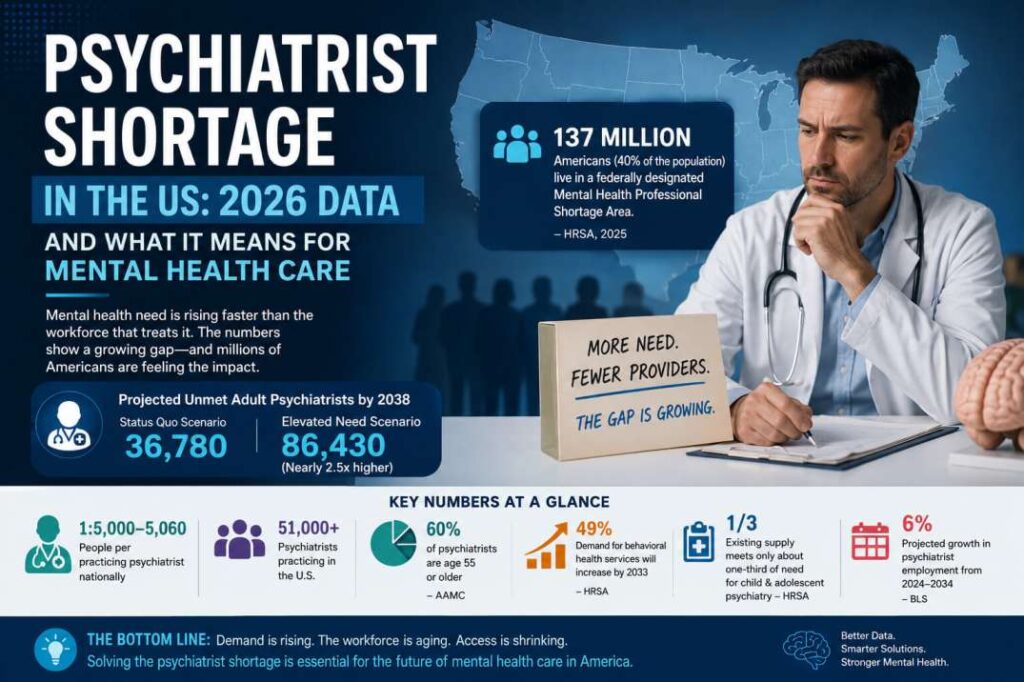
Mental health need in the United States is rising faster than the workforce that treats it. As of late 2025, roughly 137 million Americans — about 40% of the population — were living in a federally designated Mental Health Professional Shortage Area, according to the Health Resources and Services Administration (HRSA). For psychiatrists specifically, the gap is projected to widen sharply over the next decade, even as demand for psychiatric care keeps climbing. This is exactly the kind of workforce and access problem that clinicians, researchers, and policymakers gather to work through at psychiatry conferences each year — and it’s the focus of this deep dive into the latest verified data.
This article breaks down what the numbers actually say, why the shortage is happening, who it affects most, and what solutions are being discussed heading into 2026 and beyond.
The Scale of the Shortage: What the Data Shows
The most frequently cited figure in psychiatric workforce planning is HRSA’s projection of roughly 36,780 unmet adult psychiatrists by 2038 under a status-quo demand scenario. That number isn’t the ceiling, though — under an “elevated need” scenario, one that accounts for more people actually seeking and receiving care rather than going untreated, HRSA’s Health Workforce Simulation Model projects the shortfall could climb to 86,430 adult psychiatrists, nearly two and a half times the baseline estimate.
Separate analyses using slightly different methodologies and time horizons have projected shortages as low as roughly 14,000–31,000 psychiatrists in the mid-2020s, based on long-running academic modeling published in Psychiatric Services, and as high as 93,940 adult psychiatrists by 2037 in newer projections that blend HRSA and state-level data. The range reflects different assumptions about population growth, retirement timing, and how much unmet demand is captured — but every credible model points the same direction: the gap is large, and it is not closing on its own.
Child and adolescent psychiatry faces its own distinct shortfall. HRSA projections put the gap at approximately 19,770 child and adolescent psychiatrists by 2038, with existing supply meeting only about a third of projected need — a particularly serious problem given that youth mental health concerns have escalated significantly since the pandemic.
The Provider-to-Population Ratio
Beyond raw shortage numbers, the psychiatrist-to-population ratio offers a clearer everyday picture of access. As of the most recent workforce data, the United States has roughly one practicing psychiatrist for every 5,000 to 5,060 residents nationally. For comparison, most health workforce planners consider a ratio well below that level — closer to one provider per 10,000–20,000 for adequate basic access in many other specialties — but psychiatric care requires more frequent, ongoing contact than many other medical services, which makes even a 1:5,000 ratio insufficient in practice.
Currently, more than 51,000 psychiatrists are practicing in the U.S., of whom just over 11,000 specialize in child and adolescent psychiatry, according to data compiled from the American Academy of Child and Adolescent Psychiatry. That workforce is not evenly distributed, and it is aging: roughly 60% of practicing psychiatrists are age 55 or older, per Association of American Medical Colleges (AAMC) data, meaning a large share of the current supply is approaching retirement over the next decade at the same time demand is rising.
Why the Gap Is Widening: Demand vs. Supply
The shortage isn’t simply a matter of too few psychiatrists being trained — it’s a supply-and-demand mismatch that’s accelerating on both sides.
Demand is growing faster than supply. Federal projections indicate that demand for behavioral health services will increase by approximately 49% through 2033, while the workforce supply is projected to grow by only about 11% over that same period — a demand-to-supply growth ratio of roughly 4.5 to 1. In practical terms, for every new provider entering the field, service demand is growing more than four times faster.
Bureau of Labor Statistics (BLS) employment data paints a more modest but still telling picture: from 2024 to 2034, psychiatrist employment is projected to grow about 6%, translating into roughly 1,700 new job openings nationally. That’s healthy growth for a single medical specialty, but nowhere near enough to offset retirements and rising need at the same time.
The workforce is aging out faster than it’s being replaced. With approximately six in ten psychiatrists at or past age 55, the coming wave of retirements is expected to outpace the rate at which new psychiatrists complete residency and enter practice — a dynamic that earlier academic workforce models flagged as a period of continued contraction before any meaningful expansion begins.
Reimbursement and insurance dynamics are pushing clinicians out of network. According to the American Psychological Association’s 2024 Practitioner Pulse Survey, the majority of psychologists who left or avoided insurance panels cited insufficient reimbursement rates as the primary reason, with administrative burden and payment delays also cited by a majority of respondents. While that survey covers psychologists specifically, it reflects a reimbursement environment across behavioral health broadly that makes accepting insurance less financially viable — effectively shrinking the accessible supply of psychiatric care even where providers technically exist.
State-level policy support is inconsistent. A Kaiser Family Foundation 50-state Medicaid budget survey found that about half of states — 23 — implemented fee-for-service rate increases for one or more outpatient behavioral health provider types in fiscal year 2025. But only 14 states are currently planning similar behavioral health rate increases for fiscal year 2026, suggesting the momentum behind reimbursement reform may be slowing even as the workforce gap grows.
Who Is Affected Most: Geographic and Demographic Disparities
The psychiatrist shortage is not distributed evenly across the country. It disproportionately affects rural communities, low-income regions, and states with fewer academic medical centers.
- Rural counties bear the brunt of the gap. An estimated 65% of non-metropolitan counties in the U.S. lack a practicing psychiatrist entirely, according to workforce distribution research. Urban areas aren’t immune either — many face selective shortages driven by insurance acceptance and subspecialty availability, even where raw provider counts look adequate on paper.
- State-by-state variation is stark. Texas, for example, had 246 of its 254 counties wholly or partly designated as Mental Health Professional Shortage Areas as of recent federal data — despite being one of the largest states by population and psychiatric workforce in absolute terms. Western mountain states, including Idaho, Montana, Nevada, Wyoming, and Utah, face some of the most severe per-capita shortages nationally, largely due to large geographic service areas and limited metropolitan population centers.
- Nearly all states report a workforce shortage. A 2024 National Conference of State Legislatures (NCSL) survey found that 43 of 44 responding states reported an active behavioral health workforce shortage — underscoring that this is a near-universal, not regional, problem.
- Treatment gaps follow provider gaps. Federal shortage-area data indicates current workforce capacity meets only about 26% of documented behavioral health need in designated shortage areas, and a substantial share of adults with diagnosable mental illness go without any care at all, largely due to provider unavailability rather than lack of willingness to seek treatment.
What This Means for Patients and the Health System
The downstream effects of the psychiatrist shortage extend well beyond long appointment waitlists.
Longer wait times and delayed diagnosis. In shortage areas, patients often wait weeks or months for an initial psychiatric evaluation, which can allow treatable conditions — depression, anxiety, bipolar disorder, psychosis — to worsen before intervention begins.
Increased burden on primary care and emergency departments. When psychiatric care isn’t accessible, patients in crisis frequently end up in emergency rooms or rely on primary care physicians who may have limited specialized training in complex psychiatric medication management.
Geriatric psychiatry is a compounding blind spot. HRSA also projects a 2038 shortage of over 1,500 geriatricians — meaning the physician workforce best positioned to catch early mental health symptoms in older adults, a population with rising rates of late-life depression and neuropsychiatric conditions tied to dementia, is shrinking in parallel with the psychiatric workforce itself.
Economic and market pressure is building. As demand outpaces the supply of psychiatrists willing or able to accept insurance, compensation for psychiatric care is climbing — the average psychiatrist salary was reported at approximately $269,120 in 2024 by the BLS, with compensation trending upward through 2026 as health systems compete for a limited talent pool. That’s good news for psychiatrists’ earning potential, but it also signals a widening gap in affordability and access for patients who rely on insurance coverage rather than out-of-pocket payment.
What’s Being Done — and Where the Conversation Is Heading
Addressing a workforce shortage of this scale requires coordinated action across training pipelines, reimbursement policy, and technology-enabled care models. Several approaches are gaining traction:
Loan repayment and incentive programs. The National Health Service Corps (NHSC) Loan Repayment Program remains one of the more effective tools for drawing psychiatrists and other behavioral health clinicians into designated shortage areas, offering substantial student loan repayment in exchange for service commitments in underserved communities.
Telepsychiatry expansion. Remote psychiatric consultation has become one of the fastest-growing tools for extending limited psychiatric capacity into regions with few or no in-person providers, particularly rural counties where in-person psychiatric access is essentially nonexistent.
Pharmacogenomic-guided prescribing and AI-assisted diagnostic support. Emerging clinical tools aimed at improving prescribing accuracy and diagnostic consistency are increasingly seen as ways to help a limited psychiatric workforce operate more efficiently, even if they can’t solve the raw numbers problem on their own.
Policy-level workforce planning. State-by-state analyses — including a 2026 Pew Charitable Trusts review — have identified concrete policy levers such as formal workforce needs assessments, financial incentives for practicing in shortage areas, and expanded pipeline programs to grow the number of licensed providers entering the field.
Residency expansion. Because residency training capacity is a major bottleneck limiting how quickly new psychiatrists enter the workforce, expanding funded residency slots — particularly in underserved regions — is widely viewed as one of the highest-leverage long-term interventions.
These are exactly the kinds of workforce, technology, and policy solutions being actively debated at clinical and academic gatherings this year. Physicians, residents, researchers, and health policy leaders working to close this gap are increasingly turning to events like psychiatry conferences 2026 to compare data, share what’s working in their own states and health systems, and build the kind of cross-institutional collaboration that a fragmented, unevenly distributed workforce crisis actually requires.
Key Takeaways
- Roughly 137 million Americans — 40% of the population — live in a federally designated Mental Health Professional Shortage Area.
- HRSA projects a baseline shortage of about 36,780 adult psychiatrists by 2038, rising to as many as 86,430 under elevated-need scenarios.
- The current psychiatrist-to-population ratio sits at roughly 1 provider per 5,000–5,060 residents nationally.
- Demand for behavioral health services is projected to grow 49% by 2033, while supply grows only about 11% — a widening gap, not a stable one.
- Nearly 60% of practicing psychiatrists are 55 or older, meaning retirements will accelerate the shortage over the next decade.
- Rural counties face the most severe access gaps, with roughly two-thirds lacking a practicing psychiatrist entirely.
- Solutions under active discussion include loan repayment programs, telepsychiatry expansion, residency growth, and reimbursement reform.
Sources
- Health Resources and Services Administration (HRSA), State of the Behavioral Health Workforce, 2025
- HRSA Health Workforce Simulation Model, Designated Health Professional Shortage Areas data, December 2024
- U.S. Bureau of Labor Statistics, Occupational Employment and Wage Statistics and Employment Projections, 2024–2034
- Association of American Medical Colleges (AAMC), physician workforce age data
- American Academy of Child and Adolescent Psychiatry, workforce data
- American Psychological Association, 2024 Practitioner Pulse Survey
- Kaiser Family Foundation, 50-state Medicaid budget survey
- National Conference of State Legislatures (NCSL), 2024 behavioral health workforce survey
- Pew Charitable Trusts, state-level behavioral health workforce analysis, April 2026
- Psychiatric Services journal, psychiatrist workforce projection study (Satiani et al.)









Leave a Reply