






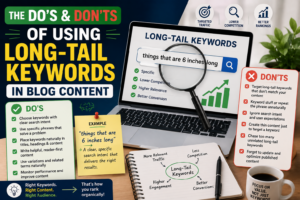
Long-tail keywords can help bloggers attract visitors who are searching for specific information. Unlike broad keywords, these phrases usually describe a clear question, problem, comparison, or need.
For example, a general keyword such as “blogging” could represent dozens of different intentions. A more detailed phrase such as “how to start a travel blog on a budget” tells the writer much more about what the reader expects.
Websites such as www theboringmagazine .com can use specific topics alongside broader categories to create content for readers at different stages of their search journey. However, adding longer phrases to an article does not automatically improve its rankings. They must be relevant, natural, and supported by genuinely useful information.
Here are the most important do’s and don’ts of using long-tail keywords in blog content.
1. Do Choose Keywords with Clear Search Intent
Before targeting a phrase, determine what the searcher wants to accomplish.
A user may be looking for:
- A quick answer
- A detailed tutorial
- A list of examples
- A product comparison
- A solution to a problem
The format and depth of your article should reflect that intention. A keyword containing “how to” may require a tutorial, while a phrase containing “best” may call for comparisons and recommendations.
Don’t: Select a keyword just because a research tool reports search volume for it.
2. Do Use Specific Phrases as Content Guides
A good long-tail keyword can provide a clear direction for an article.
Consider the phrase things that are 6 inches long. It communicates a precise expectation: the reader wants familiar examples that can help them visualize a seven-inch measurement.
An article targeting that phrase should provide relevant objects, straightforward explanations, and useful measurement context. It should not spend most of its length discussing unrelated topics.
This principle applies to every niche. The more specific the query is, the more closely the content should match it.
Don’t: Use a long-tail phrase when your article only addresses it briefly or indirectly.
3. Do Place Keywords in Important Locations
Use the primary phrase naturally in prominent parts of the page, including the title, introduction, main heading, and other descriptive locations where appropriate. Google’s Search Essentials recommends using the words people search for in prominent page elements while keeping the content helpful and readable.
The keyword may also appear in:
- A relevant subheading
- The page URL
- Image alt text, when descriptive
- The meta description
- Internal-link anchor text
Every placement should make sense to the reader.
Don’t: Insert the exact phrase into every heading or paragraph.
4. Do Write for the Reader First
Long-tail keyword optimization should support the content rather than control every sentence.
Readers want complete, understandable answers. Provide explanations, examples, practical steps, and any context needed to solve their problem.
Google’s published guidance emphasizes creating reliable, people-first content rather than content designed primarily to influence search rankings.
Don’t: Produce awkward or repetitive copy merely to maintain an exact keyword density.
5. Do Include Natural Variations
Searchers can express the same need in several ways. A writer discussing long-tail keyword research might naturally use related phrases such as:
- Specific search queries
- Low-competition keywords
- Question-based keywords
- Detailed search phrases
- Niche keyword opportunities
Using meaningful variations makes the article sound more natural and can help it cover the subject comprehensively.
Don’t: Create a separate section for every minor variation of the same keyword.
6. Do Evaluate the Search Results
Before drafting an article, search for the target phrase and study the pages that currently appear.
Look at:
- The dominant content format
- The depth of the leading articles
- Common questions being answered
- Weak or outdated information
- Opportunities to provide something clearer
This process can reveal whether users prefer a guide, list, definition, video, product page, or another format.
Don’t: Copy the structure and wording of competing articles. Use them to understand expectations, then create something more useful.
7. Do Connect Related Keywords Through Content Clusters
Long-tail keywords work well as supporting topics within a broader content strategy.
A site covering SEO might create a central keyword-research guide and connect it to focused articles about keyword difficulty, search intent, content gaps, question keywords, and keyword clustering.
Internal links can then help readers move between related pages while showing how the topics connect.
Don’t: Publish dozens of isolated posts without considering their relationship to your main subject.
8. Do Avoid Keyword Stuffing
Repeating keywords unnaturally can reduce readability and make an article appear manipulative.
Google defines keyword stuffing as filling a page with words or numbers in an attempt to manipulate rankings, particularly when those terms appear unnaturally or out of context.
Use the phrase where it adds clarity, and rely on natural language throughout the rest of the article.
Don’t: Force the target keyword into sentences where a pronoun, synonym, or shorter expression would sound better.
9. Do Consider the Value of the Traffic
A low-volume keyword can still be worthwhile when it attracts the right readers.
Instead of looking only at traffic estimates, consider whether the phrase:
- Fits your niche
- Addresses a real audience need
- Supports your broader content plan
- Can lead readers to related articles
- Offers a realistic ranking opportunity
Smaller, focused audiences are often more engaged than visitors arriving through vague searches.
Don’t: Reject every keyword that lacks a large monthly search volume.
10. Do Monitor and Improve Published Content
Keyword research does not end when the article is published.
Review performance data to see which queries generate impressions, clicks, and engagement. You may discover relevant phrases that were not included in the original plan.
Use those insights to improve explanations, add missing sections, update examples, and strengthen internal links.
Don’t: change the target keyword repeatedly before the article has had a reasonable opportunity to be discovered and evaluated.
Final Thoughts
Long-tail keywords are most effective when they connect a specific search need with a genuinely helpful answer. Their value comes from clarity and relevance not simply from being longer than other keywords.
Choose phrases with recognizable intent, study the search results, use keywords naturally, and build each article around the information readers expect. Avoid repetition, thin content, and unrelated keyword variations added only for optimization.
When long-tail keywords are integrated into a focused content strategy, they can help a blog cover its niche more thoroughly, reach specific audiences, and build sustainable organic visibility over time.









Leave a Reply