






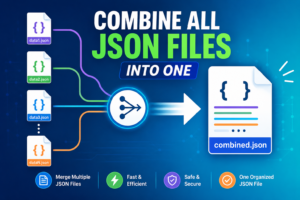
JSON is one of the most widely used formats for exchanging data between applications and API responses. However, in many real-world cases, users often end up with several JSON files containing related data. Managing multiple files can be time-consuming and not an easy task for every user.
In this situation, users start searching for a solution to combine all JSON files into one for better management. Creating a single, unified dataset that is easier to manage, analyze, and share. Merging JSON files helps streamline workflows, improve productivity, and ensure better data organization. In this guide, we will walk you through the best solutions to make the entire process simple. Now, let’s begin.
Why Need to Combine JSON Files into One?
Combining multiple JSON files into a single file is a common requirement when dealing with scattered or segmented data. It helps streamline data handling, reduces complexity, and makes further processing much more efficient. Whether you are a developer, analyst, or business user, merging JSON files can significantly improve your workflow. Here are some reasons:
- Simplified Data Management – Handling one consolidated file is far easier than managing multiple separate files.
- Improved Data Analysis – A single dataset allows quicker querying, reporting, and data visualization.
- Better Performance – Reduces the overhead of opening and processing multiple files repeatedly.
- Enhanced Data Organization – Keeps related information in one structured and consistent format.
- Easy Data Sharing & Migration – Sharing one file is more convenient than sending multiple JSON files.
- Reduced Risk of Data Loss – Centralizing data minimizes the chances of missing or misplaced files.
- Supports Automation & Integration – Many tools and applications work more efficiently with a single input file.
Overall, combining all JSON files into one not only saves time and effort but also enhances data usability and consistency. It is a practical approach for anyone looking to manage, analyze, or transfer JSON data more effectively.
Quick Solution to Combine All JSON Files into One
- Download and run the SysTools JSON Merger Tool on your machine.
- Click to Add File & Folder to upload JSON files.
- Select the primary file and click on the Merge option.
- A Pop-up will appear, tap on Ok button.
- Lastly, click on View Report to open a single JSON file.
Common Challenges While Combining JSON Files
While merging JSON files, users may face several issues:
- Invalid JSON Format Errors
- Handling Nested Structures
- Duplicate Records
- Large File Processing Delays
Proper validation and the right method can help overcome these challenges.
How to Combine All JSON Files into One? Top Methods
When dealing with multiple JSON files, choosing the right method to combine them is essential for ensuring accuracy and efficiency. Depending on your technical expertise, data size, and complexity, there are several approaches available—from simple manual techniques to advanced automated solutions. In the following section, we will explore the top methods that can help you merge all JSON files into one seamlessly and without data loss.
Method 1: Combine Multiple JSON Files into Single File Manually
The manual method is suitable for users who are working with a small number of JSON files and have basic technical knowledge. This approach involves opening each file in a text editor and carefully merging the content while maintaining proper JSON structure. It works best for simple datasets but can become complex with large or nested files. Follow the instructions given below:
- Take a backup of all original JSON files.
- Open each JSON file in a text editor like Notepad++ or VS Code.
- Check whether the files contain arrays or objects
- Copy the data from each file and paste it into a single JSON structure.
- Ensure proper comma placement and remove extra brackets.
- Fix duplicate keys or structural inconsistencies, if any.
- Validate the merged file using a JSON validator.
- Save the final combined JSON file with a new name.
PROS:
- Completely free method
- No additional software required
- Suitable for small and simple JSON files
- Full manual control over data structure
CONS:
- Time-consuming for multiple files
- High risk of syntax errors
- Difficult to manage large or nested JSON files
Method 2: Combine All JSON Files into One – Automated Solution
When dealing with multiple or large JSON files, manual and technical methods can become time-consuming and error-prone. In such cases, using an automated solution is the most efficient and reliable approach. One such trusted solution is the SysTools JSON Combiner Tool, which allows users to seamlessly combine multiple JSON files into a single structured file while maintaining data integrity and hierarchy. Here are the working steps:
- Launch the above-mentioned tool on your system.
- Browse and upload multiple JSON files.
- Choose a primary file and set the destination path.
- Now, click on the Merge option to run the process.
- Lastly, tap on View Report to open a new single JSON file.
Prime Features of Using Advanced Approach
- Bulk JSON File Merging – Combine multiple JSON files at once without repeating the process
- Maintains Original Structure – Preserves nested objects, arrays, and key-value hierarchy accurately
- Handles Large & Complex Files – Efficiently processes heavy and structured JSON datasets without errors
- No Data Loss Guarantee – Ensures complete data integrity during the merging process
- User-Friendly Interface – Simple dashboard suitable for both technical and non-technical users
- Supports All JSON File Types – Works with JSON files from APIs, web apps, and databases
- Flexible Output Options – Allows users to choose the destination path for the final merged file
Time to Wrap Up!
In this comprehensive guide, we have shared two best approaches to combine all JSON files into one in a hassle-free way. Manual methods are easy to use but do not provide accurate results, and also come with some disadvantages that can be error-prone. Using a professional solution is an ideal choice to combine JSON files into one with just a few clicks. So, choose the technique that suits your needs and preferences.









Leave a Reply