






The Mirror Lies and the Camera Tells On It
You’ve lived this exact moment. The outfit looked genuinely good in the mirror, you felt sharp walking out, and then someone’s photo from the evening arrives and the whole thing reads flat, shapeless, somehow cheaper than it was. Nothing changed between the mirror and the lens, except everything did, because cameras see clothes differently than eyes do, and nobody teaches the difference. Mirrors show you a moving, three dimensional person with your brain filling in texture, depth and context. Cameras flatten all of it into one frozen frame, strip half the texture, exaggerate wrinkles, shift colors and lock whatever your hem was doing at that exact millisecond into permanent record. The brands that photograph well understand this physics deeply, and it shows in their catalogs, since a label like cole buxton builds pieces in heavyweight textured fabrics precisely because dense cloth holds shadows and shape under a lens where thin fabric vanishes into flat color. Photos are now where outfits live their real lives, group shots, stories, the pictures a date posts, and your wardrobe appears in more photographs per month than mirrors per day.
Texture Is What Cameras Actually See
Strip an outfit of movement and dimension, which is what every photo does, and texture becomes the last surviving evidence of quality, which is why texture is the first rule of camera dressing. A lens can’t feel fabric weight, but it can see what weight does, the shadow lines inside a heavy drape, the visible knit structure of dense cotton, the way brushed fleece holds soft depth while thin jersey renders as flat dead color. Heavyweight tees whose surfaces show grain on camera, sweatshirts whose dense faces catch light in gradients rather than blocks, and knit sets whose stitch texture reads clearly in a phone photo all photograph expensive because texture is the only thing the flattened image has left to judge. Test your closet with a simple method, photographing pieces in plain daylight and sorting by what survives. Heavyweight fleece, chunky knits, denim, corduroy, suede and leather all photograph with depth. Thin cotton, shiny polyester and worn out jersey all photograph as color swatches with sleeves. Stack surviving textures and photos gain layers, fleece against denim against leather reading as three materials even in a flat frame, while a single texture outfit needs perfect everything else to avoid reading as one shape.
The Camera Test: Six Checks Before the Photo
Run these six checks on any outfit heading somewhere photographable, in the order the lens reads them:
- Silhouette freeze: Photos lock your shape mid movement, so check standing still and slightly turned. Volume without anchor becomes a blob at freeze frame
- Wrinkle audit: Cameras exaggerate every crease into a shadow line. Steam the pieces that show, especially across chest and thighs where sitting prints its evidence
- Color shift check: Photograph the outfit once in daylight before trusting it
- Hem and junction lock: Pant to shoe intersections photograph exactly as they sit, so set the stack or break deliberately
- Neckline close up: Group photos crop to chest height constantly, meaning your collar zone appears in more frames than your full outfit
- Layer visibility: A layered outfit only photographs as layered if each layer shows, so stagger lengths and open outer pieces enough for the camera to count them
Run all six in ninety seconds before leaving, and the evening’s photos stop being a lottery.
Color on Camera
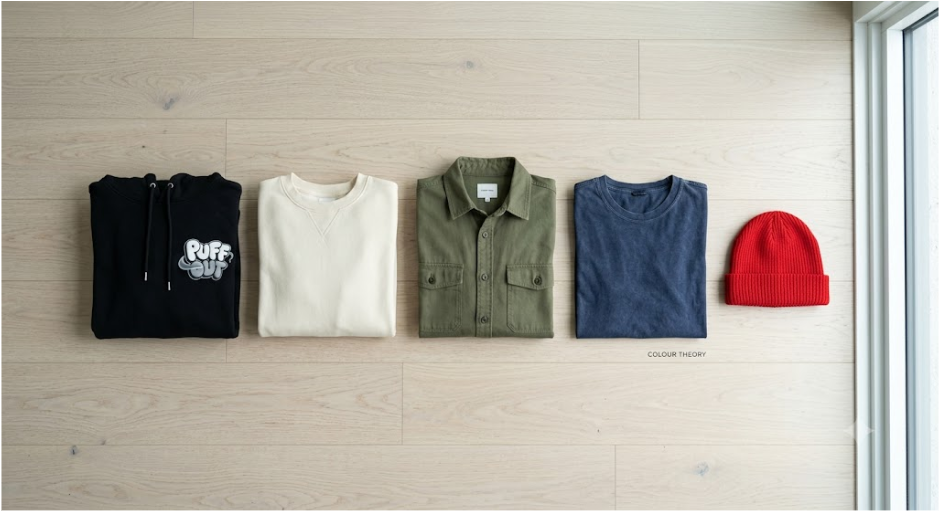
Color behaves differently under a lens than in a mirror, and knowing the shifts saves outfits from dying in the edit. Black photographs deep and slimming in good light but eats all its own detail in dim rooms, becoming a shape shaped hole in night photos, which is why texture matters double on dark pieces. Cream and off white photograph beautifully almost everywhere, catching light softly and showing fabric texture better than any other tone, the quiet reason cream became the content era’s favorite neutral. Earth tones, olive, brown, washed navy, hold true across most lighting and flatter most skin, making them the safest camera palette. Grey performs mid. The traitors: pure white blows out in sunlight and flash, losing all texture into a glowing panel, so off white and cream beat it in nearly every photographed situation. Bright reds and oranges oversaturate on phone cameras, bleeding past their edges and dominating frames beyond their actual size. Neon anything breaks phone sensors outright. Pattern scale carries its own physics too, since fine patterns like thin stripes can moiré into shimmer on screens, while bold graphics photograph crisp. Build the photographed wardrobe on cream, earth and textured black, deploy one saturated element deliberately, and the camera starts cooperating.
Fit at Freeze Frame
Fit problems the eye forgives in motion become permanent exhibits at freeze frame, so camera fit runs one notch more precise than mirror fit:
- Shoulder seams photograph from every angle, including the three quarter and side views mirrors rarely show you
- Sleeve length locks at its worst moment, so knuckle grazing that looks relaxed in mirrors reads sloppy frozen
- Excess fabric pools visibly when seated, and half of life’s photos happen sitting, so the dinner table test predicts more real photos than any standing pose
- Length staggering reads stronger on camera than in person, rewarding the hoodie hem below the jacket and the tee edge below both
- Slight tapering photographs dramatically better than it looks in mirrors, because the frozen silhouette needs the narrowing line toward the shoe
- One size of oversized photographs as style, two sizes photographs as borrowed
The practical response isn’t buying new clothes, it’s promoting your best fitting pieces to photographed occasions and letting the almost right ones live in unphotographed daily life.
Light Is the Real Stylist
The same outfit photographs expensive at golden hour and cheap under a ceiling bulb, which means light outranks clothing in every frame. Golden hour flatters everything, warming skin, deepening fabric texture and casting soft directional shadows that give clothes dimension, so any outfit you actually want documented deserves that window when you can choose it. Open shade comes second, rendering colors true and texture clean, the reason street style photography lives on the shaded sides of streets. Overcast daylight runs a close third, nature’s softbox. The hostile lights matter just as much. Direct midday sun carves harsh shadows under every wrinkle, overhead indoor lighting drops unflattering shadows down faces, and mixed color indoor light shifts fabric colors in ways no wardrobe survives. Flash flattens texture to nothing and bounces off synthetic fabrics with a plastic sheen, which is why quality cotton and knit survive flash photos that turn technical fabrics into trash bags. Statement pieces have their own light logic, since bold graphics need adequate light to read at all, and a strong print from a brand like hellstar does its best work in daylight and open shade where the contrast registers fully, while dim bar lighting reduces any graphic to a smudge. You can position within any room, facing windows, avoiding downlights, stepping toward doors.
Posture and the Ten Percent Clothes Can’t Do
Clothes deliver ninety percent of a photograph and the body wearing them delivers the rest. Weight distribution first, because standing evenly on both feet photographs stiff, while shifting weight to one leg drops one shoulder naturally and breaks the symmetry that reads as posing. Hands second, since dangling hands broadcast awkwardness, so give them a job, one in a pocket, adjusting a cuff, holding a drink, mid gesture, anything but hanging. The slight angle third, as facing a camera dead on flattens shoulders and widens the frame’s read of you, while a quarter turn narrows the silhouette and adds dimension to every layer you’re wearing. Breathing normally fourth, cured by exhaling right before the frame. Movement beats all of it when available, because walking shots and candids photograph clothes the way they actually live.
Building the Photo Ready Rotation
Camera dressing is mostly promotion and demotion rather than purchase. Photograph your ten most worn pieces in open shade with a phone, thirty minutes total, and let the frames judge, since the results split any wardrobe cleanly into pieces that photograph above their price, at their price and below it. Promote the overperformers, usually the heavyweight, textured, earth toned and cream pieces, into a designated photo rotation for dates, events and trips. Demote the underperformers into unphotographed daily duty. Fill documented occasions using venue and light logic, textured plains for dim dinners, one bold graphic for daylight events, cream and earth for golden hour anything. The phone lookbook habit locks the system in, saving frames of outfits that photographed well into one album.
Final Words
The camera flattens, shifts and freezes, and every outfit that dies in photos died on one of those three verbs. Dress in texture the lens can hold onto, build on cream, earth and textured black while dosing one saturated statement to the room, and run the ninety second six check before anything photographable.
FAQ
Q: Why do my outfits look worse in photos than in the mirror?
Cameras flatten depth, strip texture and freeze your worst mid movement moment. Textured heavyweight fabrics close most of the gap.









Leave a Reply