






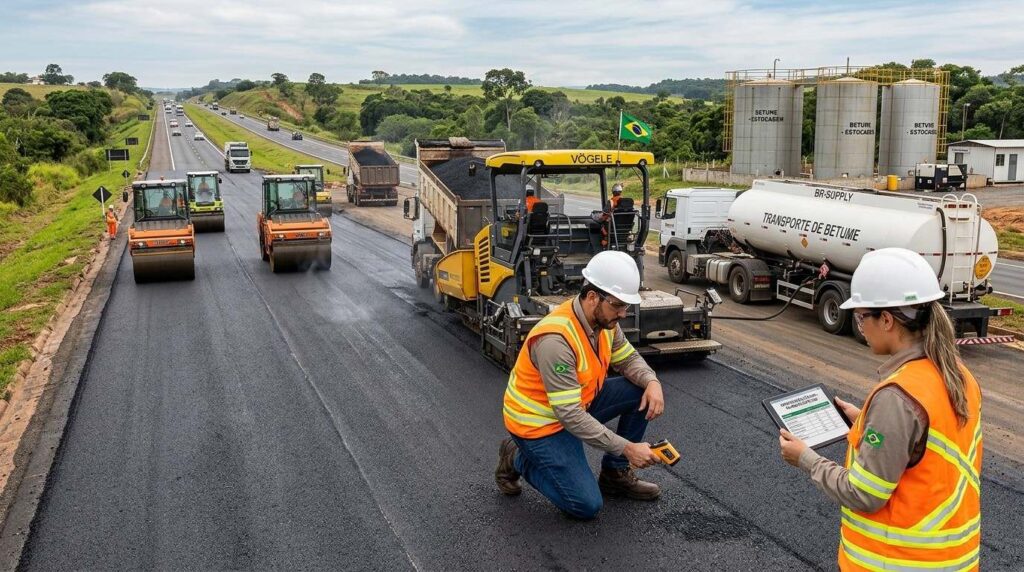
Brazil’s road infrastructure is an important part of the country’s transportation and economic system. Highways and urban roads connect major cities with industrial areas, agricultural regions, ports, distribution centers, and commercial markets. Maintaining these transportation routes requires appropriate pavement materials, reliable construction practices, and effective quality control.
Among the materials used in asphalt pavement, bitumen has a particularly important function. It acts as a binder that holds aggregate particles together and helps form a cohesive asphalt mixture.
For engineers, contractors, infrastructure developers, and procurement professionals, understanding Brazil Bitumen involves more than knowing its basic definition. Grade selection, pavement conditions, traffic loading, climate, testing, storage, and supply logistics all need to be considered when specifying a binder for a road project.
The Function of Bitumen in Asphalt Pavement
Asphalt mixtures generally consist of mineral aggregates combined with a bituminous binder. During production, heated bitumen coats the aggregate particles and helps create a continuous mixture.
Once the asphalt is placed and compacted, the binder contributes to cohesion within the pavement structure.
Depending on the mixture and project conditions, bitumen can contribute to:
- Binding aggregate particles
- Providing cohesion
- Improving moisture resistance
- Supporting pavement flexibility
- Maintaining asphalt mixture workability
- Contributing to resistance against repeated traffic stresses
The performance of an asphalt pavement, however, depends on the complete pavement system. Aggregate characteristics, mixture design, compaction, drainage, pavement thickness, construction temperatures, and maintenance all influence the final result.
Why Bitumen Selection Requires Engineering Analysis
There is no single bitumen grade that is automatically suitable for every road in Brazil.
Different projects have different environmental and structural requirements. A highway carrying heavy freight traffic may need a different binder strategy from a low-volume urban street.
Before selecting a binder, project teams can evaluate:
- Climatic conditions
- Pavement temperature
- Traffic volume
- Heavy vehicle loading
- Aggregate characteristics
- Asphalt mixture design
- Required service life
- Applicable technical standards
This project-specific approach helps ensure that the selected Brazil Bitumen meets the actual requirements of the pavement rather than being chosen solely because it is readily available.
Common Penetration Grades
Penetration grading is a traditional method of classifying paving bitumen. The grade is associated with the penetration measured under controlled laboratory conditions.
Common examples include 40/50, 60/70, and 80/100.
Bitumen 40/50
Bitumen 40/50 is considered a harder penetration-grade binder compared with higher penetration grades.
Its use depends on the requirements of the asphalt mixture, environmental conditions, traffic loading, and applicable project specifications.
Bitumen 60/70
Bitumen 60/70 is one of the commonly recognized paving grades used for asphalt applications.
It can be considered for highway paving, urban roads, road rehabilitation, and other applications when its properties meet the required specification.
When evaluating Bitumen 60/70 in Brazil, buyers should examine laboratory results, certificates, and technical specifications instead of relying only on the numerical grade.
Bitumen 80/100
Bitumen 80/100 is generally softer than 60/70 within the penetration classification system.
Its suitability depends on the application and environmental conditions. Engineers should consider the expected pavement temperature and traffic conditions before selecting this or another softer grade.
Performance-Based Binder Selection
Penetration grades are not the only way to classify asphalt binders.
Performance Grade systems provide a different approach by considering binder behavior at specified temperature conditions. This can be useful when pavement designers need to account for high-temperature and low-temperature performance.
Viscosity-based classifications can also provide information about the flow behavior of bitumen.
The appropriate classification system depends on the project requirements and applicable standards.
For a Brazil Bitumen Supplier, understanding the customer’s technical requirements is therefore important before recommending a specific binder.
Climate Conditions Across Brazil
Brazil’s large geographical area means that pavement conditions can vary considerably.
Roads may be exposed to different combinations of temperature, rainfall, humidity, solar radiation, and seasonal weather.
Temperature is particularly important because the physical behavior of bitumen changes with temperature.
At elevated temperatures, bitumen becomes softer. Under heavy traffic, an unsuitable binder or poorly designed asphalt mixture may contribute to deformation.
At lower temperatures, the binder becomes harder, making flexibility and cracking resistance relevant considerations.
This is why climate data should be considered during pavement and binder selection.
Traffic and Heavy Freight Routes
Traffic loading has a direct relationship with pavement requirements.
Highways connecting agricultural production regions, industrial areas, warehouses, and ports may carry substantial freight traffic.
Repeated heavy axle loading can contribute to pavement distress over time if the pavement structure and asphalt mixture are not appropriately designed.
Engineers can consider:
- Average daily traffic
- Percentage of heavy vehicles
- Axle loading
- Expected traffic growth
- Braking and acceleration zones
- Turning areas
- Design service period
These factors help establish appropriate pavement and binder requirements.
Quality Control and Laboratory Testing
Quality assurance is essential when purchasing and using bitumen.
Testing helps verify whether the material conforms to the required technical specification.
Depending on the product and applicable standard, common evaluations can include penetration, softening point, viscosity, flash point, solubility, density, and other properties.
Penetration Testing
Penetration testing measures the depth that a standard needle penetrates a bitumen sample under controlled conditions.
The result is used to help classify conventional penetration-grade binders.
Softening Point Testing
The softening point provides information about binder behavior as temperature increases.
This can be useful when evaluating how a binder may behave under warmer pavement conditions.
Viscosity Testing
Viscosity describes how easily the material flows at specified temperatures.
This information can be relevant to pumping, heating, mixing, and handling operations.
Flash Point Testing
Flash point testing provides information important for safe heating and handling procedures.
The specific testing program should always follow the applicable product standard and project specification.
Selecting a Reliable Brazil Bitumen Supplier
A dependable supply chain is important for large infrastructure projects.
When evaluating a Brazil Bitumen Supplier, buyers should consider more than the quoted material price.
Product Quality
The supplier should demonstrate appropriate quality-control procedures and consistent product characteristics.
Technical Documentation
Useful documentation may include:
- Technical data sheets
- Certificates of Analysis
- Laboratory reports
- Product specifications
- Safety information
- Shipping documentation
This information allows buyers and engineers to verify the material before it enters the production process.
Supply Capacity
Large projects can require significant quantities of bitumen over extended periods.
The supplier should have sufficient production and distribution capacity to support the required schedule.
Delivery Reliability
Construction schedules depend on material availability. Delayed deliveries can interrupt asphalt production and paving operations.
For this reason, delivery planning should be considered during procurement rather than after the purchase order has been placed.
International Supply and Logistics
For companies working with a Brazil Bitumen Exporter, international logistics can involve additional considerations.
These may include:
- Port availability
- Shipping schedules
- Bulk transportation
- Packaging requirements
- Import documentation
- Customs procedures
- Inland transportation
- Storage facilities
The complete logistics chain should be evaluated before ordering large quantities.
Clear documentation between the supplier, shipping company, importer, and final buyer can help reduce avoidable delays.
Bitumen Storage and Handling
Proper storage is important for maintaining material quality.
Storage tanks should be appropriately maintained and protected against water and contamination. Heating should be carefully controlled according to the product requirements.
Unnecessary or prolonged exposure to excessive temperatures should be avoided because it can affect binder characteristics.
Storage capacity is also an important planning consideration. Large projects should coordinate incoming shipments with actual consumption and available tank capacity.
Personnel handling heated bitumen should follow appropriate workplace safety procedures and use suitable protective equipment.
Bitumen in Road Rehabilitation
Bitumen is not limited to new road construction.
Existing pavement requires maintenance and rehabilitation as traffic and environmental exposure gradually affect the surface.
Depending on pavement condition, rehabilitation may involve asphalt overlays, partial reconstruction, surface treatments, or other engineering solutions.
Before selecting a rehabilitation strategy, engineers may examine:
- Cracking
- Rutting
- Surface deformation
- Moisture damage
- Existing pavement structure
- Traffic conditions
- Drainage
The results of this assessment can help determine the appropriate materials and construction approach.
Importance of Long-Term Pavement Planning
The lowest purchase price does not necessarily represent the best value for an infrastructure project.
A more complete evaluation considers the expected service life and total project requirements.
Factors such as binder quality, aggregate performance, mixture design, construction quality, drainage, traffic, maintenance, and rehabilitation costs can all affect the long-term economics of a road.
A technically suitable binder combined with good pavement design and construction practices can support more reliable infrastructure performance.
Sustainable Road Infrastructure
Infrastructure development is increasingly focused on resource efficiency and long-term performance.
Pavement recycling and rehabilitation can reduce the need for complete reconstruction in suitable situations.
Reclaimed asphalt materials may be incorporated into new asphalt mixtures when allowed by the project specification and supported by appropriate engineering evaluation.
Durable pavement design can also reduce the frequency of major interventions over the life of a road.
These approaches can form part of a broader strategy for improving infrastructure efficiency.
Conclusion
Brazil Bitumen is an important material for asphalt pavement and road infrastructure, but selecting the appropriate product requires a project-specific approach.
Penetration grades such as 40/50, 60/70, and 80/100 offer different characteristics, while viscosity and performance-based classifications provide additional options for specific engineering requirements.
Climate, traffic loading, pavement design, laboratory testing, supplier capabilities, transportation, and storage should all be considered before purchasing a binder.
For infrastructure companies, working with a dependable Brazil Bitumen Supplier can simplify procurement by providing consistent products, technical documentation, testing information, and reliable delivery.
Ultimately, successful pavement performance depends on the complete system rather than the binder alone. Proper aggregate selection, asphalt mixture design, compaction, drainage, construction quality, and maintenance must work together with an appropriate bitumen binder.
By combining sound engineering with careful material procurement, construction professionals can support durable and reliable road infrastructure throughout Brazil.










Leave a Reply