






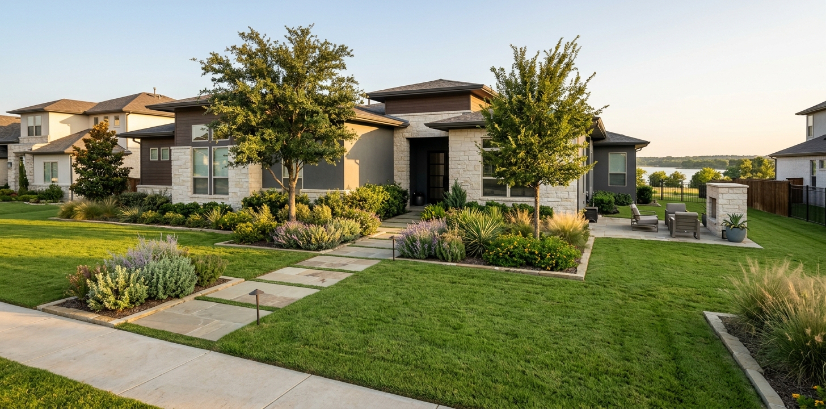
Modern homes often have a clean, structured appearance, and the landscape around them should feel like a natural continuation of that design. In Little Elm, however, creating an attractive yard involves more than choosing plants or keeping the grass green. Outdoor spaces need to accommodate strong summer heat, changing weather, water management, drainage, and the everyday needs of the people who use them.
Thoughtful landscaping in Little Elm therefore starts with understanding how the property actually works. A successful yard should complement the architecture, provide comfortable outdoor areas, support healthy plant growth, and remain manageable long after the initial installation.
The best landscapes are not necessarily the most elaborate. They are the ones where every major element—from lawns and pathways to planting, shade, drainage, and hardscape—has a clear purpose.
Start With the Home and Property
Before selecting plants, installing a lawn, or choosing materials for a patio, homeowners should evaluate the property itself.
Architecture, lot size, existing trees, sunlight patterns, drainage, and available outdoor space can all influence what will work.
A landscape that looks impressive on another property may not translate well to your own yard. Even neighboring homes can have different growing conditions because of shade, grading, soil, drainage, or the position of the house.
A useful starting point is to identify:
- Areas receiving direct sunlight for most of the day
- Spaces remaining shaded for several hours
- Existing trees and plants worth preserving
- Locations where water tends to collect
- Natural walking routes around the property
- Outdoor areas the household uses most frequently
Understanding these conditions can prevent homeowners from making landscaping decisions based purely on appearance.
Create a Connection Between the House and Yard
A modern landscape should feel connected to the building rather than designed as a completely separate space.
Architectural lines can be echoed through pathways, defined planting beds, borders, patios, and carefully positioned trees or shrubs.
That does not mean every modern landscape needs to be extremely minimalist.
Natural planting can soften strong architectural lines and make contemporary homes feel more inviting. A property with geometric features, for example, may benefit from softer shrubs and ornamental grasses around the foundation.
The objective is balance: the house and landscape should complement rather than compete with each other.
Consider Little Elm’s Climate and Growing Conditions
Plant selection should reflect local conditions rather than appearance alone.
Little Elm experiences hot summers and seasonal weather changes that can place significant stress on lawns and landscaping. Long-term performance therefore depends on selecting plants and materials suited to the property’s actual conditions.
The Town of Little Elm also maintains landscaping and development requirements addressing areas such as landscape materials, maintenance, and water use. Because local requirements can change, homeowners should check the town’s current guidance before undertaking major landscaping, irrigation, or lawn projects.
Plant selection should consider:
- Sun and shade requirements
- Heat tolerance
- Water requirements
- Mature height and width
- Root growth
- Seasonal appearance
- Expected maintenance
Choosing plants for how they will perform over several years is more important than how they look on installation day.
Choose Plants for Their Full Life Cycle
A common landscaping mistake is selecting plants based on their size at the nursery.
A small shrub may look perfectly proportioned when planted but become overcrowded after several growing seasons. Trees can create similar problems when their mature canopy or root systems were not considered during installation.
Proper spacing from the beginning gives plants room to mature naturally and can reduce aggressive pruning and replacement later.
For North Texas landscapes, homeowners should prioritize plants suited to the property’s sunlight, drainage, soil conditions, and irrigation availability rather than selecting varieties solely for visual appeal.
A Modern Landscape Needs Purposeful Lawn Space
A healthy lawn can provide important visual and practical benefits.
Open turf creates contrast against planting beds and hardscape while providing space for children, pets, outdoor games, or informal gatherings.
However, more lawn is not automatically better.
Modern landscape design often works best when lawn areas have a defined purpose. Reducing unnecessary turf can create space for planting, patios, shade, or other outdoor features while potentially reducing maintenance requirements.
The appropriate amount of lawn depends on how the household uses the property.
When Sod Installation Is Worth Considering
For homeowners who want an established lawn without waiting for seed to develop, sod can provide a faster visual result.
Properly installed sod can quickly create a dense grass surface and help define a newly landscaped property.
The important word is properly.
Sod should not simply be placed over poorly prepared ground. Existing vegetation may need to be removed, soil conditions evaluated, and the surface properly prepared before installation.
Watering is particularly important during establishment. Newly installed turf has different requirements from an established lawn, so homeowners should have an appropriate watering plan ready before the sod arrives.
Good Lawn Care Is About Consistency
An attractive new lawn requires ongoing care.
Maintenance should respond to grass variety, soil conditions, seasonal growth, rainfall, temperature, and other environmental factors rather than following exactly the same routine throughout the year.
Overwatering can create problems, while insufficient watering during periods of extreme heat can stress turf. Mowing too short may also weaken grass and expose more soil.
A practical routine may include:
- Mowing according to actual growth
- Checking irrigation coverage
- Monitoring dry or stressed areas
- Managing weeds before they spread
- Watching for drainage problems
- Adjusting watering as weather conditions change
Little Elm has implemented outdoor watering and water-conservation requirements. Because schedules, restrictions, and exemptions can change, homeowners installing new turf or major planting should verify the Town of Little Elm’s current watering guidance before beginning the project.
Design Outdoor Areas Around How You Live
A modern yard should provide more than an attractive view through the window. It should give people reasons to spend time outside.
Consider how the household actually uses the property.
A family that entertains regularly may benefit from a larger patio connected to an open lawn. Someone who prefers quiet evenings outdoors may place greater value on a shaded seating area surrounded by planting.
A backyard could include:
- Lawn for recreation
- Patio for dining
- Shaded seating for relaxation
- Planting beds for seasonal interest
- Space for children or pets
- Clear routes between the house and outdoor areas
These zones do not require physical walls. Changes in paving, landscaping, furniture, planting, or elevation can provide enough separation to make each area feel distinct.
Pathways Should Follow Natural Movement
Pathways are sometimes treated mainly as decorative elements, but their primary purpose is movement.
Before deciding where a walkway should go, consider how people naturally move through the property.
Where do they walk after leaving the driveway? How do they reach the backyard? Is there a practical route between the kitchen and patio? Can garden or maintenance areas be reached conveniently?
Designing pathways around actual movement can make the entire landscape feel more intuitive.
Materials should also complement the home’s architecture while remaining durable and appropriate for outdoor conditions.
Leave Room for Open Space
Not every empty section of a yard needs another feature.
Trying to fill every available area with planting, structures, furniture, or decoration can make a landscape feel crowded.
Modern design often benefits from visual breathing room. Open lawn, simple planting, or an uncluttered section between major features can create balance.
Instead of always asking, “What can we put here?”, homeowners can also ask:
“Does this area actually need anything?”
Sometimes simplicity is the stronger design decision.
Use Shade to Make Outdoor Living More Comfortable
Texas sunshine can make patios and other outdoor spaces uncomfortable during the hottest parts of the day, making shade an important part of landscape planning.
Trees can provide long-term natural shade, while pergolas, covered patios, umbrellas, and similar structures can offer more immediate protection.
Tree placement deserves careful planning. A tree installed near a seating area may eventually become one of the property’s most valuable landscape features, but its mature canopy, roots, proximity to structures, and maintenance requirements should be considered from the beginning.
Natural and built shade can also work together. A pergola surrounded by trees and low-maintenance planting, for example, can create an attractive transition between the home and garden.
Water Management Belongs in the Landscape Design
Drainage may not be the most visually exciting element of landscaping, but it can be one of the most important.
A yard may look perfect during dry weather and reveal major problems after heavy rainfall.
Homeowners should observe how water behaves during and after rain.
Warning signs include:
- Persistent puddles
- Muddy areas
- Soil erosion
- Exposed roots
- Damaged turf
- Water flowing toward structures
The appropriate solution depends on the property. Grading, drainage systems, planting, irrigation, and hardscape may all affect how water moves.
Drainage should ideally be considered before installing expensive turf, planting beds, patios, or other permanent features.
Hardscape Should Complement the Greenery
Patios, pathways, retaining walls, edging, and outdoor living areas can provide structure and make a modern landscape easier to use.
However, hardscape should support the landscape rather than overwhelm it.
Large amounts of unrelated paving or concrete can make a yard feel harsh, particularly when there is insufficient planting to soften the space.
Keep the Material Palette Cohesive
Using too many unrelated materials can make a landscape feel visually fragmented.
A more cohesive design may repeat two or three complementary materials across different parts of the property.
For example, stone used near the entrance might reappear around a backyard seating area. Repeating materials creates visual continuity without requiring every feature to match exactly.
Low Maintenance Does Not Have to Mean Boring
A lower-maintenance landscape can still provide substantial visual interest.
The key is choosing features that deliver impact without requiring constant attention.
A practical landscape might use:
- Plants suited to local conditions
- Mulched planting beds
- Efficient irrigation
- Purposeful lawn areas
- Durable hardscape
- Clearly defined edges
- A manageable variety of plants
A few well-positioned trees, shrubs, grasses, and planting beds can sometimes create more visual impact than dozens of unrelated varieties.
Professional Planning Can Prevent Expensive Mistakes
Not every landscape project requires professional assistance.
Small planting changes, routine maintenance, and simple garden improvements may be manageable for homeowners.
Larger projects are different.
When sod, drainage, grading, irrigation, trees, planting beds, pathways, and outdoor living areas need to work together, one poorly planned element can affect several others.
Homeowners considering a substantial project may therefore benefit from consulting a professional landscaping service in Little Elm, particularly when drainage, irrigation, grading, lawn installation, and planting need to be coordinated.
Professional planning can be particularly useful for:
- Complete landscape redesigns
- Sod and new lawn projects
- Drainage improvements
- Grading
- Large planting plans
- Irrigation planning
- Hardscape integration
- Ongoing landscape maintenance
The objective is not simply to install individual features but to make sure those features work together as one landscape system.
Plan for the Landscape You Will Have Five Years From Now
Landscapes change.
Trees grow, shrubs spread, lawns respond to shade and weather, and households may use outdoor spaces differently over time.
Before installing a major feature, consider how it is likely to perform several years from now.
Ask:
- Will this tree still have enough room?
- Will its canopy affect the lawn?
- Will the planting bed remain accessible?
- Will shrubs become overcrowded?
- Will the patio still be large enough?
- Will the lawn continue receiving sufficient sunlight?
- Could future growth interfere with pathways or structures?
A landscape designed with maturity in mind is generally easier to maintain than one designed only for its appearance immediately after installation.
Common Landscaping Mistakes to Avoid
Many long-term landscaping problems begin with decisions that initially seemed harmless.
Common examples include:
- Choosing plants based only on appearance
- Ignoring mature plant size
- Planting too closely
- Installing sod without adequate soil preparation
- Overwatering lawns and plants
- Ignoring existing drainage problems
- Creating new drainage problems with hardscape
- Installing features without considering natural walking routes
- Using too many unrelated materials
- Adding more features than the property needs
Good landscape design does not require incorporating every possible idea. It requires choosing the ideas that make sense for the specific property.
Seasonal Maintenance Keeps the Design Looking Intentional
Even a carefully planned landscape requires maintenance.
Mowing, edging, pruning, watering, weed management, plant care, and seasonal adjustments all contribute to maintaining the original design.
The important principle is adaptability.
A lawn’s requirements during peak summer heat may differ considerably from its needs during cooler months. Plants may also require different levels of attention as weather and growth patterns change.
Rather than following one rigid maintenance schedule throughout the year, homeowners should monitor actual conditions and adjust accordingly.
Create a Landscape That Feels Personal
Modern landscaping does not mean copying a particular design trend.
The strongest outdoor spaces usually reflect the people who live there.
If outdoor meals are important, prioritize a comfortable dining area. If gardening is a hobby, create accessible planting beds. If children need room to play, protect an open section of lawn. If relaxation is the priority, shade and comfortable seating may deserve more space.
The landscape should support the household’s lifestyle rather than forcing the household to adapt to the design.
That is what ultimately separates an attractive yard from a genuinely useful outdoor living environment.
Final Thoughts
Successful landscaping in Little Elm involves much more than neat grass and attractive flower beds. The strongest designs consider the home’s architecture, North Texas conditions, sunlight, water requirements, drainage, maintenance, and the way the household actually uses its outdoor space.
From plant selection and sod installation to lawn care, shade, pathways, drainage, and outdoor living areas, each element should contribute something useful.
The strongest outdoor spaces are those that look intentional, function naturally, and remain manageable as they mature. By planning around the property, climate, and household from the beginning, homeowners can create a Little Elm landscape that continues to work well long after installation.
Frequently Asked Questions About Landscaping in Little Elm
What makes good landscaping in Little Elm?
Good landscaping combines appearance with practical considerations such as sunlight, drainage, appropriate plant selection, lawn health, water use, maintenance, and household needs. The best design suits both the property and the people using it.
Is sod installation suitable for modern homes?
Yes. Sod can provide an established lawn and create strong visual contrast with planting beds and hardscape. Proper soil preparation, installation, watering, and establishment care are important for long-term results.
How can I reduce landscape maintenance?
Choose plants appropriate for the property, avoid overcrowding, use irrigation efficiently, keep lawn areas purposeful, and avoid adding unnecessary features. Designing around mature plant sizes can also reduce future pruning and replacement.
Should drainage be addressed before landscaping?
Ideally, yes. Understanding how water moves across the property before major installation can help protect lawns, plants, hardscape, and areas around the home.
How much lawn should a modern home have?
There is no ideal percentage. Lawn size should reflect how the household uses the property, available sunlight, water and maintenance preferences, and the amount of space needed for planting or outdoor living.
When should I hire a landscaping professional?
Professional assistance can be particularly valuable for projects involving grading, drainage, irrigation, sod installation, extensive planting, hardscape, or a complete landscape redesign. Coordinating these elements early can help prevent expensive changes later.










Leave a Reply