






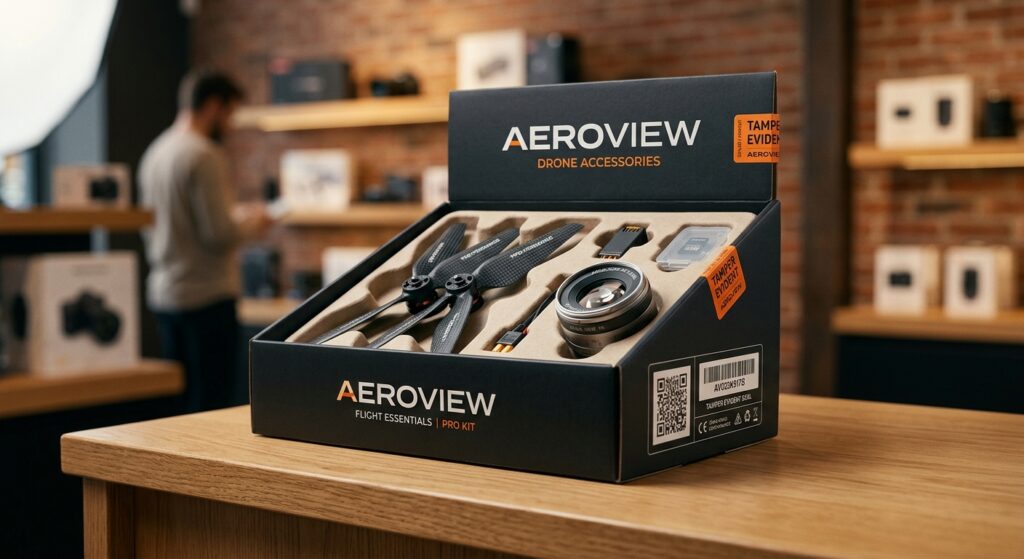
Retail packaging for drone products has a more demanding job than simply attracting attention on a store shelf. A package containing a battery, sensor, camera module, controller, propeller, or other drone component may need to protect sensitive equipment, communicate compatibility, support inventory management, and provide evidence of tampering—all while remaining practical for retail display.
This is where retail display box packaging becomes particularly relevant.
A well-designed display box can combine product protection, branding, retail presentation, traceability, and increasingly, digital identification. As drone technology expands across consumer, commercial, industrial, and security applications, packaging is becoming part of a broader product and supply-chain ecosystem.
Understanding how packaging design, automation, authentication, and security work together can help drone manufacturers, component suppliers, retailers, and packaging developers make better decisions.
What Is Retail Display Box Packaging?
A retail display box is a carton or container designed to hold products while also presenting them directly to shoppers.
Instead of unpacking and arranging every individual product, retail employees may be able to place an entire display unit on a shelf or counter after opening a cover, removing a perforated section, or converting the shipping carton into its display configuration.
Common formats include:
- Counter display boxes
- Shelf-ready packaging
- Dispenser-style cartons
- Floor displays
- Product trays
- Branded retail cartons
Corrugated fiberboard is often suitable for heavier merchandise or displays requiring additional structural strength. Paperboard may be appropriate for lightweight products and smaller accessories.
Retail display packaging can perform several functions simultaneously. It can protect merchandise during transportation, organize products at the point of sale, communicate brand and technical information, simplify shelf setup, and support inventory identification.
For drone-related products, however, packaging may have another important responsibility: helping protect and identify valuable or sensitive components.
Why Drone Products Have Different Packaging Requirements
The drone ecosystem extends far beyond the aircraft itself.
Products may include:
- Propellers
- Batteries
- Cameras
- Sensors
- Flight controllers
- Chargers
- Antennas
- Communication modules
- Payload systems
- Memory and storage products
- Replacement components
- Security accessories
Each product presents different packaging requirements.
A lightweight propeller set does not require the same structural protection as a camera module or battery. Likewise, a component intended for an industrial drone may require more technical identification and traceability than a low-cost consumer accessory.
For commercial and professional applications, buyers may need to identify model numbers, compatibility information, serial numbers, lot information, specifications, and other product details quickly.
Packaging therefore becomes part of product operations as well as retail presentation.
Choosing Materials for Retail Display Boxes
Material selection can affect protection, printing quality, shipping weight, cost, presentation, and environmental performance.
Corrugated Fiberboard
Corrugated materials can provide structural strength for larger displays or products requiring greater protection during distribution.
They may be particularly useful when multiple individual products are shipped and displayed within the same outer structure.
Paperboard
Paperboard is commonly used for smaller and lighter retail products. Its relatively smooth surface can also accommodate detailed printing, branding, instructions, and product photography.
Kraft and Fiber-Based Materials
Kraft and other fiber-based materials may appeal to brands looking for a more natural presentation or seeking to reduce unnecessary material complexity.
Protective Inserts
Internal protection can be equally important.
Depending on the product, inserts may be manufactured from paperboard, molded fiber, corrugated material, or other suitable protective materials.
The right material should ultimately be determined by the weight, fragility, value, shipping environment, and retail presentation requirements of the actual product, rather than appearance alone.
Printing and Product Communication
Retail display boxes also provide valuable space for product and brand communication.
Depending on the printing and manufacturing process, packaging may include:
- Brand logos
- Product photographs
- Model numbers
- Barcodes
- QR codes
- Serial information
- Compatibility details
- Setup instructions
- Safety information
- Required compliance markings
For drone accessories, compatibility information is particularly important.
A buyer may need to know whether a battery, camera, sensor, propeller, or controller works with a specific aircraft model or generation. Making this information immediately visible can reduce confusion and potentially decrease incorrect purchases or returns.
The challenge is balancing technical information with readability.
Too much information can overwhelm the package, while too little can leave customers uncertain about whether the product meets their requirements.
Retail Display Packaging and Inventory Automation
Modern packaging is increasingly expected to communicate with inventory systems as effectively as it communicates with shoppers.
Barcodes, QR codes, serial identifiers, and RFID systems can connect a physical product with digital information.
Depending on the system used, that information might support:
- Inventory records
- Warehouse locations
- Product registration
- Warranty information
- Manufacturing batches
- Service history
- Order fulfillment
- Product authentication
This becomes particularly interesting as warehouses adopt more automated inventory technologies.
How Drones Can Interact With Packaged Inventory
Drones themselves can play a role in warehouse and inventory operations.
Indoor drones equipped with cameras, scanners, or other sensors can potentially inspect storage locations and collect inventory information in suitable environments.
This creates an unusual relationship:
Drones can be products inside retail packaging while also being tools used to inspect packaged inventory.
Packaging designed for automated environments should therefore consider machine readability.
Large, clearly positioned barcodes or other machine-readable identifiers can make automated scanning more practical. RFID may provide another option in facilities equipped with compatible systems.
However, technology alone does not guarantee successful recognition. Warehouse layout, lighting, shelf positioning, label orientation, scanning hardware, software integration, and operational procedures can all affect performance.
Packaging should therefore be tested in the environment where automated identification will actually occur.
Computer Vision and Packaging Recognition
Computer vision introduces another connection between packaging and automated inventory management.
Camera-equipped systems may be able to recognize package shapes, logos, colors, printed identifiers, or machine-readable codes.
Potential applications include:
- Shelf auditing
- Inventory counts
- Product-location verification
- Misplaced-item detection
- Warehouse inspection
Consistency becomes important.
If identification marks move substantially between production runs, automated recognition may become more difficult. Establishing predictable areas for barcodes, QR codes, serial numbers, and other identifiers can improve machine visibility.
Environmental conditions also matter. Reflective surfaces, poor lighting, obstructed labels, damaged cartons, and tightly packed shelves can reduce recognition accuracy.
Packaging engineers should therefore test both human readability and machine readability rather than assuming one automatically guarantees the other.
Why Security Matters for Drone Component Packaging
Security becomes particularly important when packaging contains higher-value or operationally sensitive drone components.
A small retail carton could contain an expensive camera, navigation component, sensor, communication module, or flight controller.
Retail accessibility is useful for shoppers, but greater access can also create opportunities for theft, unauthorized opening, product substitution, or tampering.
Packaging cannot solve every security problem, but it can contribute to a broader protection strategy.
Tamper-Evident Features
Seals, tear indicators, security labels, and controlled-opening structures can help retailers or customers identify whether a package appears to have been opened.
The objective is not necessarily to make opening impossible. Instead, tamper-evident packaging can make unauthorized access more visible.
Serial Identification
Unique serial numbers can connect individual products to manufacturing, inventory, warranty, or registration systems.
For higher-value components, this creates a stronger link between the physical product and its digital record.
QR-Based Verification
QR codes can direct customers or retail employees to product-registration, compatibility, instructional, or authentication systems.
However, QR codes should be implemented carefully.
The destination should use a controlled and properly maintained domain, particularly when the code is intended for authentication. Organizations should avoid treating an ordinary printed QR code as a complete security mechanism because codes themselves can potentially be copied.
RFID
RFID can support inventory identification and tracking in environments equipped with the appropriate infrastructure.
Whether RFID makes financial sense depends on product value, operational requirements, inventory volume, and the level of traceability required.
Packaging as Part of Drone Supply-Chain Security
For professional drone systems, physical packaging can become one component of a broader supply-chain security strategy.
Useful controls may include:
- Unique product serial numbers
- Tamper-evident seals
- Lot and batch identification
- Controlled QR-based verification
- RFID where appropriate
- Product-registration records
- Packaging data connected with warehouse-management systems
The level of security should correspond with the risk and value of the product.
Adding sophisticated authentication technology to a low-cost accessory may not be economically justified. A high-value flight controller, specialized sensor, camera, or communications component may warrant stronger controls.
Most importantly, packaging security should be layered.
A printed graphic can potentially be copied. A QR code can be duplicated. A label can be removed. No single feature should therefore be expected to provide complete product authentication.
For higher-risk products, manufacturers may combine physical tamper evidence, unique identification, controlled digital verification, and inventory records.
Counterfeit Drone Parts and Product Authentication
Counterfeit or unauthorized replacement components can create financial and operational risks.
A battery, propeller, electronic module, or other component may visually resemble an authorized product while differing in manufacturing quality, specifications, or origin.
Packaging can help buyers evaluate authenticity by providing consistent manufacturer information, product identifiers, serial numbers, tamper evidence, and access to controlled verification systems.
For example, a manufacturer could combine:
- A unique serial number
- Tamper-evident packaging
- A secure online verification record
- Product registration
Retail staff could inspect the physical package while customers gain another method of verifying product information after purchase.
Packaging should nevertheless be viewed as one layer of authentication rather than a complete anti-counterfeit solution.
Special Considerations for Drone Batteries
Drone batteries require additional attention because lithium-ion and lithium-polymer batteries can be subject to specific transportation, packaging, labeling, and safety requirements depending on battery configuration, shipping method, destination, and applicable regulations.
Retail presentation should never override transportation or safety requirements.
Packaging teams working with drone batteries should therefore coordinate with logistics, safety, and compliance professionals before finalizing packaging specifications.
This is an area where authoritative regulatory guidance should take precedence over purely aesthetic packaging considerations.
Sustainability, Cost and Packaging Performance
Effective packaging needs to balance protection, material consumption, shipping efficiency, presentation, and cost.
Oversized packaging can increase:
- Material consumption
- Freight volume
- Storage requirements
- Transportation costs
- Waste
Right-sizing can reduce unnecessary material, but reducing material too aggressively can also compromise product protection.
Structural testing can help manufacturers determine whether a packaging design provides sufficient strength for the expected distribution environment.
Recyclability should also be considered.
Fiber-based structures can offer advantages in markets with established paper and cardboard recovery systems. However, coatings, adhesives, plastic windows, laminates, and mixed-material components can affect local recycling options.
The objective should therefore be appropriate material use rather than simply using the least material possible.
How to Design a Better Drone Retail Display Box
A good design process should begin with the product rather than the artwork.
Packaging developers should first understand:
- Product dimensions
- Weight
- Fragility
- Value
- Shipping method
- Retail environment
- Customer access requirements
- Theft or tampering risk
- Compatibility information
- Inventory-identification requirements
From there, several practical questions can guide the design:
- Will the display sit on a counter, shelf, or floor?
- How many products should each display contain?
- Can customers remove one unit without disturbing the others?
- Are product identifiers visible to store employees?
- Can automated inventory equipment read the relevant codes?
- Is compatibility information immediately understandable?
- Does the packaging reveal evidence of unauthorized opening?
- Is the structure strong enough for transportation and retail handling?
- Are sensitive components adequately protected?
- Can unnecessary packaging material be reduced without compromising performance?
Testing should extend beyond examining a prototype in an office.
Transportation vibration, stacking pressure, warehouse handling, retail setup, repeated product removal, and environmental conditions can expose weaknesses that are not obvious from visual inspection alone.
The Future of Retail Packaging for Drone Products
Retail packaging is increasingly becoming connected to digital product identity.
Serialized products, QR-based registration, RFID, automated inventory systems, and computer vision are creating stronger links between physical packaging and software.
For drone products, this evolution has particular relevance.
Packaging may need to:
- Protect sensitive hardware
- Communicate technical compatibility
- Support automated inventory
- Provide product identity
- Help reveal tampering
- Support traceability
- Connect customers with digital product information
- Assist authentication processes
At the same time, drones may increasingly participate in warehouse inspection and inventory operations, making machine-readable packaging more valuable.
Security considerations are also likely to remain important as commercial and professional drone users place greater emphasis on component origin, product authenticity, and supply-chain integrity.
The retail box still performs its most basic function—holding and protecting a product. But increasingly, that same box can also carry identity data, communicate compatibility, interact with inventory systems, support authentication, and connect the physical product to its digital record.
Frequently Asked Questions
What products are suitable for retail display box packaging?
Retail display packaging can work for electronics, cosmetics, food products, accessories, hardware, and numerous other consumer goods. Within the drone industry, smaller products such as propellers, connectors, camera accessories, controller components, sensors, and related accessories can be particularly suitable.
Can retail display packaging improve drone product security?
It can support security, but it should not be treated as a complete security system. Tamper-evident features, serial identification, controlled QR verification, and RFID can contribute to product traceability and authentication when combined with appropriate operational and digital controls.
Can drones scan retail display boxes?
Camera- or scanner-equipped drones can support inventory inspection in suitable warehouse environments. Successful scanning depends on factors including label visibility, lighting, positioning, hardware capabilities, and system integration.
What material is best for a retail display box?
There is no universally best material. Corrugated fiberboard can be useful for heavier displays, while paperboard may suit smaller and lighter products. Weight, fragility, printing requirements, distribution conditions, cost, and retail placement should determine the material.
Why are QR codes useful on drone packaging?
QR codes can connect customers or employees with product registration, instructions, compatibility information, warranty resources, or authentication records. When used for verification, the destination and associated digital system should be appropriately secured and maintained.
Does sustainable packaging matter for drone products?
Yes. Right-sized packaging and thoughtful material selection can reduce unnecessary material and transportation volume. Sustainability goals should still be balanced with the protection requirements of sensitive electronics and other drone components.
What makes a good drone accessory display box?
A strong display box combines clear product identification, compatibility information, appropriate physical protection, convenient retail access, and efficient presentation. For higher-value products, tamper evidence, serialization, and traceability features may provide additional value across the supply chain.










Leave a Reply