






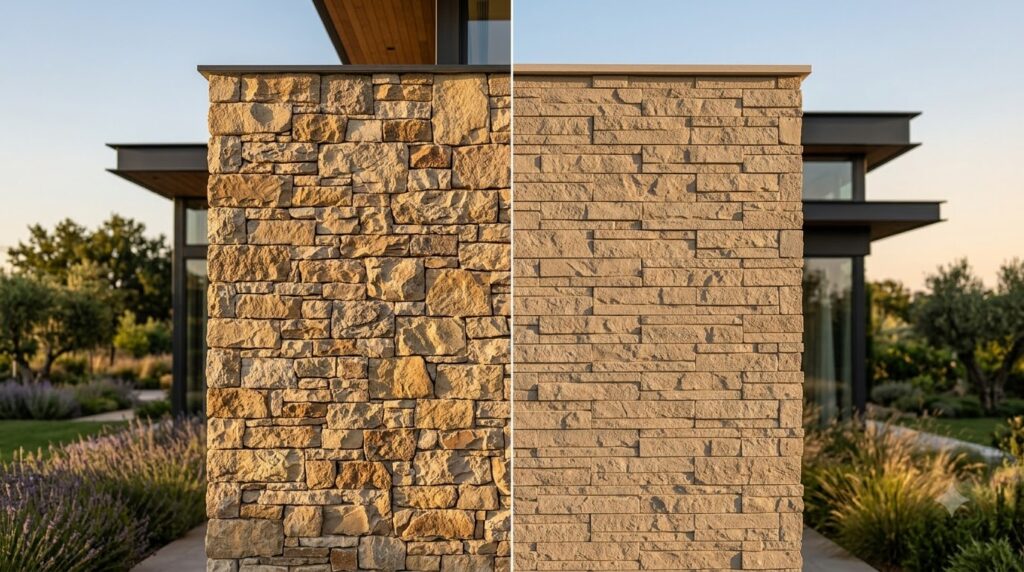
Natural stone cladding is the better choice for long-term, high-visibility walls, while artificial stone cladding suits projects with tight weight limits or a need for a uniform look. Both can work well on a property. The right one depends on where the wall sits, how long you plan to own the building and how much natural variation you want in the finish.
This guide compares the two side by side, so property owners, developers and buyers can decide with confidence.
Choose natural stone if you want authentic variation, long-term durability and a finish that ages well.
Choose artificial stone if structural weight limits, a uniform appearance or interior use come first.
Natural vs Artificial Stone Cladding at a Glance
What is natural stone cladding?
Natural stone cladding is a wall finish made from real stone that has been quarried, cut and finished into panels, strips or individual pieces. Each piece keeps the colour, grain and texture of the rock it came from, so no two walls look exactly alike. Common formats include ledgestone, stacked stone, castlestone and crazy stone, which differ in how the pieces are cut and laid.
What is artificial stone cladding?
Artificial stone cladding, also called manufactured stone veneer, is a moulded product designed to imitate the look of real stone. It is often made from cement-based or resin-based materials, cast in a mould and coloured. That makes each piece consistent and usually lighter than quarried stone. People choose it when they need a uniform appearance or when the wall structure limits how much weight it can carry.
| Factor | Natural stone | Artificial stone |
|---|---|---|
| Appearance | Real variation in colour, grain and texture | Consistent, repeatable pattern from a mould |
| Colour variation | Unique to each piece and batch | Controlled, and pieces can repeat |
| Durability | Long-lasting material that ages through gradual tonal change | Depends on the product and manufacturer |
| Maintenance | Periodic cleaning; some stones benefit from sealing | Periodic cleaning; follow the manufacturer’s guidance |
| Weight and installation | Heavier; needs suitable fixing and structural planning | Lighter; easier on walls with limited load capacity |
| Repairability | Individual pieces can be replaced; keep spare stock from the same batch | Depends on the product line staying available |
| Environmental footprint | Quarried and cut; long service life; transport distance matters | Manufactured; footprint depends on materials and process |
| Best suited to | Villa exteriors, entrances, feature walls | Weight-limited walls, interiors, uniform looks |
How They Compare, Factor by Factor
Appearance and authenticity
Natural stone offers depth and variation that a mould cannot fully reproduce. Light plays across the surface, and every piece carries its own tone. Artificial stone repeats a pattern, which can look tidy up close but more uniform across a large wall. Quality varies widely between artificial products, so always ask to see a physical sample.
Durability and weathering
Natural stone has long been used on building exteriors, and it ages through gradual change in tone. Performance still differs by stone type, because sandstone, limestone, marble and granite each react differently to weather. Match the stone to the exposure.
For artificial stone, performance depends on the product, so ask the manufacturer for weathering and UV resistance information.
Maintenance and long-term care
Both options need periodic cleaning to remove dust, algae or staining. Some natural stones, especially porous or light-coloured ones, benefit from sealing. Artificial stone care depends on the product, so follow the manufacturer’s guidance and ask your supplier what maintenance to expect over time.
Weight and installation
Natural stone is heavier, so the wall needs a suitable substrate, a fixing method chosen for the stone and climate, and an experienced installer. Artificial stone is lighter and easier to handle, which helps on walls with limited load capacity. Both still need correct detailing for drainage and waterproofing.
Upfront cost vs lifecycle cost
Artificial stone often has a lower purchase price, while natural stone is usually chosen for its longer service life. The fairer comparison covers the years you will own the wall: purchase, installation, maintenance and eventual replacement.
Ask suppliers for quotes that show all of these, not just the material price.
Which suits your climate?
- UAE and GCC: Strong sun, heat and blown sand put surface finish and colour stability to the test. Choose stone and finishes suited to sustained UV exposure, and view any sample outdoors.
- UK: Rain, damp and freeze-thaw cycles make water absorption and drainage detailing important. Ask how the stone performs in wet, cold conditions.
- India: Monsoon rain and humidity favour dense stone, good drainage and sound waterproofing behind the cladding. Confirm the finish suits the local exposure.
These are general guidelines. Confirm suitability for your specific stone and site with your supplier and installer.
Which One Should You Choose?
When artificial stone is the right choice
- The wall has a weight limit. Lighter cladding suits structures that cannot carry the load of quarried stone.
- You want a uniform look. A repeatable pattern works for spaces where consistency matters more than variation.
- The application is an interior accent. Indoor feature walls avoid the weather exposure that tests exterior products.
When natural stone is worth it
- The wall is highly visible. Villa exteriors, entrances and hospitality frontages benefit from the depth and character of real stone.
- You plan to hold the property long term. A material with a long service life suits owners who think in decades, not seasons.
- You want a one-of-a-kind finish. Natural variation means your wall will not be repeated elsewhere.
When exploring natural stone, compare different stone types, finishes and formats before making a decision. Request physical samples and view them in the actual environment where the cladding will be installed. This makes it easier to assess colour, texture and variation under natural light.
How to Buy With Confidence
How to tell them apart before you buy
- Turn the piece over. Natural stone shows cut or split faces, while moulded products often have a uniform, cast back.
- Look for repeating patterns. Moulded pieces can repeat the same texture across a wall.
- Check the edges. Natural edges vary from piece to piece, while moulded edges tend to be consistent.
- View a physical sample in daylight. Place it on site, next to your other finishes, at different times of day.
- Ask for documentation. Reputable suppliers can explain a stone’s type and origin, or a product’s composition.
5 questions to ask a stone supplier
- Which stone is this, and where does it come from?
- What finishes and colours are available, and can I see samples?
- What is the typical lead time, given as a range, and what can affect it?
- Do you offer installation support, or recommend installers?
- Can you show completed projects similar to mine?
Clear, specific answers to these questions are a good sign. Vague ones are worth pressing on before you commit.
Frequently Asked Questions
Is natural stone cladding better than artificial?
Natural stone is better for authenticity and long-term wear, while artificial stone is better where weight or uniformity matters. Neither is universally better. Choose natural stone for exterior and feature walls meant to last, and artificial stone for lighter structures and interior accents.
Does artificial stone cladding fade?
It can, depending on the product. Quality varies by manufacturer, and colour stability under strong sun differs between finishes. Ask for the manufacturer’s UV and weathering information, and view a sample outdoors before committing, especially in hot, sunny climates.
Can you tell natural from artificial stone once installed?
Often yes, up close. Natural stone shows irregular colour, grain and edges, while moulded stone can repeat textures across a wall. From a distance, a good manufactured product can be hard to distinguish, so check samples and paperwork before you buy.
Is natural stone cladding suitable for exterior walls?
Yes, when the right stone and fixing method are chosen for the climate. Natural stone has long been used on building exteriors. Match its density and finish to local weather, and use an installer experienced in exterior detailing such as drainage and waterproofing.
Which is easier to install?
Artificial stone is generally lighter and easier to handle, so it suits walls with limited load capacity. Natural stone is heavier and calls for careful planning of the substrate and fixing method. Both need skilled installation to perform well over time.
The Bottom Line
Choose natural stone cladding when authenticity, longevity and a finish that ages well matter most. Choose artificial stone when weight limits or a uniform look come first.
Either way, compare physical samples in daylight, put the right questions to your supplier and match the material to your climate. That way, the wall you choose stays a good fit for the property for years to come.









Leave a Reply