






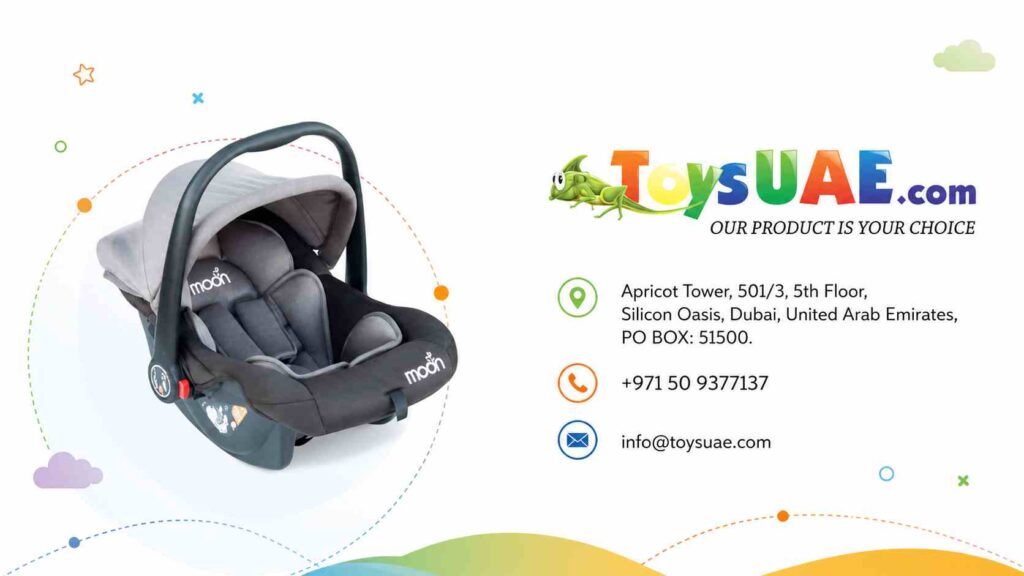
Choosing a child car seat can feel complicated. Parents need to consider safety standards, the child’s size, the vehicle, installation method, harness position and how long the restraint can be used before the child outgrows it.
There is no single car seat that is automatically the safest choice for every family.
A suitable child restraint is one that meets an applicable recognised safety standard, is appropriate for the child’s current size and developmental stage, fits the vehicle correctly and can be installed and used according to the manufacturer’s instructions.
For families in the UAE, climate, vehicle compatibility and local traffic requirements are additional considerations.
The most important principle is simple:
A premium car seat cannot provide its intended protection if it is unsuitable for the child, incompatible with the vehicle or installed incorrectly.
What Does “Adjustable” Mean in a Child Car Seat?
An adjustable car seat is designed so that certain components can be repositioned as a child grows.
Depending on the model, adjustable features may include:
- Headrest height
- Harness height
- Recline position
- Side-wing position
- Seat or base configuration
- Rear-facing and forward-facing modes
- Booster functionality on some multi-stage models
These features can make it easier to maintain an appropriate fit as the child grows, but adjustability does not automatically make a restraint safer.
The seat still needs to be used within the manufacturer’s specified height, weight and configuration limits.
Before changing any setting or moving a child into another mode, check the restraint’s instruction manual.
Start With the Safety Standard
Before comparing fabrics, colours or convenience features, check the restraint’s approval information and labelling.
Two standards parents may encounter are UN Regulation No. 44 (R44/04) and the newer UN Regulation No. 129 (R129).
R44/04 primarily classifies child restraints according to weight groups.
R129 is the newer regulatory framework and places greater emphasis on a child’s stature or height. It also introduced additional requirements, including side-impact testing and rear-facing travel to at least 15 months for applicable restraint categories.
The term i-Size is closely associated with R129, but the two terms should not always be treated as perfect synonyms. i-Size refers to particular categories and vehicle-compatibility provisions within the broader R129 framework.
For parents buying a new child restraint in 2026, R129 should generally be the primary standard to look for when comparing current products, while also confirming that the specific restraint is approved for use in the relevant market and compatible with the intended vehicle.
Always examine the actual approval label and manufacturer documentation rather than relying solely on retailer descriptions.
The Safest Seat Is the One That Fits the Child and Vehicle
Safety certification is only the beginning.
A child restraint also needs to fit:
- The child
- The vehicle
- The installation method
- The way the family will actually use it
Before buying, check the manufacturer’s minimum and maximum height and weight limits for every mode you expect to use.
Then check the vehicle manufacturer’s guidance on child-restraint installation, ISOFIX or lower-anchor positions, seat-belt routing and any relevant restrictions.
A seat that looks ideal online may not fit well in every vehicle.
This is particularly important with larger convertible or multi-stage restraints, which can occupy considerable front-to-back or side-to-side space.
Understand Rear-Facing and Forward-Facing Harness Position
Harness positioning changes according to the direction in which the child restraint is being used.
Rear-Facing
For rear-facing use, harness straps are generally positioned at or below the child’s shoulders, following the restraint manufacturer’s instructions.
Forward-Facing
For forward-facing use, harness straps are generally positioned at or above the child’s shoulders.
Harness straps should lie flat rather than twisted and should be adjusted snugly.
A useful snugness check is whether you can pinch excess harness webbing at the child’s shoulder. If significant webbing can be pinched, the harness may need further adjustment.
However, always follow the instructions supplied with the specific restraint because designs and adjustment systems differ.
Keep Children Rear-Facing as Long as the Seat Allows
Parents should not use age alone to decide when to turn a child forward-facing.
Rear-facing restraints help distribute crash forces across the child’s head, neck and back.
A child should generally remain rear-facing until reaching the maximum rear-facing height or weight permitted by the specific restraint manufacturer.
R129 also introduced a requirement for rear-facing travel to at least 15 months for applicable restraint systems.
The minimum requirement should not automatically be treated as the ideal point for turning the seat forward.
If the child still fits safely within the restraint’s rear-facing limits, continuing to use it rear-facing can provide additional protection.
ISOFIX or Seat-Belt Installation?
ISOFIX connects a compatible child restraint to designated anchor points in the vehicle.
Its main practical advantage is that it can make correct and repeatable installation easier by reducing some of the routing and tightening steps associated with seat-belt installation.
However, ISOFIX should not be interpreted as meaning that every ISOFIX restraint is inherently safer in every crash than every correctly installed belt-fitted restraint.
A properly approved seat installed correctly with the vehicle seat belt can also provide appropriate protection.
When Using ISOFIX
Check:
- Whether the vehicle has compatible ISOFIX positions
- Whether the child restraint is approved for the intended seating position
- Any applicable child-restraint or anchorage weight limits
- Whether a support leg or top tether is required
- Whether installation indicators show the correct connection
When Using a Vehicle Seat Belt
Follow both the car-seat manual and vehicle owner’s manual carefully.
Make sure:
- The belt follows the correct belt path
- The belt is not twisted
- The vehicle belt is locked where required
- The restraint is tightened according to the manufacturer’s instructions
When tested at the belt path, an installed car seat should generally not move more than about 2.5 cm (1 inch) side-to-side or front-to-back.
Do not judge installation tightness by pulling aggressively on parts of the seat away from the belt path.
Do Not Forget the Top Tether When Required
For a forward-facing restraint equipped with a top tether, the tether is an important part of the installation.
It connects the upper portion of the child restraint to the vehicle’s designated tether anchor and helps limit forward movement during a crash.
Parents should locate the correct tether anchor using the vehicle owner’s manual rather than attaching the tether to an arbitrary cargo hook or other fitting.
Follow the restraint and vehicle instructions for the specific installation.
Convertible and Multi-Stage Car Seats
A convertible restraint can typically be used rear-facing and later forward-facing within the manufacturer’s specified limits.
Some multi-stage or all-in-one products can eventually be configured as booster seats as well.
The advantage is that one restraint may accommodate several stages of a child’s growth.
Potential benefits include:
- Fewer seat purchases
- Adjustable headrest and harness positions
- Extended rear-facing capability on some models
- Familiarity with one restraint system
There are also trade-offs.
Convertible and multi-stage seats can be larger and heavier than infant carriers. They may be inconvenient for families that frequently move the restraint between vehicles.
Before buying one, check the actual dimensions rather than assuming that a product described as “convertible” will fit comfortably in every car.
Get the Recline Angle Right
Correct recline is particularly important for babies travelling rear-facing.
A seat that is too upright for a young infant may affect head and airway positioning.
Many rear-facing restraints include built-in angle indicators or adjustment mechanisms to help achieve the manufacturer’s recommended recline.
As the child grows, the permitted recline position may change.
Always follow the specific product instructions rather than using a universal angle taken from another car seat.
If a baby’s head position appears concerning, first check whether the restraint is installed at the correct manufacturer-approved recline.
Do not add unapproved pillows, head supports or thick padding behind or underneath the child.
Only use inserts or accessories that the restraint manufacturer approves for that specific model and configuration.
Choose Headrest and Side Support Carefully
An adjustable headrest can help maintain an appropriate fit as a child grows.
When evaluating a restraint, consider:
- How easily the headrest adjusts
- Whether harness height changes with the headrest
- Whether the adjustment can be made accurately
- Whether the side structure accommodates the child comfortably
- Whether any infant insert is approved for that specific seat
Side-impact protection should be evaluated as part of the restraint’s overall approved design rather than by assuming that a large head cushion alone makes a seat safer.
The restraint manufacturer’s instructions should determine when inserts or padding are added, adjusted or removed.
Consider UAE Conditions
Families in the UAE face practical conditions that can influence everyday car-seat use.
Heat
Vehicle interiors and restraint components can become extremely hot when a car is parked in direct sunlight.
Before placing a child in the seat:
- Check buckles and other exposed components for excessive heat
- Check the seating surface
- Allow the vehicle interior to cool where necessary
- Consider breathable, manufacturer-approved seat materials
Do not place unapproved covers, padding or accessories between the child and the restraint simply to address heat.
Vehicle Changes
Families who regularly use more than one car should check compatibility in each vehicle.
A restraint that installs easily in a family SUV may fit differently in a smaller car.
Parents who frequently use taxis, rental vehicles or other transport should also consider how practical the restraint is to move and correctly reinstall.
UAE Child-Restraint Rules Parents Should Know
Parents should understand both best-practice safety guidance and applicable UAE traffic requirements.
Official UAE traffic information identifies failure to provide a child seat for a child under four years old as an offence.
It also identifies allowing a child under 10 years old or shorter than 145 cm to sit in the front seat as an offence.
Traffic rules can change, so parents should verify the latest requirements through official UAE or relevant emirate traffic authorities.
Legal compliance should also be viewed as the minimum requirement rather than the only factor determining safe restraint use.
A child’s restraint should continue to be selected according to the child’s size, the restraint manufacturer’s limits and correct installation requirements.
Consider Everyday Practicality Before Buying
A child restraint needs to work safely every day, not just perform well on a product-comparison page.
Before choosing one, consider:
Child Fit
Check the child’s current height and weight against the manufacturer’s approved limits.
Vehicle Fit
Check rear-seat space, ISOFIX or anchorage availability and the manufacturer’s compatibility information.
Installation
Consider whether you can confidently reproduce the correct installation.
Adjustability
Check whether headrest, harness and recline settings can be changed without introducing fitting errors.
Cleaning
Removable and washable covers can be useful, but follow the manufacturer’s cleaning instructions. Harness webbing and other safety components may have specific cleaning restrictions.
Moving Between Cars
If the restraint will frequently be moved, consider its weight and the complexity of reinstalling it correctly.
Long-Term Use
Consider how long the child is likely to remain within the approved limits of each configuration rather than relying only on broad age ranges used in advertising.
Families comparing child car seats from retailers can use these criteria to compare restraint types, while checking the individual product’s approval standard, child-size range, installation requirements and vehicle compatibility before purchasing.
Do Not Assume a Used Car Seat Is Safe
A second-hand restraint requires additional caution because its history may be difficult to verify.
Before using one, confirm:
- The model and manufacture information are still readable
- The seat has not exceeded the manufacturer’s usable-life or expiration guidance
- There are no unresolved safety recalls
- All required components and instructions are present
- The restraint has not been involved in a crash requiring replacement
- The structure and harness have not been modified or damaged
If the history cannot be established, choosing another restraint may be the safer option.
Check the Manufacturer’s Service-Life Guidance
There is no single universal expiration period that applies to every child restraint.
Manufacturers specify the usable life or expiration guidance for individual products.
Check the label, instruction manual or manufacturer information for the specific model rather than assuming that every seat should be replaced after the same number of years.
Age is also not the only reason a restraint may need replacement. Damage, missing components, recalls or crash involvement can affect whether continued use is appropriate.
What Should You Do With a Car Seat After a Crash?
Do not assume that every minor incident automatically requires replacement, but do not continue using a crash-involved restraint without checking the appropriate guidance.
Replacement requirements can depend on:
- The severity of the crash
- Visible damage
- Manufacturer instructions
- Applicable safety guidance
The U.S. National Highway Traffic Safety Administration, for example, recommends replacing child restraints following moderate or severe crashes but states that automatic replacement may not be necessary following a minor crash that meets all of its specified criteria.
Manufacturer instructions remain important because individual manufacturers may set their own replacement requirements.
If there is uncertainty, contact the restraint manufacturer before continuing to use the seat.
Common Car-Seat Mistakes to Avoid
Even an approved child restraint can be used incorrectly.
Common problems include:
Loose Installation
Check movement at the belt path. The restraint should generally not move more than about 2.5 cm (1 inch) side-to-side or front-to-back.
Incorrect Harness Height
Remember the general distinction:
Rear-facing: at or below the shoulders.
Forward-facing: at or above the shoulders.
Then confirm the specific manufacturer’s instructions.
Loose Harness Straps
Harness straps should lie flat and snug against the child without unnecessary slack.
Bulky Clothing Under the Harness
Bulky coats or thick clothing can prevent the harness from fitting closely to the child’s body.
Turning Forward-Facing Too Early
Keep the child rear-facing until the maximum rear-facing height or weight limit of the restraint is reached.
Adding Unapproved Accessories
Aftermarket cushions, padding, strap covers and other products can change how the restraint fits or performs.
Use only accessories approved by the restraint manufacturer for the specific model and configuration.
Using the Wrong Belt Path
Convertible seats may have different belt paths for rear-facing and forward-facing installation.
Always verify the correct route in the manual.
Ignoring the Top Tether
When a forward-facing installation requires a tether, use the designated vehicle tether anchor as instructed.
Child Car Seat Safety Checklist
Before every major change in configuration—and periodically during normal use—check the following:
- ☐ The restraint is approved for the intended use
- ☐ The child remains within the permitted height and weight limits
- ☐ Rear-facing or forward-facing mode is appropriate
- ☐ Harness height is correct for the direction of travel
- ☐ Harness straps lie flat and are snug
- ☐ The restraint uses the correct belt path or ISOFIX installation
- ☐ The installation moves no more than about 2.5 cm at the belt path
- ☐ Rear-facing recline is within the manufacturer’s permitted range
- ☐ The top tether is correctly attached where required
- ☐ Only manufacturer-approved inserts and accessories are being used
- ☐ The restraint has no unresolved recall affecting safe use
- ☐ Its crash history is known
- ☐ It remains within the manufacturer’s stated usable life
- ☐ The vehicle owner’s manual and car-seat instructions have both been followed
If any of these points is uncertain, check the manufacturer’s documentation before travelling.
Final Thoughts
There is no single adjustable car seat that can be labelled the safest choice for every child and every vehicle.
A better approach is to evaluate the complete safety system.
Start with an appropriate approved restraint. Make sure it fits the child’s current size and stage, confirm that it is compatible with the vehicle and install it exactly as instructed.
Keep children rear-facing within the restraint’s permitted limits, position the harness correctly for the direction of travel and pay attention to recline, anchoring and tether requirements.
As children grow, reassess the fit rather than changing configurations simply because they have reached a particular birthday.
Parents should also check the restraint after vehicle changes, significant growth, crashes or any situation that could affect installation or safe use.
The best child restraint is not necessarily the most expensive or the one with the longest feature list.
It is one that meets the appropriate safety requirements, fits the child, fits the vehicle and is used correctly on every journey.









Leave a Reply