






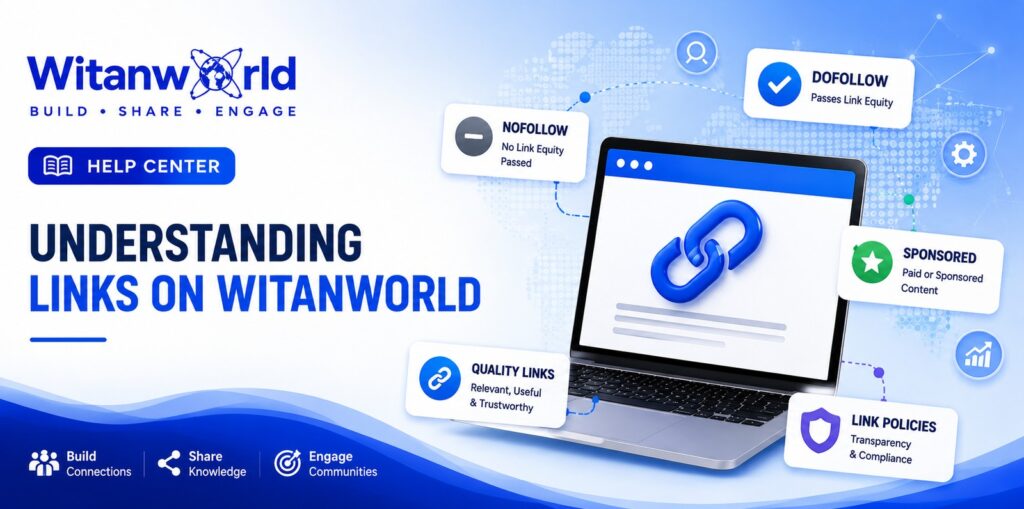
Witanworld Help Center Guide
Estimated Reading Time: 12–15 Minutes
INTRODUCTION
Links are an important part of digital publishing. They allow authors to reference supporting information, acknowledge sources, direct readers to useful resources, connect related knowledge, and—where permitted—reference businesses, products, organizations, or services.
However, not every link serves the same purpose.
A link may be editorial, informational, commercial, promotional, sponsored, or user-generated. Search engines can also interpret links differently depending on how they are technically classified.
For Witanworld authors, contributors, businesses, SEO partners, and agencies, understanding these differences is important for maintaining content quality, transparency, reader trust, and responsible publishing practices.
This guide explains:
Dofollow Links → Nofollow Links → Sponsored Links → Anchor Text → Link Insertion → Editorial Links → Link Quality → Witanworld Link Policies
Witanworld’s Terms require users not to share content that violates applicable policies, is unlawful, misleading, fraudulent, or infringes the rights of others. They also recognize sponsored and commercial content as distinct forms of activity on the platform.
1. What Is a Link?
A hyperlink—or simply a link—connects one webpage or online resource to another.
For example, an article about artificial intelligence might link to:
- A research paper
- A university study
- An official government report
- A company website
- A supporting Witanworld article
- A product or service referenced in the discussion
Readers can follow the link to obtain additional information.
At its best, linking creates a knowledge journey:
Article → Supporting Source → Related Knowledge → Deeper Understanding
Links should therefore primarily serve the reader and the content.
2. Why Links Matter on Witanworld
Witanworld is designed around knowledge exchange and discovery. Its Terms describe the platform’s mission as enabling individuals to exchange knowledge and build community.
Useful links can strengthen that objective.
A well-placed link may:
- Support a statement or argument
- Direct readers to primary sources
- Provide additional context
- Credit research or information
- Connect related Witanworld content
- Help readers explore a topic
- Identify an organization or resource
- Provide a relevant commercial destination when appropriately permitted
But links can also reduce article quality when they are irrelevant, misleading, excessive, manipulative, or inserted primarily to influence search rankings.
The key principle is:
Every link should have a legitimate reason to exist.
3. Internal Links vs. External Links
Before discussing dofollow and nofollow links, it is helpful to understand the two basic link destinations.
Internal Links
An internal link points to another page on Witanworld.
For example:
Article A on Witanworld → Article B on Witanworld
Internal links can help readers discover:
- Related articles
- Help Center guides
- Relevant topics
- Witanworld resources
- Supporting knowledge
External Links
An external link directs readers from Witanworld to another website.
For example:
Witanworld Article → University Research Paper
or:
Witanworld Article → Company Website
External links can be valuable when they provide additional evidence, context, resources, or appropriately disclosed commercial information.
4. What Is a Dofollow Link?
“Dofollow” is the common SEO term used to describe a normal hyperlink that does not carry a link relationship attribute instructing search engines to treat it as nofollow, sponsored, or similar.
In simplified terms, a standard link may allow search engines to consider the relationship between the linking page and the destination page.
This is one reason dofollow links are often sought by:
- Businesses
- Website owners
- SEO professionals
- Digital marketing agencies
- Publishers
However:
A dofollow link should never be interpreted as a guaranteed ranking benefit.
Search engines independently determine how links are evaluated.
Witanworld cannot guarantee:
- Search rankings
- Domain authority improvements
- Traffic increases
- Indexing
- Search-engine treatment
- SEO outcomes
Any SEO benefit should be considered a potential outcome rather than a guarantee.
5. What Is a Nofollow Link?
A nofollow link contains a technical relationship attribute commonly expressed as:
rel="nofollow"
This tells search engines that the publisher does not want the link treated in the same way as a standard editorial link for ranking purposes.
A nofollow link can still be valuable to readers.
People can still:
- Click it
- Visit the destination
- Discover the referenced organization
- Learn more
- Generate referral traffic
Therefore:
Nofollow does not mean “useless.”
It simply describes how the link is technically qualified.
6. What Is a Sponsored Link?
A sponsored link is associated with advertising, sponsorship, paid placement, or another commercial arrangement.
The commonly recognized relationship attribute is:
rel="sponsored"
Sponsored-link treatment helps distinguish:
Independent Editorial Reference
from
Commercial Relationship
This distinction is important for transparency.
Witanworld’s Terms explicitly recognize ads, offers, and other sponsored content, and Witanworld also offers sponsored-content advertising formats.
Where a link forms part of paid or sponsored content, Witanworld may classify or treat it according to the applicable commercial, editorial, technical, or search-engine requirements.
7. Dofollow vs. Nofollow vs. Sponsored
| Link Type | General Purpose | Can Readers Click It? | Typical Context |
|---|---|---|---|
| Standard / Dofollow | Normal editorial hyperlink | Yes | Relevant editorial references |
| Nofollow | Qualified hyperlink | Yes | Links where normal endorsement/ranking treatment isn’t appropriate |
| Sponsored | Identifies commercial relationship | Yes | Advertising, sponsorship or paid placement |
| Internal | Connects Witanworld content | Yes | Related articles and resources |
The most important point is that these classifications primarily describe link relationships.
They do not determine whether the destination is useful to a reader.
8. What Is an Editorial Link?
An editorial link is included because it genuinely improves the article.
For example:
A climate-change article links to the underlying scientific report supporting a statistic.
The author is not adding the link merely because someone requested a backlink.
The source is linked because it is useful to the reader.
Strong editorial links commonly point to:
- Research
- Official reports
- Source data
- Relevant organizations
- Supporting documentation
- Further reading
- Related Witanworld articles
The Editorial Test
Ask:
Would this link still belong in the article if SEO did not exist?
If the answer is yes, it is likely serving a genuine editorial purpose.
9. What Is a Commercial Link?
A commercial link directs readers toward a business-related destination and may be connected with:
- Promotion
- Advertising
- Sponsorship
- Lead generation
- Product/service exposure
- Guest-post arrangements
- Paid content
- Link-insertion arrangements
Commercial links are not automatically inappropriate.
What matters is that they are:
Relevant + Transparent + Permitted + Appropriate
Witanworld’s Terms state that supplemental commercial and advertising terms may apply when users access the platform for business purposes, advertising, selling products, or other commercial activity.
10. What Is Link Insertion?
Link Insertion generally refers to adding a link to content that already exists.
For example:
An existing article discusses cybersecurity software.
A relevant cybersecurity provider asks whether an appropriate reference to one of its resources can be added to an existing passage.
If approved, the link can be incorporated into the article without publishing an entirely new article.
However, link insertion should never simply mean:
Pay to put any URL into any article.
The requested destination should be relevant to the existing content and comply with applicable Witanworld editorial and commercial requirements.
11. Link Insertion vs. Guest Post
These are different publishing arrangements.
Guest Post
A new article is submitted for publication and may contain approved links within the content.
Link Insertion
A link is requested for inclusion within an existing article.
In both cases, editorial relevance remains important.
A link should make contextual sense to the reader.
12. Anchor Text
Anchor text is the clickable text associated with a hyperlink.
For example:
Learn more about digital transformation strategies.
If the words digital transformation strategies are clickable, they are the anchor text.
Anchor text should clearly communicate what the reader can expect after clicking.
13. Good Anchor Text
Good anchor text is:
- Natural
- Relevant
- Descriptive
- Contextual
- Useful to readers
Example
Better:
Read the organization’s 2026 cybersecurity research report.
Less Useful:
Click here
The descriptive version gives readers meaningful information before they follow the link.
14. Avoid Manipulative Anchor Text
Authors and commercial partners should avoid unnatural repetition designed primarily to manipulate search rankings.
For example, repeatedly inserting:
best cheap digital marketing company
into unrelated sentences can damage readability and editorial quality.
Anchor text should fit naturally into the article.
Witanworld Principle
Write for the reader first. Optimize second.
15. Relevance Is the Most Important Link Rule
A link should be contextually relevant to the surrounding content.
Consider an article about:
Artificial Intelligence in Healthcare
A link to:
medical AI research
may be highly relevant.
A link to:
unrelated vacation packages
would generally have no legitimate editorial relationship.
Adding unrelated links simply for backlink value reduces content quality.
16. Link Destination Quality Matters
Authors should consider not only the words surrounding the link but also where the link leads.
Before adding an external link, consider:
- Is the destination relevant?
- Is the website legitimate?
- Does it provide useful information?
- Is the page functional?
- Is the destination misleading?
- Does it create an obvious security concern?
- Does it violate applicable Witanworld policies?
- Is it appropriate for Witanworld’s audience?
A well-written article can lose credibility when it directs readers to poor-quality destinations.
17. Avoid Misleading Links
The anchor text should reasonably correspond to the destination.
For example:
Misleading
Download the Official Research Report
→ links to an unrelated sales page.
Better
Explore ABC Company’s Analytics Platform
→ links to ABC Company’s relevant product page.
Readers should have a reasonable idea of what they are clicking.
Witanworld’s Terms prohibit misleading and fraudulent activity on its products.
18. Links to Sources & References
Links are particularly valuable when supporting:
- Statistics
- Research findings
- Laws and regulations
- Government information
- Scientific claims
- Industry reports
- Technical documentation
Whenever practical, prioritize the original or authoritative source.
For example:
Original Research Institution
is generally preferable to:
Website summarizing another website that summarized the research.
This helps readers verify information themselves.
19. Don’t Overload Articles With Links
More links do not automatically make an article more authoritative.
Too many links can:
- Distract readers
- Make content look promotional
- Reduce readability
- Create unnecessary exit points
- Weaken editorial focus
- Make the article appear designed primarily for SEO
There is no universal number that is correct for every article.
Use the number of links genuinely required to support the content.
20. Avoid Repetitive Links
If the same destination has already been clearly linked, there is usually no need to link it repeatedly throughout every paragraph.
For example, linking the same company homepage 15 times in a 1,500-word article generally adds little reader value.
Use links purposefully.
21. Links Should Not Replace Good Content
An article should provide meaningful knowledge on Witanworld itself.
Avoid creating content that essentially says:
For everything you need to know, visit our website.
followed by a link.
Readers should receive substantial value from the Witanworld article.
Links should extend the knowledge, not substitute for it.
22. Paid Links & Editorial Independence
Payment for a publishing service does not mean that every requested link, URL, claim, or anchor text must automatically be accepted.
Commercial arrangements and editorial approval are separate considerations.
Witanworld reserves rights under its Terms to remove content that violates applicable terms and policies and may take action against accounts for violations.
Accordingly, Witanworld may review:
- Destination URL
- Anchor text
- Article context
- Content quality
- Relevance
- Commercial nature
- Applicable policies
before approving a requested link.
23. Sponsored Content Should Be Transparent
Readers should be able to distinguish genuine knowledge-sharing from commercial promotion where disclosure is required.
Witanworld currently identifies Sponsored Content as one of its advertising formats.
Sponsored or commercially arranged content may therefore be subject to additional:
- Disclosure
- Editorial
- Advertising
- Link
- Technical
- Commercial
requirements.
Transparency protects both readers and publishers.
24. Restricted or Inappropriate Links
Witanworld may reject or remove links associated with content or destinations that violate its Terms, Community Standards, commercial requirements, or other applicable policies.
Witanworld’s Terms prohibit, among other things, content or activity that is unlawful, misleading, discriminatory, fraudulent, infringes others’ rights, or violates applicable Witanworld policies.
Authors should therefore avoid assuming that publication of an article automatically guarantees approval of every included external link.
25. Links Can Be Reviewed After Publication
Link compliance does not necessarily end when an article is published.
External websites change.
A destination that was appropriate when published could later:
- Become unavailable
- Redirect somewhere else
- Change ownership
- Become irrelevant
- Contain substantially different content
- Become unsafe
- Violate Witanworld policies
Witanworld may therefore review links when necessary to protect content quality and the community.
26. Broken Links
A broken link points to a page that no longer works or cannot be found.
Common examples include:
- Deleted pages
- Changed URLs
- Expired resources
- Incorrect URLs
- Website migrations
Broken links create a poor reader experience.
Authors should periodically review important links in evergreen content where practical.
If a source disappears:
Replace it → Update it → or Remove the Link
27. Redirected Links
Be careful with links that redirect users through multiple websites before reaching the final destination.
Redirects may be legitimate, but excessive or unexpected redirects can make it harder to understand where readers are being sent.
Whenever possible, link directly to the intended authoritative destination.
28. Shortened URLs
URL-shortening services can make destinations less transparent.
Where practical, prefer a direct destination rather than an unnecessarily shortened or obscured URL.
Readers should be able to trust where Witanworld content is sending them.
29. Affiliate Links
Affiliate links create a commercial relationship because the referring party may receive compensation or another benefit when readers take an action.
They should therefore not be treated automatically as ordinary independent editorial citations.
Where affiliate arrangements are permitted, appropriate disclosure and commercial-link treatment may be required.
Do not assume that affiliate links are automatically permitted simply because ordinary external links are allowed.
When uncertain, obtain approval before publication.
30. Links in Comments, Groups & Forums
Links can also appear in community interactions rather than formal articles.
The same fundamental principle should apply:
Share a link because it helps the conversation—not simply because you want a backlink.
Witanworld’s community guidance encourages meaningful contributions rather than generic engagement.
Avoid:
- Repetitive promotional links
- Irrelevant self-promotion
- Mass link posting
- Deceptive destinations
- Links unrelated to the discussion
Community participation should create knowledge value.
31. Internal Linking on Witanworld
Internal links deserve particular attention because they can create a stronger knowledge ecosystem.
For example, this article can link readers to:
- Witanworld SEO Guide
- Publishing Guidelines
- Copyright Guidelines
- Editorial Review Guide
- Categories & Tags Guide
- Billing & Payments Guide
This creates:
Article → Related Article → Related Topic → Deeper Knowledge
Internal linking should therefore be part of article optimization whenever genuinely useful.
32. Link Policies & Search Engines
Search-engine guidelines evolve over time.
Witanworld may therefore modify how links are technically treated to comply with:
- Search-engine requirements
- Advertising requirements
- Platform policies
- Editorial standards
- Legal requirements
- Security considerations
A link being published today does not create a permanent guarantee that its technical attributes can never change.
33. No SEO Guarantee
This point is particularly important for SEO partners and commercial customers.
Publication of a link on Witanworld does not guarantee:
- Google rankings
- Search visibility
- Domain Authority
- Domain Rating
- Page Authority
- Indexing
- Referral traffic
- Leads
- Sales
- Link-equity transfer
- Any specific search-engine outcome
Search engines independently control their algorithms, indexing, ranking, and treatment of links.
Witanworld provides publishing and placement services—not guaranteed search-engine rankings.
34. Recommended Link Workflow
Before adding any external link to a Witanworld article:
Step 1 — Identify the Purpose
Why does the reader need this link?
Step 2 — Check Relevance
Does the destination directly relate to the surrounding content?
Step 3 — Check the Destination
Is the website legitimate, functional, and appropriate?
Step 4 — Choose Natural Anchor Text
Describe the destination accurately.
Step 5 — Determine the Relationship
Is it:
Editorial? Commercial? Sponsored? Paid? Affiliate?
Step 6 — Apply Appropriate Treatment
Follow applicable Witanworld editorial and commercial requirements.
Step 7 — Preview
Make sure the link works correctly.
Step 8 — Publish
Complete publication only after the content and links meet applicable standards.
35. Link Quality Checklist
Before submitting or requesting a link, ask:
Is the link relevant to the article?
Does it provide reader value?
Is the destination legitimate?
Does the anchor text describe the destination naturally?
Is the link placed in appropriate context?
Have I avoided keyword stuffing?
Have I avoided unnecessary repetition?
Is any commercial relationship appropriately handled?
Does the destination comply with Witanworld policies?
Does the link work?
Is the link genuinely necessary?
Would the article still provide substantial value without the external link?
Have I avoided making unsupported SEO guarantees?
If the answer to these questions is yes, the link is more likely to contribute positively to the article.
36. Quick Reference Guide
| Link | Meaning | Primary Consideration |
|---|---|---|
| Internal Link | Points within Witanworld | Knowledge discovery |
| External Link | Points to another website | Relevance & destination quality |
| Dofollow / Standard Link | Normal hyperlink without restrictive relationship attribute | Editorial context |
| Nofollow Link | Qualified with nofollow |
Link relationship |
| Sponsored Link | Associated with commercial/sponsored relationship | Transparency |
| Editorial Link | Independently included for reader value | Relevance & credibility |
| Link Insertion | Link added to existing content | Context & approval |
| Affiliate Link | May generate compensation/benefit | Disclosure & commercial treatment |
| Anchor Text | Clickable words of a link | Natural relevance |
37. Frequently Asked Questions
What is a dofollow link?
“Dofollow” commonly refers to a standard hyperlink without a nofollow or similar qualifying relationship attribute.
What is a nofollow link?
A nofollow link contains a relationship attribute indicating that search engines should treat the link differently from an ordinary editorial link.
Can people still click nofollow links?
Yes. Nofollow relates to technical search-engine treatment, not whether readers can follow the link.
What is a sponsored link?
A sponsored link identifies a commercial relationship such as advertising, sponsorship, or paid placement.
Does Witanworld accept external links?
External links can form part of Witanworld content, subject to applicable editorial, commercial, community, and platform requirements. Witanworld’s Terms recognize both content sharing and commercial/sponsored activity while requiring compliance with its policies.
Can I request link insertion into an existing article?
Where Witanworld offers such a commercial service, requests remain subject to relevance, editorial review, destination quality, and applicable terms.
Does a paid link guarantee SEO improvement?
No. Witanworld cannot guarantee how Google or another search engine will evaluate a link or whether it will improve rankings.
Can I choose any anchor text?
Requested anchor text should be relevant, natural, accurate, and editorially appropriate. Witanworld may require changes where necessary.
Can a published link be changed or removed later?
Yes, links may require updating or removal when they become broken, misleading, inappropriate, non-compliant, or otherwise unsuitable.
Can I put many links in my article?
Use only links that genuinely support the content. Excessive links can reduce readability and make an article appear overly promotional.
38. The Witanworld Link Principle
The simplest way to understand responsible linking on Witanworld is:
Relevant. Useful. Transparent. Natural. Trustworthy.
Every link should pass five questions:
Is it relevant?
↓
Does it help the reader?
↓
Is the destination trustworthy?
↓
Is the relationship transparent?
↓
Does it meet Witanworld’s applicable policies?
If the answer is yes, the link is serving its intended purpose.
Conclusion
Links are valuable because they connect knowledge.
They allow Witanworld authors to support ideas, acknowledge sources, connect related articles, direct readers toward deeper resources, and—where appropriate—connect audiences with organizations, products, services, or sponsored resources.
But the value of a link comes from context and relevance, not merely from its SEO classification.
Remember:
- Dofollow does not mean guaranteed rankings.
- Nofollow does not mean no value.
- Sponsored does not mean inappropriate.
- Paid does not mean automatically approved.
- More links do not necessarily mean better SEO.
The strongest Witanworld articles use links naturally, selectively, transparently, and in ways that strengthen the knowledge being shared.
Build Knowledge. Link Responsibly. Protect Trust.
Related Articles
- Witanworld SEO Guide: How to Optimize Your Articles for Maximum Visibility
- How to Publish Your First Article on Witanworld
- Understanding Categories & Tags on Witanworld
- Copyright, Plagiarism & Content Ownership on Witanworld
- Why Was My Article Rejected? Understanding Editorial Review
- Witanworld Billing, Payments, Renewals & Invoices.









Leave a Reply