






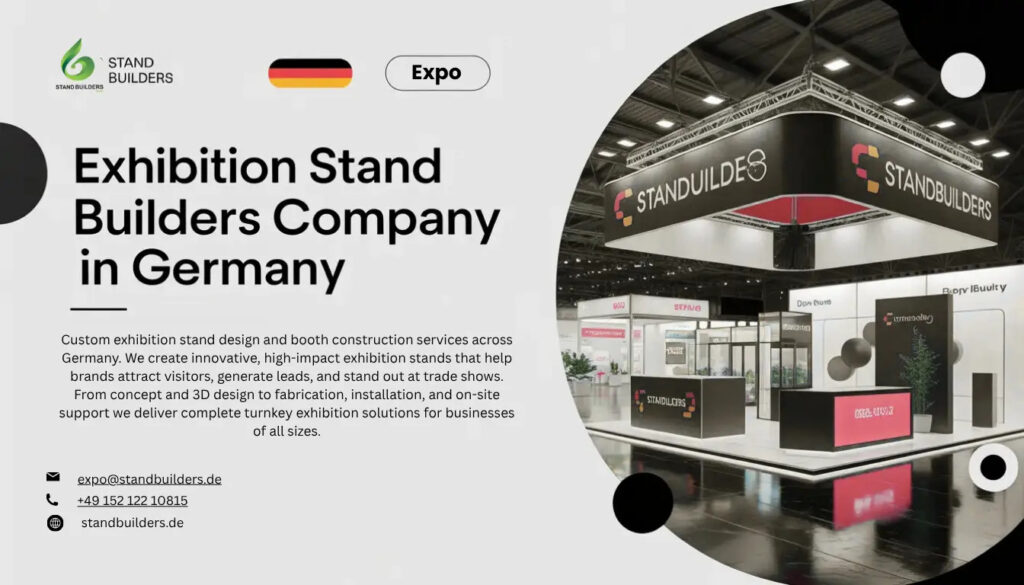
Germany is one of Europe’s most important exhibition markets, hosting trade fairs across manufacturing, automotive technology, healthcare, electronics, retail, energy, engineering and many other industries.
For an exhibitor, however, securing floor space and creating an attractive stand are only part of the challenge. A visually impressive booth can still underperform if visitors do not understand the company’s proposition, the layout creates congestion, staff are poorly prepared, technical requirements have been overlooked or leads disappear after the event.
Effective exhibition planning therefore requires several disciplines to work together:
Objective → Audience → Space → Experience → Operations → Measurement
This guide explains how businesses can use that framework when preparing for exhibitions in Germany—from selecting a stand format and planning visitor movement to budgeting, sustainability, venue coordination, supplier selection and measuring results.
1. Why Exhibition Planning Matters in Germany
German trade fairs can attract professional audiences from domestic and international markets. At major events, visitors may encounter hundreds or even thousands of exhibitors competing for their limited time and attention.
That creates an immediate communication challenge.
A visitor walking through an exhibition hall should be able to understand, within a relatively short time:
- Who the exhibitor is
- What the company offers
- Who the solution is intended for
- Why the offering may be relevant
- What the visitor should do next
This means exhibition planning should begin well before discussions about colours, furniture or architectural features.
Germany also contains several major exhibition destinations—including Frankfurt, Munich, Düsseldorf, Cologne, Hannover and Berlin. Each venue and event can have different audiences, hall configurations, technical procedures and exhibitor requirements.
The stand should therefore be designed for the specific event and venue, rather than treating every exhibition as interchangeable.
2. Start With the Objective, Not the Stand
One of the easiest mistakes to make is to begin with:
What should our exhibition stand look like?
A better first question is:
What should this exhibition accomplish?
Different commercial objectives require different spaces.
A manufacturer launching machinery may need room for demonstrations and technical conversations.
A company seeking distributors may prioritize meeting areas and qualification spaces.
A software provider might require interactive demonstrations and consultation stations.
A company attending primarily to meet existing customers may require more hospitality and private discussion space.
Potential objectives include:
- Generating qualified leads
- Meeting distributors
- Finding channel partners
- Launching a product
- Demonstrating technology
- Meeting existing customers
- Building brand awareness
- Entering a new geographic market
- Recruiting employees
- Meeting investors or strategic partners
- Conducting customer research
Once the objective is established, the design becomes easier to evaluate.
Every significant element should answer:
How does this help achieve the exhibition objective?
3. Understand the Audience
The next question is:
Who needs to engage with the stand?
A stand aimed at engineers may require detailed technical information, demonstration equipment and knowledgeable product specialists.
A stand targeting senior executives may benefit from concise strategic messaging and appropriate meeting areas.
A consumer-facing exhibition may require greater emphasis on product interaction and high visitor throughput.
Consider:
Audience → Need → Message → Interaction → Desired Action
If several audience types are expected, the stand may need separate interaction zones.
For example:
General Visitors → high-level proposition
Technical Buyers → specifications/demonstrations
Qualified Prospects → consultation
Executives/Partners → meeting area
This is more effective than trying to communicate everything to everyone in the same space.
4. Understand German Venue and Organizer Requirements
International exhibitors should not assume that a stand approved for one exhibition can automatically be reproduced at another.
Technical requirements can vary according to the:
- Exhibition
- Organizer
- Venue
- Hall
- Stand location
- Stand size
- Construction type
Depending on the event, exhibitors may need to consider requirements concerning:
- Maximum construction height
- Stand boundaries
- Structural approvals
- Suspended structures and rigging
- Electrical installations
- Fire-safety requirements
- Materials
- Emergency access
- Floor loading
- Installation schedules
- Dismantling schedules
- Contractor access
- Loading and logistics
- Waste disposal
- Insurance
- Internet and utilities
- Technical submissions
These should not be treated as universal German requirements. The relevant rules depend on the individual event and venue.
Practical rule
Always obtain the current exhibitor manual and technical guidelines for the specific event before finalizing the stand design.
A beautiful design that cannot obtain the necessary approval is not a successful design.
5. Choosing the Right Exhibition Stand Type
The appropriate stand format depends on floor space, objectives, budget, frequency of exhibiting and the experience the business wants to create.
Modular Exhibition Stands
Modular systems use components that can potentially be reconfigured for different stand sizes and events.
They may be useful for companies that exhibit repeatedly because some structural elements can be reused.
Potential advantages include:
- Reconfigurability
- Consistent branding
- Potential reuse across events
- Easier adaptation
- Potentially lower rebuilding requirements over multiple exhibitions
However, modularity should not come at the expense of the visitor experience.
Custom-Built Exhibition Stands
Custom construction provides greater architectural freedom.
A custom stand can incorporate:
- Product displays
- Demonstration areas
- Meeting rooms
- Storage
- Lighting
- Digital installations
- Hospitality areas
- Suspended elements where permitted
- Specialized branding features
This can be appropriate for flagship exhibitions, major launches or situations where the physical environment forms an important part of brand presentation.
The trade-off is typically greater design, production and project-management complexity.
Island and Open-Plan Stands
Island stands are accessible from multiple sides and can offer strong visibility within large halls.
Their openness can encourage visitors to approach from different directions.
That also creates a planning challenge.
Without clear zones, visitors may struggle to understand:
- Where to enter
- Where demonstrations occur
- Where to ask questions
- Where meetings take place
- Where staff should stand
Open space still requires structure.
Inline or Shell-Scheme Stands
Smaller exhibitors or companies attending an event for the first time may use inline or organizer-provided shell-scheme spaces.
These can simplify certain aspects of construction but may provide less architectural flexibility.
Strong messaging, graphics, lighting where permitted and thoughtful use of limited space become particularly important.
6. Comparing Stand Formats
| Stand Type | Potential Strength | Potential Limitation | Often Suitable When |
|---|---|---|---|
| Modular | Reusable and adaptable | Architectural flexibility may be constrained | Exhibiting repeatedly |
| Custom | High design flexibility | Greater complexity and potentially higher cost | Flagship events or launches |
| Island/Open | Visibility from multiple directions | Requires careful traffic planning | Larger, open exhibition spaces |
| Inline/Shell Scheme | Simpler setup | More limited space and design freedom | Smaller stands or first-time exhibitors |
There is no universally “best” stand format.
The right question is:
Which format best supports the exhibition objective within the available space, budget and operational constraints?
7. Design Around Visitor Behaviour
An exhibition stand can look excellent in a 3D visualization but become difficult to use once it contains:
- Visitors
- Employees
- Furniture
- Product displays
- Demonstration equipment
- Bags and personal belongings
- Hospitality items
- Screens
- Marketing materials
Design therefore needs to account for actual human movement.
A useful framework is:
Attract → Enter → Understand → Engage → Convert → Exit
Attract
Can a visitor approaching from the aisle understand the broad proposition?
Enter
Is the entrance obvious and relatively unobstructed?
Understand
Can visitors quickly determine what the company does?
Engage
Is there an appropriate way to explore the product, watch a demonstration or speak to staff?
Convert
Can interested visitors move naturally toward a deeper conversation, meeting, demonstration or lead-capture process?
Exit
Can visitors leave without creating unnecessary congestion?
This turns stand design from decoration into experience design.
8. Make Branding Clear, Not Overwhelming
Exhibition halls contain a large amount of visual information.
Adding more information is not always the solution.
Branding should work at different distances.
From the aisle
Visitors may need:
- Recognizable company name
- Clear category or proposition
- Strong visual identity
At the stand
They may need:
- Product information
- Demonstrations
- Specifications
- Use cases
- Evidence
- Staff explanations
During a serious conversation
They may require:
- Technical documentation
- Pricing discussions
- Product comparisons
- Commercial information
- Detailed presentations
Trying to place all three levels of information on one wall usually creates clutter.
A useful principle is:
Distance Determines Detail
The farther away the visitor is, the simpler the communication should generally be.
9. Use Interactive Technology With a Purpose
Digital screens, touch interfaces, product configurators, virtual demonstrations and interactive presentations can help communicate complex products.
But technology should solve a communication problem rather than exist merely for visual effect.
Before adding an interactive feature, ask:
- What does the visitor need to understand?
- Is the physical product difficult to bring to the exhibition?
- Does interaction explain something that static graphics cannot?
- Can a configurator simplify product selection?
- Does the experience support qualification?
- Will staff actually use the technology effectively?
- What happens if the technology fails?
For example, an industrial manufacturer may use an interactive model to explain the internal components of equipment that cannot practically be displayed at the venue.
A software company may demonstrate workflows through an interactive interface.
Principle:
Technology Should Solve a Communication Problem
If a printed diagram communicates the idea better than an expensive touchscreen, use the diagram.
10. Plan for Staff as Carefully as Visitors
The people working at the stand are part of the exhibition experience.
They need:
- Space to move
- Access to storage
- Clear responsibilities
- Product knowledge
- Lead-qualification guidance
- Meeting schedules
- Break arrangements
- Access to relevant materials
Before the event, establish who will:
- Greet visitors
- Qualify prospects
- Conduct demonstrations
- Handle technical questions
- Meet key customers
- Capture lead information
- Manage scheduled appointments
- Coordinate with organizers or contractors
A well-designed stand with an unprepared team can still underperform.
11. Sustainability and Design for Reuse
Temporary exhibition environments can consume significant amounts of material and energy.
Businesses can therefore consider sustainability during the design stage rather than treating it as an afterthought.
A useful framework is:
Reuse → Reconfigure → Rent → Reduce → Recycle
Reuse
Can structural components be used at another exhibition?
Reconfigure
Can the stand adapt to a different floor size?
Rent
Can furniture, equipment or other elements be rented locally rather than transported or purchased for limited use?
Reduce
Can unnecessary materials, packaging or transportation volume be avoided?
Recycle
Can materials be separated and appropriately processed after use?
Other considerations can include:
- Replaceable graphics
- Energy-efficient lighting
- Reusable furniture
- Modular structural elements
- Transport requirements
- Material selection
- End-of-life planning
No single material or construction method should automatically be described as “sustainable.” Environmental impact depends on factors including manufacturing, transportation, reuse frequency and disposal.
12. Understand the Total Exhibition Cost
The construction quotation is not the entire exhibition budget.
Businesses may need to account for:
Venue and Space
- Exhibition floor space
- Organizer fees
- Utilities
- Internet
- Electrical connections
- Rigging where applicable
Stand
- Design
- Construction
- Graphics
- Furniture
- Lighting
- Technology
- Storage
Logistics
- Transportation
- Material handling
- Installation
- Dismantling
- Storage
- Waste handling
People
- Travel
- Accommodation
- Local transport
- Staff time
- Training
Marketing
- Pre-event campaigns
- Printed materials
- Demonstrations
- Hospitality
- Promotional activities
A useful planning model is:
Total Exhibition Investment = Space + Stand + Graphics + Technology + Utilities + Logistics + Labour + Travel + Marketing + Contingency
The exact components will vary by event.
Starting the budget early also makes it easier to distinguish between elements that support the exhibition objective and features that are primarily decorative.
13. Measure Exhibition ROI Beyond Stand Cost
How much did the stand cost? is an important question.
But it is not the final question.
Suppose one stand costs less but produces almost no relevant conversations, while another costs more and generates significant qualified opportunities.
Cost alone cannot determine which performed better.
Possible exhibition metrics include:
- Total visitors engaged
- Qualified visitors
- Scheduled meetings
- Product demonstrations
- Leads captured
- Sales-qualified leads
- Distributor conversations
- Partnership discussions
- Follow-up meetings
- Opportunities created
- Pipeline value
- Customers acquired
Two simple operational measures can also help:
Cost per Qualified Lead
Total Exhibition Investment ÷ Number of Qualified Leads
Cost per Relevant Meeting
Total Exhibition Investment ÷ Number of Relevant Meetings
These metrics are not appropriate for every exhibition objective, but they encourage businesses to connect expenditure with outcomes.
14. Plan Before, During and After the Exhibition
Exhibition success does not begin when the doors open or end when the stand is dismantled.
Think in three stages.
Before the Event
- Define objectives
- Identify target audiences
- Invite priority prospects
- Schedule meetings
- Finalize messaging
- Train stand staff
- Test demonstrations
- Establish lead-qualification criteria
- Confirm logistics
- Review venue requirements
- Test lead-capture systems
During the Event
- Manage visitor flow
- Conduct demonstrations
- Qualify visitors
- Capture contact details appropriately
- Record conversation context
- Manage scheduled meetings
- Monitor stand operations
- Address technical/logistical problems
- Identify high-priority follow-ups
After the Event
- Clean and categorize lead data
- Prioritize prospects
- Assign follow-up owners
- Contact priority leads
- Schedule subsequent meetings
- Track opportunities
- Review results
- Document operational lessons
- Evaluate what should change next time
A large collection of business cards is not the same thing as a successful exhibition.
15. How to Evaluate an Exhibition Stand Builder in Germany
International exhibitors may choose to work with an experienced exhibition contractor for design, production, logistics, installation and venue coordination.
Supplier selection should not be based on attractive renderings alone.
Ask potential suppliers:
- Have you worked at this specific venue?
- Have you worked at this exhibition before?
- Who manages technical submissions and approvals?
- What work is completed in-house?
- What is subcontracted?
- Who coordinates with the venue?
- Who manages installation?
- Who supervises dismantling?
- What does the quotation include?
- What does it exclude?
- How are design changes charged?
- How are transport and handling calculated?
- Who owns reusable structural elements?
- What on-site support is provided?
- What happens if production is delayed?
- How are last-minute issues handled?
- What happens to materials after dismantling?
Also evaluate:
Experience → Technical Capability → Communication → Project Management → Transparency → Local Knowledge
The cheapest quotation is not necessarily the lowest-cost outcome if exclusions, delays or rework appear later.
16. Common Exhibition Planning Mistakes
Too Much Information
Visitors moving through busy halls usually cannot absorb walls of text.
Prioritize the message.
Designing Without Considering Traffic
Furniture and displays can unintentionally block entrances or create congestion.
Test layouts using realistic visitor volumes.
Ignoring Staff Requirements
Staff need storage, movement space and appropriate areas for conversations.
Treating Technology as Decoration
Interactive installations should have a communication purpose.
Forgetting Hidden Costs
Utilities, logistics, travel, storage and venue services can materially affect the final budget.
Starting Too Late
Approvals, production, logistics and installation work around fixed deadlines.
Ignoring Adjacent Stands
Sight lines, aisle traffic and neighbouring structures can affect visibility.
Capturing Leads Without Context
A name and email address may be much less useful than knowing:
- What the visitor needs
- Their organization
- Their role
- Their timeline
- Their level of interest
- The agreed next action
Failing to Follow Up
An exhibition lead loses value when nobody takes responsibility for the next conversation.
17. Exhibition Planning Checklist
Before final approval, ask:
Strategy
- What is the primary exhibition objective?
- Who is the target audience?
- What should visitors understand?
Design
- Is the proposition visible from the aisle?
- Is entry straightforward?
- Is visitor movement logical?
- Are demonstrations accessible?
- Are meeting spaces appropriate?
- Is there enough hidden storage?
Technical
- Have current organizer guidelines been reviewed?
- Are technical submissions complete?
- Are utilities confirmed?
- Are logistics and access arrangements clear?
Operations
- Has staff been trained?
- Are responsibilities assigned?
- Is the lead-capture process ready?
- Are demonstrations tested?
Budget
- Does the budget include more than construction?
- Is contingency included?
- Are supplier exclusions understood?
Measurement
- Which KPIs define success?
- How will leads be qualified?
- Who owns follow-up?
- How will commercial outcomes be tracked?
If several of these questions cannot be answered shortly before the event, the problem is unlikely to be solved by adding another design feature.
Frequently Asked Questions
What makes exhibition planning in Germany different?
Germany hosts many large, specialized international trade fairs. Exhibitors may encounter event- and venue-specific technical, logistical and operational requirements, so the current exhibitor manual and technical guidelines should be reviewed for each event.
When should exhibition stand planning begin?
There is no universal timeline. Larger custom projects, international logistics and complex approval requirements generally require more preparation than a simple stand. Businesses should work backward from organizer submission, installation and event deadlines rather than relying on a generic number of months.
Are modular exhibition stands suitable for international exhibitions?
They can be. Modular systems may be useful for companies attending multiple events because components can potentially be reused and reconfigured. Suitability depends on the available space, objectives, venue requirements and desired visitor experience.
What affects exhibition stand cost?
Potential factors include floor space, stand size, construction method, materials, graphics, lighting, technology, furniture, utilities, transportation, handling, installation, dismantling, storage and venue requirements.
Is a custom stand always better than a modular stand?
No. Custom construction provides greater design freedom, while modular systems can provide reuse and flexibility. The right choice depends on objectives, budget, frequency of exhibiting and operational requirements.
How should businesses choose an exhibition stand builder?
Consider relevant event and venue experience, technical capability, project management, communication, production resources, cost transparency, installation support and knowledge of organizer requirements.
How should exhibition success be measured?
Measurement should reflect the original objective. Relevant metrics can include qualified leads, meetings, demonstrations, partnership conversations, sales opportunities, pipeline value or customer acquisition rather than simply visitor numbers.
Conclusion
Successful exhibition participation in Germany requires much more than an attractive stand.
The strongest projects align:
Objective → Audience → Space → Experience → Operations → Measurement
The stand format should support the business objective. The design should reflect how visitors actually move and consume information. Technology should solve communication problems. Sustainability should be considered through reuse and resource efficiency. Venue requirements should be understood before construction begins. Budgets should reflect the complete exhibition investment rather than the stand alone.
Most importantly, the exhibition should be treated as a business process extending across:
Before → During → After
A well-planned stand helps visitors understand the business, gives staff an effective environment for meaningful conversations and creates a structured path from initial engagement to measurable outcomes.
The objective is not simply to build the most impressive stand in the hall.
It is to create the right environment for the right conversations with the right audience—and then turn those conversations into meaningful outcomes.
Contributor Resource
This guide incorporates exhibition planning and stand-construction insights contributed by Stand Builders. Businesses should independently compare potential suppliers based on relevant exhibition experience, technical capability, venue knowledge, project management, cost transparency and their specific event requirements.










Leave a Reply